


Review
doi: 10.1007/s00018-011-0822-3.
Epub 2011 Sep 25.
Composition and functional role of the mucus layers in the intestine
Affiliations
- PMID: 21947475
- PMCID: PMC11114784
- DOI: 10.1007/s00018-011-0822-3
Item in Clipboard
Review
Composition and functional role of the mucus layers in the intestine
Cell Mol Life Sci.
2011 Nov.
Abstract
In discussions on intestinal protection, the protective capacity of mucus has not been very much considered. The progress in the last years in understanding the molecular nature of mucins, the main building blocks of mucus, has, however, changed this. The intestinal enterocytes have their apical surfaces covered by transmembrane mucins and the whole intestinal surface is further covered by mucus, built around the gel-forming mucin MUC2. The mucus of the small intestine has only one layer, whereas the large intestine has a two-layered mucus where the inner, attached layer has a protective function for the intestine, as it is impermeable to the luminal bacteria.
Figures

Schematic presentation of intestinal gel-forming and transmembrane mucins with their highly O-glycosylated mucin domains. Red protein core, Green oligosaccharides
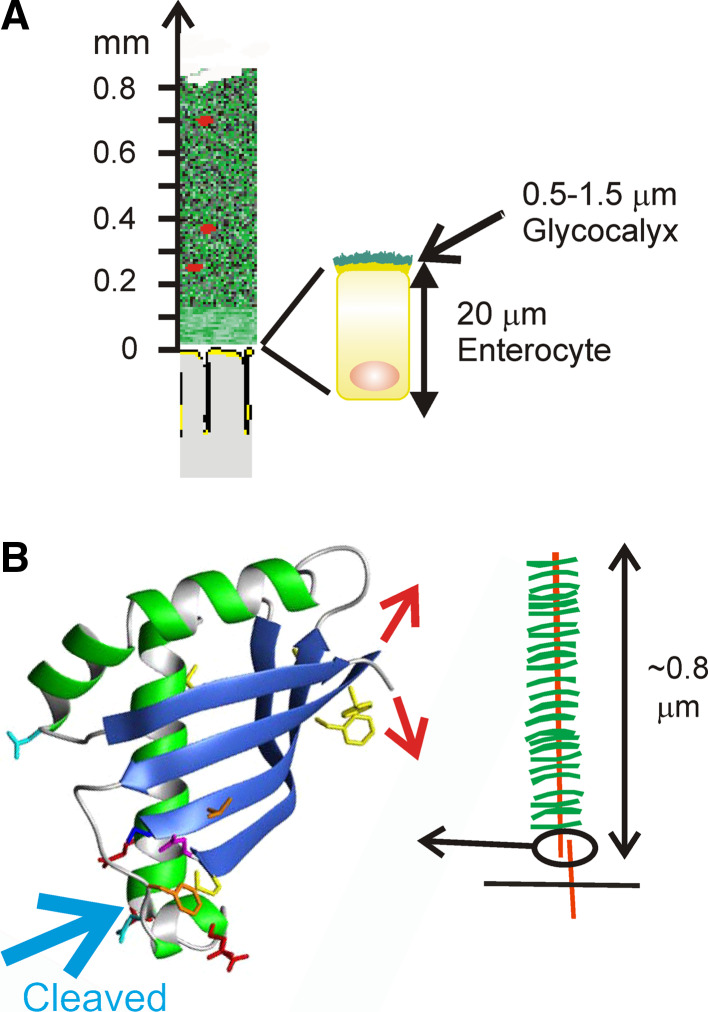
The enterocyte glycocalyx. a Schematic presentation of the mucus layers of rat distal colon, illustrating their dimensions in comparison with the glycocalyx of the apical membrane of the enterocyte. b The transmembrane mucins of the SEA-type have an autoproteolytically cleaved SEA domain just outside of the cell membrane. The structure of the MUC1 SEA domain is shown to the left with the cleaved site indicated by a blue arrow [12]

The MUC2 mucin. a The MUC2 mucin forms dimers in its C-terminus and trimers in its N-terminus. The localization of the second CysD domain are marked with arrows. b A model of the net-like polymeric network, as organized by the MUC2 mucin, forming large sheets. c The CysD domains form non-covalent dimers between two sheets of MUC2, that further organizes the mucin net-work
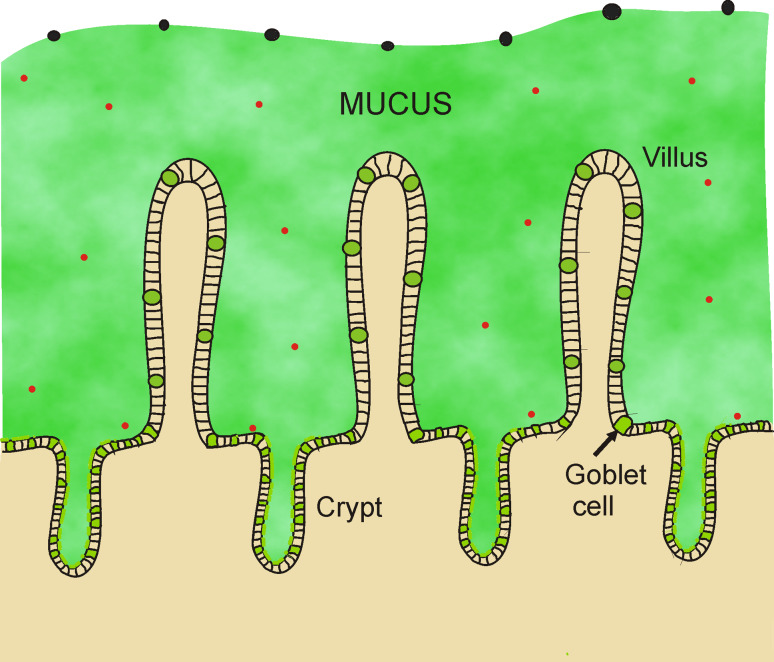
The mucus organization of the small intestine. The organization of the ileal mucus is shown, as revealed by the addition of charcoal to the mucus surface (black dots on top). This mucus is permeable, as represented by red beads (in the size of bacteria) in the mucus

The mucus organization of the distal large intestine. a The two mucus layers as organized by the MUC2 mucin. b Measurements of the total mucus (inner and outer layers) in distal colon in an explant culture system. The loose mucus was first removed by gentle aspiration and the growth of the mucus was monitored by measuring the increase in the total mucus thickness over time
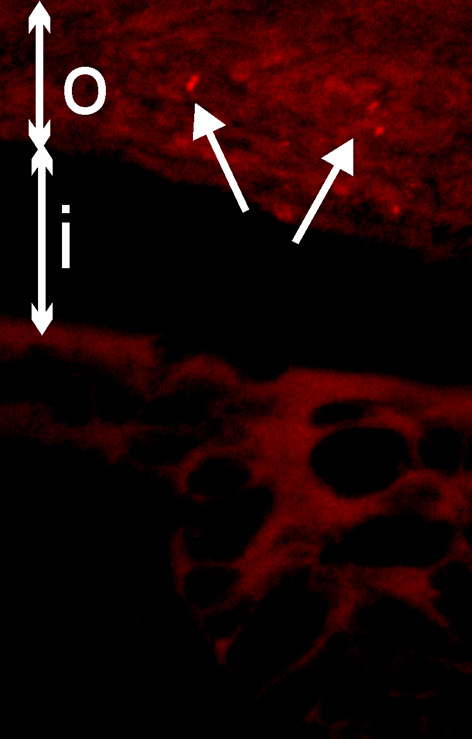
Commensal bacteria is only found in the outer mucus layer of distal colon. Lactobacilli were stained by in situ hybridization and found in the outer (o) mucus layer. The lack of bacteria in the inner stratified mucus layer (i) makes it appear as an empty space. The epithelium is revealed by epifluorescence
References
Publication types
MeSH terms
Substances
LinkOut - more resources
Full Text Sources
Miscellaneous
