. 2011 Dec;79(12):4828-38.
doi: 10.1128/IAI.05574-11. Epub 2011 Sep 26.

Mycobacterium tuberculosis Hip1 dampens macrophage proinflammatory responses by limiting toll-like receptor 2 activation

Affiliations

Mycobacterium tuberculosis Hip1 dampens macrophage proinflammatory responses by limiting toll-like receptor 2 activation

Ranjna Madan-Lala et al. Infect Immun. 2011 Dec.

Abstract

Mycobacterium tuberculosis is a highly successful human pathogen that evades host innate immunity by interfering with macrophage functions. In addition to avoiding macrophage microbicidal activities, M. tuberculosis triggers secretion of proinflammatory cytokines and chemokines in macrophages. The levels of proinflammatory cytokines induced by clinical M. tuberculosis isolates are thought to play an important role in determining tuberculosis disease progression and severity, but the mechanisms by which M. tuberculosis modulates the magnitude of inflammatory responses remain unclear. Here we show that M. tuberculosis restricts robust macrophage activation and dampens proinflammatory responses through the cell envelope-associated serine hydrolase Hip1 (hydrolase important for pathogenesis 1). By transcriptionally profiling macrophages infected with either wild-type or hip1 mutant bacteria, we found that the hip1 mutant induced earlier and significantly higher levels of several proinflammatory cytokines and chemokines. We show that increased activation of Toll-like receptor 2 (TLR2)- and MyD88-dependent signaling pathways mediates the enhanced cytokine secretion induced by the hip1 mutant. Thus, Hip1 restricts the onset and magnitude of proinflammatory cytokines by limiting TLR2-dependent activation. We also show that Hip1 dampens TLR2-independent activation of the inflammasome and limits secretion of interleukin-18 (IL-18). Dampening of TLR2 signaling does not require viable M. tuberculosis or phagocytosis but does require Hip1 catalytic activity. We propose that M. tuberculosis restricts proinflammatory responses by masking cell surface interactions between TLR2 agonists on M. tuberculosis and TLR2 on macrophages. This strategy may allow M. tuberculosis to evade early detection by host immunity, delay the onset of adaptive immune responses, and accelerate disease progression.


Figures
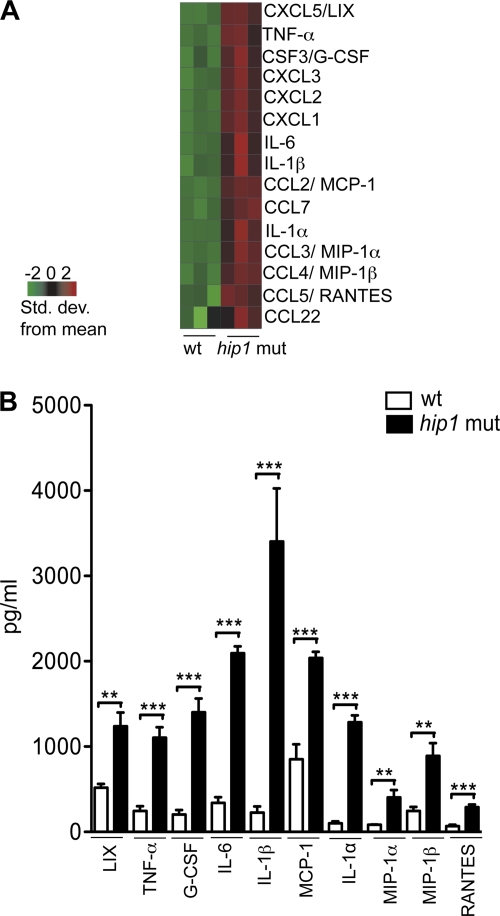
Fig. 1.
Fig. 1.
Enhanced proinflammatory responses in hip1 mutant-infected macrophages. C57BL/6 BMM were infected with the wt or hip1 mutant strain at an MOI of 10. At 24 h postinfection, cell-free supernatants were harvested for cytokine assays and macrophage RNA was extracted for gene expression analysis using Affymetrix microarrays. (A) Heat map depicting microarray data corresponding to the expression of several proinflammatory cytokine and chemokine transcripts in wt- versus hip1 mutant-infected macrophages. The expression level of each gene (in rows) is represented by the number of standard deviations above (red) or below (green) the average value for that gene across all samples (in columns). (B) Proinflammatory cytokine and chemokine levels were measured in the supernatants of wt- or hip1 mutant-infected macrophages by multiplex ELISA at 24 h postinfection. Results are representative of 2 independent experiments. Values are presented as means plus SD for triplicate assays. **, P < 0.01; ***, P < 0.001.
Fig. 2.
Fig. 2.
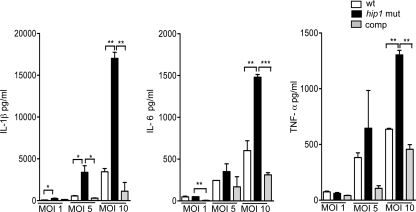
Dose-dependent induction of proinflammatory cytokines and complementation of the hip1 mutant phenotype. C57BL/6 BMM were infected with the wt, hip1 mutant, or complemented hip1 mutant (comp) strain at MOIs of 1, 5, and 10. Supernatants were collected at 24 h postinfection and were assayed for IL-1β, IL-6, and TNF-α by ELISA. Values are presented as means plus SD, and the data are representative of 3 independent experiments. *, P < 0.05; **, P < 0.01; ***, P < 0.001.
Fig. 3.
Fig. 3.
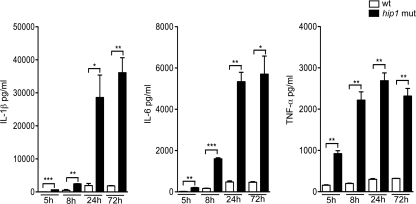
Rapid induction of proinflammatory cytokines in the absence of Hip1. C57BL/6 BMM were infected with the wt or hip1 mutant strain at an MOI of 10. Supernatants were collected at 5, 8, 24, and 72 h postinfection and were assayed for IL-1β, IL-6, and TNF-α by ELISA. Values are presented as means plus SD, and the data are representative of 3 independent experiments. *, P < 0.05; **, P < 0.01; ***, P < 0.001.
Fig. 4.
Fig. 4.
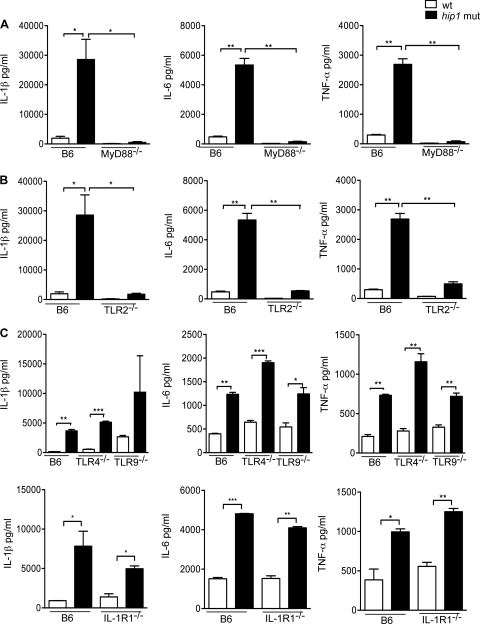
Enhanced induction of proinflammatory cytokines by the hip1 mutant requires TLR2 and MyD88 signaling. BMM from C57BL/6 and MyD88−/− mice (A), TLR2−/− mice (B), and TLR4−/−, TLR9−/−, and IL-1R1−/− mice (C) were infected with the wt or hip1 mutant strain at an MOI of 10. Supernatants were collected at 24 h postinfection and assayed for IL-1β, IL-6, and TNF-α by ELISA. Values are presented as means plus SD, and the data are representative of 3 independent experiments. *, P < 0.05; **, P < 0.01; ***, P < 0.001.
Fig. 5.
Fig. 5.
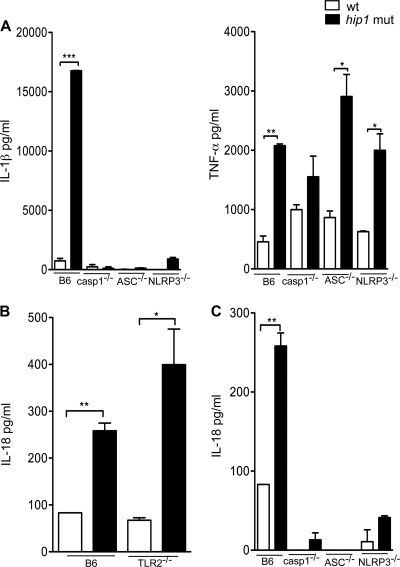
IL-1β and IL-18 secretion is dependent on components of the inflammasome complex. (A) BMM from C57BL/6, caspase-1−/−, ASC−/−, and NLRP3−/− mice were infected with the wt or hip1 mutant strain at an MOI of 10. Supernatants collected at 24 h postinfection were assayed for IL-1β and TNF-α by ELISA. BMM from C57BL/6 or TLR2−/− mice (B) or from C57BL/6, caspase-1−/−, ASC−/−, and NLRP3−/− mice (C) were also infected with the wt or hip1 mutant strain at an MOI of 10. Supernatants collected at 24 h postinfection were assayed for IL-18 by ELISA. Values are presented as means plus SD, and the data are representative of 3 independent experiments. *, P < 0.05; **, P < 0.01; ***, P < 0.001.
Fig. 6.
Fig. 6.
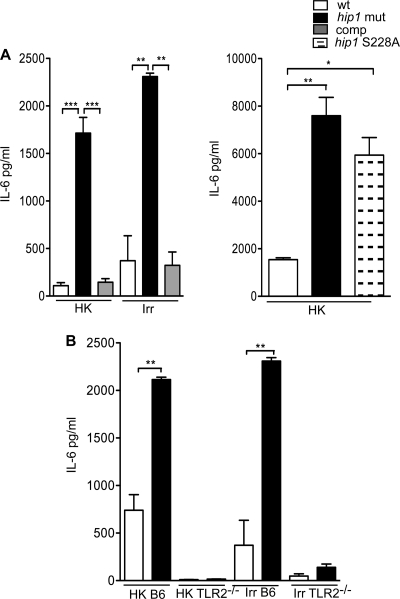
Bacterial viability is not required for Hip1-mediated restriction of TLR2-dependent cytokines. (A) C57BL/6 BMM were infected at an MOI of 10 with the heat-killed (HK) or irradiated (Irr) wt, hip1 mutant, or complemented hip1 (comp) strain or with the hip1 mutant complemented with catalytically inactive Hip1 (hip1 S228A). Supernatants collected at 24 h postinfection were assayed for IL-6 by ELISA. (B) C57BL/6 and TLR2−/− BMM were infected with the heat-killed (HK) wt, hip1 mutant, or complemented hip1 mutant (comp) strain at an MOI of 10. Supernatants collected at 24 h postinfection were assayed for IL-6 by ELISA. Values are presented as means plus SD, and the data are representative of 3 independent experiments. *, P < 0.05; **, P < 0.01; ***, P < 0.001.
Fig. 7.
Fig. 7.
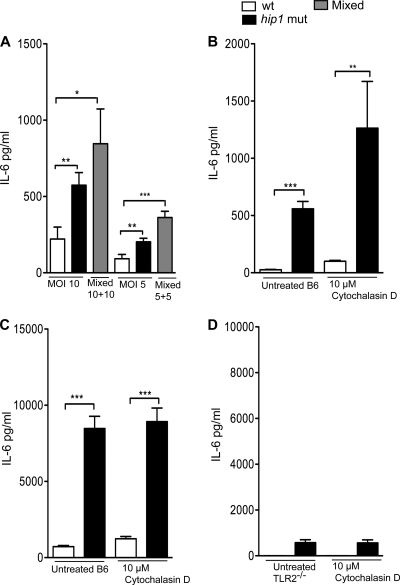
hip1 mutant-induced proinflammatory response is dominant over wt response and is independent of phagocytosis. (A) C57BL/6 BMM were infected with heat-killed (HK) cultures of the wt or the hip1 mutant at an MOI of 10 or 5 or with mixed cultures of the wt and the hip1 mutant at a 1:1 ratio (MOIs of 10 and 10 or 5 and 5). Supernatants collected at 24 h postinfection were assayed for IL-6 by ELISA. (B) C57BL/6 BMM were left untreated or treated with 10 μM cytochalasin D for 1 h and then infected with the heat-killed wt or hip1 mutant strain, and supernatants collected at 6 h postinfection were assayed for IL-6 by ELISA. C57BL/6 (C) or TLR2−/− (D) BMM were left untreated or treated with 10 μM cytochalasin D for 1 h and then infected with the live wt or hip1 mutant strain, and supernatants collected at 24 h postinfection were assayed for IL-6 by ELISA. Values are presented as means plus SD, and the data are representative of 3 independent experiments. *, P < 0.05; **, P < 0.01; ***, P < 0.001.

References

    1. Abel B., et al. 2002. Toll-like receptor 4 expression is required to control chronic Mycobacterium tuberculosis infection in mice. J. Immunol. 169:3155–3162 - PubMed
    1. Bafica A., et al. 2005. TLR9 regulates Th1 responses and cooperates with TLR2 in mediating optimal resistance to Mycobacterium tuberculosis. J. Exp. Med. 202:1715–1724 - PMC - PubMed
    1. Banaiee N., Kincaid E. Z., Buchwald U., Jacobs W. R., Jr., Ernst J. D. 2006. Potent inhibition of macrophage responses to IFN-gamma by live virulent Mycobacterium tuberculosis is independent of mature mycobacterial lipoproteins but dependent on TLR2. J. Immunol. 176:3019–3027 - PubMed
    1. Bhatt K., Salgame P. 2007. Host innate immune response to Mycobacterium tuberculosis. J. Clin. Immunol. 27:347–362 - PubMed
    1. Brightbill H. D., et al. 1999. Host defense mechanisms triggered by microbial lipoproteins through Toll-like receptors. Science 285:732–736 - PubMed

Publication types

MeSH terms

LinkOut - more resources