Review
. 2011 Dec 8;118(24):6247-57.
doi: 10.1182/blood-2011-07-328880. Epub 2011 Sep 26.

NUP98 gene fusions and hematopoietic malignancies: common themes and new biologic insights

Affiliations
Review

NUP98 gene fusions and hematopoietic malignancies: common themes and new biologic insights

Sheryl M Gough et al. Blood. .

Abstract

Structural chromosomal rearrangements of the Nucleoporin 98 gene (NUP98), primarily balanced translocations and inversions, are associated with a wide array of hematopoietic malignancies. NUP98 is known to be fused to at least 28 different partner genes in patients with hematopoietic malignancies, including acute myeloid leukemia, chronic myeloid leukemia in blast crisis, myelodysplastic syndrome, acute lymphoblastic leukemia, and bilineage/biphenotypic leukemia. NUP98 gene fusions typically encode a fusion protein that retains the amino terminus of NUP98; in this context, it is important to note that several recent studies have demonstrated that the amino-terminal portion of NUP98 exhibits transcription activation potential. Approximately half of the NUP98 fusion partners encode homeodomain proteins, and at least 5 NUP98 fusions involve known histone-modifying genes. Several of the NUP98 fusions, including NUP98-homeobox (HOX)A9, NUP98-HOXD13, and NUP98-JARID1A, have been used to generate animal models of both lymphoid and myeloid malignancy; these models typically up-regulate HOXA cluster genes, including HOXA5, HOXA7, HOXA9, and HOXA10. In addition, several of the NUP98 fusion proteins have been shown to inhibit differentiation of hematopoietic precursors and to increase self-renewal of hematopoietic stem or progenitor cells, providing a potential mechanism for malignant transformation.


Figures
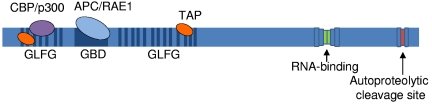
Figure 1
Figure 1
Schematic representation of the NUP98 protein. Blue lines indicate GLFG repeats, the dark blue box indicates the GLEBS binding domain (GBD), and green and red boxes indicate the nucleoporin RNA-binding site and autoproteolytic cleavage site, respectively. Known NUP98 interacting factors are indicated; transcriptional coactivator CBP/p300 (purple) and the TAP transport cofactor (orange) bind the GLFG repeats. The APC/RAE1 complex (light blue) binds the GBD.
Figure 2
Figure 2
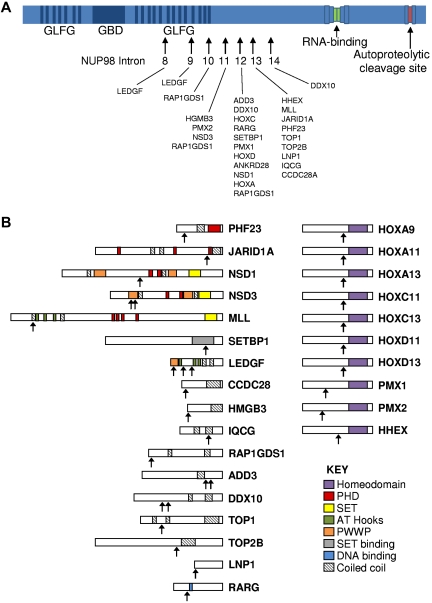
NUP98 fusion proteins. (A) Schematic showing structure of the NUP98 protein and position of NUP98 fusion points in human leukemias. Arrows indicate fusion points. In all cases, the amino terminus of NUP98 is fused to the carboxyl terminus of the partner gene. (B) Schematic showing relevant domains of partner proteins and the position of the protein fusion. Domains are indicated in the key. Arrows indicate fusion point.
Figure 3
Figure 3
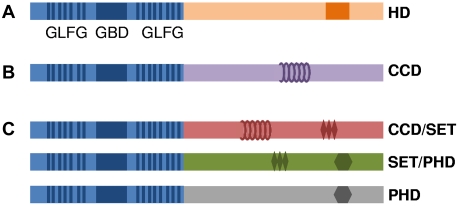
Schematic representation of 3 archetypes of NUP98 fusions. (A) NUP98-HD fusion protein. (B) NUP98-coiled-coil motif fusion protein. (C) Three subgroups of NUP98 oncoproteins that potentially modify chromatin via coiled-coil domain (CCD), SET, or PHD finger motifs. The GBD is represented by a blue box, the GLFG repeats are shown as vertical blue lines, the HD domain is shown as an orange box, the CCD is shown as coils, the SET domain is shown as diamonds, and the PHD domain is shown as a hexagon.
Figure 4
Figure 4
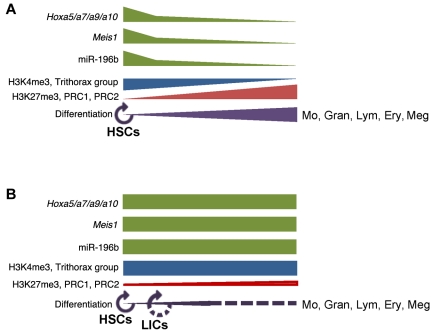
Simplified model of the relationship between Hoxa cluster gene expression and epigenetic modifications. (A) During normal hematopoiesis, Hoxa and miR-196b transcript levels are highest in HSPCs and decrease as cells differentiate to functional mature hematopoietic cells. In immature HSPCs, active histone marks such as H3K4me3 and the presence of trithorax group proteins correlate with high levels of Hoxa transcripts. These transcriptional enhancer marks decrease as cells mature and differentiate, and the Hoxa locus becomes progressively silenced by repressive H3K27me3 marks and polycomb repressor complex (PRC) group proteins (129,130-134; [130-134 are reviews]). (B) Mis-regulated Hoxa cluster gene expression associated with NUP98 fusion leukemogenesis, as a result of aberrant chromatin-modifying activities conferred by the NUP98 fusion., Mo indicates monocytes; Gran, granulocytes; Lym, lymphocytes; Ery, erythrocytes; Meg, megakaryocytes; and LICs, leukemia-initiating cells.

References

    1. Mitelman F, Johansson B, Mertens F. The impact of translocations and gene fusions on cancer causation. Nat Rev Cancer. 2007;7(4):233–245. - PubMed
    1. Rowley JD. Chromosomes in leukemia and beyond: from irrelevant to central players. Annu Rev Genomics Hum Genet. 2009;10:1–18. - PubMed
    1. Druker BJ, Guilhot F, O'Brien SG, et al. Five-year follow-up of patients receiving imatinib for chronic myeloid leukemia. N Engl J Med. 2006;355(23):2408–2417. - PubMed
    1. Danial NN, Korsmeyer SJ. Cell death: critical control points. Cell. 2004;116(2):205–219. - PubMed
    1. Fontoura BM, Blobel G, Matunis MJ. A conserved biogenesis pathway for nucleoporins: proteolytic processing of a 186-kilodalton precursor generates Nup98 and the novel nucleoporin, Nup96. J Cell Biol. 1999;144(6):1097–1112. - PMC - PubMed

Publication types

MeSH terms