Hip fracture and increased short-term but not long-term mortality in healthy older women
- PMID: 21949033
- PMCID: PMC3576923
- DOI: 10.1001/archinternmed.2011.447
Hip fracture and increased short-term but not long-term mortality in healthy older women
Abstract
Background: Fractures have been associated with subsequent increases in mortality, but it is unknown how long that increase persists.
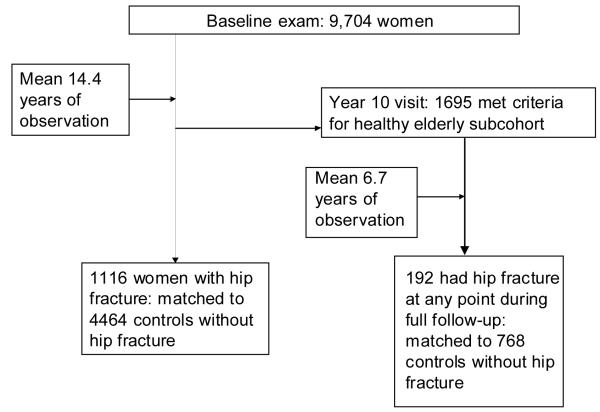
Methods: A total of 5580 women from a large community-based, multicenter US prospective cohort of 9704 (Study of Osteoporotic Fractures) were observed prospectively for almost 20 years. We age-matched 1116 hip fracture cases with 4 control participants (n = 4464). To examine the effect of health status, we examined a healthy older subset (n = 960) 80 years or older who attended the 10-year follow-up examination and reported good or excellent health. Incident hip fractures were adjudicated from radiology reports by study physicians. Death was confirmed by death certificates.
Results: Hip fracture cases had 2-fold increased mortality in the year after fracture compared with controls (16.9% vs 8.4%; multivariable adjusted odds ratio [OR], 2.4; 95% CI, 1.9-3.1]. When examined by age and health status, short-term mortality was increased in those aged 65 to 69 years (16.3% vs 3.7%; OR, 5.0; 95% CI, 2.6-9.5), 70 to 79 years (16.5% vs 8.9%; OR, 2.4; 95% CI, 1.8-3.3), and only in those 80 years or older with good or excellent health (15.1% vs 7.2%; multivariable adjusted OR, 2.8; 95% CI, 1.5-5.2). After the first year, survival of hip fracture cases and controls was similar except in those aged 65 to 69 years, who continued to have increased mortality.
Conclusions: Short-term mortality is increased after hip fracture in women aged 65 to 79 years and in exceptionally healthy women 80 years or older. Women 70 years or older return to previous risk levels after a year. Interventions are needed to decrease mortality in the year after hip fracture, when mortality risk is highest.
Comment in
-
Goals of care for hip fracture: promoting independence and reducing mortality.Arch Intern Med. 2011 Nov 14;171(20):1837-8. doi: 10.1001/archinternmed.2011.534. Arch Intern Med. 2011. PMID: 22083570 No abstract available.
References
-
- Marks R, Allegrante JP, Ronald MC, Lane JM. Hip fractures among the elderly: causes, consequences and control. Ageing Res Rev. 2003 Jan;2(1):57–93. - PubMed
-
- Browner WS, Pressman AR, Nevitt MC, Cummings SR. Mortality following fractures in older women. The study of osteoporotic fractures. Arch Intern Med. 1996 Jul 22;156(14):1521–5. - PubMed
-
- Meyer HE, Tverdal A, Falch JA, Pedersen JI. Factors associated with mortality after hip fracture. Osteoporos Int. 2000;11(3):228–32. - PubMed
-
- Richmond J, Aharonoff GB, Zuckerman JD, Koval KJ. Mortality risk after hip fracture. J Orthop Trauma. 2003 Jan;17(1):53–6. - PubMed
-
- Leibson CL, Tosteson AN, Gabriel SE, Ransom JE, Melton LJ. Mortality, disability, and nursing home use for persons with and without hip fracture: a population-based study. J Am Geriatr Soc. 2002 Oct;50(10):1644–50. - PubMed
Publication types
MeSH terms
Grants and funding
- R01 AR035583/AR/NIAMS NIH HHS/United States
- AR35582/AR/NIAMS NIH HHS/United States
- R01 AR035584/AR/NIAMS NIH HHS/United States
- AG05394/AG/NIA NIH HHS/United States
- R01 AG027576/AG/NIA NIH HHS/United States
- 2 R01 AG027574-22A1/AG/NIA NIH HHS/United States
- R01 AG005407/AG/NIA NIH HHS/United States
- R01 AR035582/AR/NIAMS NIH HHS/United States
- R01 AG005394/AG/NIA NIH HHS/United States
- AR35584/AR/NIAMS NIH HHS/United States
- K23 RR020049/RR/NCRR NIH HHS/United States
- 2 R01 AG005394-22A1/AG/NIA NIH HHS/United States
- K24 AR051895/AR/NIAMS NIH HHS/United States
- AG05407/AG/NIA NIH HHS/United States
- R01 AG027576-22/AG/NIA NIH HHS/United States
- AR35583/AR/NIAMS NIH HHS/United States
- R01 AG027574/AG/NIA NIH HHS/United States
- K23-RR020049/RR/NCRR NIH HHS/United States
LinkOut - more resources
Full Text Sources
Medical