


Interaction of PPARG Pro12Ala with dietary fat influences plasma lipids in subjects at cardiometabolic risk
- PMID: 21949049
- PMCID: PMC3220296
- DOI: 10.1194/jlr.P019281
Interaction of PPARG Pro12Ala with dietary fat influences plasma lipids in subjects at cardiometabolic risk
Abstract
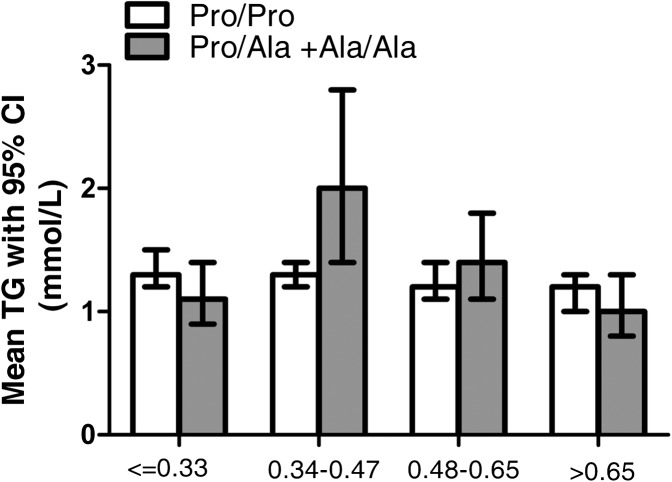
The PPARγ2 gene single nucleotide polymorphism (SNP) Pro12Ala has shown variable association with metabolic syndrome traits in healthy subjects. The RISCK Study investigated the effect of interaction between genotype and the ratio of polyunsaturated:saturated (P:S) fatty acid intake on plasma lipids in 367 white subjects (ages 30-70 years) at increased cardiometabolic risk. Interaction was determined after habitual diet at recruitment, at baseline after a 4-week high-SFA (HS) diet, and after a 24-week reference (HS), high-MUFA (HM), or low-fat (LF) diet. At recruitment, there were no significant associations between genotype and plasma lipids; however, P:S × genotype interaction influenced plasma total cholesterol (TC) (P = 0.02), LDL-cholesterol (LDL-C) (P = 0.002), and triglyceride (TG) (P = 0.02) concentrations. At P:S ratio ≤ 0.33, mean TC and LDL-C concentrations in Ala12 allele carriers were significantly higher than in noncarriers (respectively, P = 0.003; P = 0.0001). Significant trends in reduction of plasma TC (P = 0.02) and TG (P = 0.002) concentrations occurred with increasing P:S (respectively, ≤0.33 to >0.65; 0.34 to >0.65) in Ala12 allele carriers. There were no significant differences between carriers and noncarriers after the 4-week HS diet or 24-week interventions. Plasma TC and TG concentrations in PPARG Ala12 allele carriers decrease as P:S increases, but they are not dependent on a reduction in SFA intake.
Figures
References
-
- Desvergne B., Wahli W. 1999. Peroxisome proliferator-activated receptors: nuclear control of metabolism. Endocr. Rev. 20: 649–688. - PubMed
-
- Xu H. E., Lambert M. H., Montana V. G., Parks D. J., Blanchard S. G., Brown P. J., Sternbach D. D., Lehmann J. M., Wisely G. B., Willson T. M., et al. 1999. Molecular recognition of fatty acids by peroxisome proliferator-activated receptors. Mol. Cell. 3: 397–403. - PubMed
-
- NCBI dbSNP [database]. Accessed December 15, 2010, at: http://www.ncbi.nlm.nih.gov/snp.
Publication types
MeSH terms
Substances
Associated data
Grants and funding
LinkOut - more resources
Full Text Sources
Medical
Miscellaneous
