. 2012 Jan 1;302(1):L111-9.
doi: 10.1152/ajplung.00231.2011. Epub 2011 Sep 23.

Contributions of TRPV1, endovanilloids, and endoplasmic reticulum stress in lung cell death in vitro and lung injury

Affiliations

Contributions of TRPV1, endovanilloids, and endoplasmic reticulum stress in lung cell death in vitro and lung injury

Karen C Thomas et al. Am J Physiol Lung Cell Mol Physiol. .

Abstract

Endogenous agonists of transient receptor potential vanilloid-1 (TRPV1) (endovanilloids) are implicated as mediators of lung injury during inflammation. This study tested the hypothesis that endovanilloids produced following lipopolysaccharide (LPS) treatment activate TRPV1 and cause endoplasmic reticulum stress/GADD153 expression in lung cells, representing a mechanistic component of lung injury. The TRPV1 agonist nonivamide induced GADD153 expression and caused cytotoxicity in immortalized and primary human bronchial, bronchiolar/alveolar, and microvascular endothelial cells, proportional to TRPV1 mRNA expression. In CF-1 mice, Trpv1 mRNA was most abundant in the alveoli, and intratracheal nonivamide treatment promoted Gadd153 expression in the alveolar region. Treatment of CF-1 mice with LPS increased Gadd153 in the lung, lactate dehydrogenase (LDH) in bronchoalveolar lavage (BAL) fluid, and lung wet-to-dry weight ratio. Cotreating mice with LPS and the TRPV1 antagonist LJO-328 reduced Gadd153 induction and LDH in BAL but did not inhibit increases in lung wet-to-dry ratio. In Trpv1(-/-) mice treated with LPS, Gadd153 induction and LDH in BAL were reduced relative to wild-type mice, and the wet-to-dry weight ratios of lungs from both wild-type and Trpv1(-/-) mice decreased. Organic extracts of blood collected from LPS-treated mice were more cytotoxic to TRPV1-overexpressing cells compared with BEAS-2B cells and extracts from control mice, however, most pure endovanilloids did not produce cytotoxicity in a characteristic TRPV1-dependent manner. Collectively, these data indicate a role for TRPV1, and endogenous TRPV1 agonists, in ER stress and cytotoxicity in lung cells but demonstrate that ER stress and cytotoxicity are not essential for pulmonary edema.


Figures
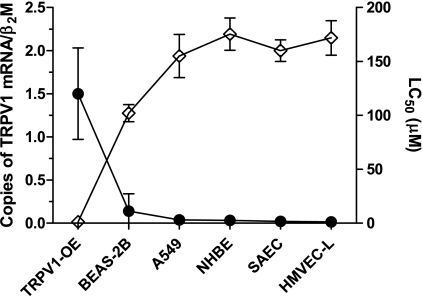
Fig. 1.
Fig. 1.
Quantification of transient receptor potential vanilloid-1 (TRPV1) mRNA values in human lung cells and corresponding concentration at which 50% loss in viability (lethality) was observed (LC50) for nonivamide. Copies of TRPV1 are represented relative to the gene β2-macroglobulin (β2M, ●; y-axis on left). LC50 values (◊; y-axis on right) were determined from dose-response curves from 24 h treatment of cells with nonivamide. BEAS-2B, human bronchial epithelial cells; HMVEC-L, human lung microvascular endothelial cells; NHBE, normal human bronchial epithelial cells; SAEC, small airway epithelial cells; TRPV1-OE, TRPV1-overexpressing BEAS-2B cells; A Pearson R value of −0.94 (P = 0.005) was obtained from correlation analysis showing a significant relationship between TRPV1 mRNA abundance and the LC50 values. Data represent means and SD of a minimum of 3 [quantitative PCR (qPCR)] or 9 (cytotoxicity) replicates.
Fig. 2.
Fig. 2.
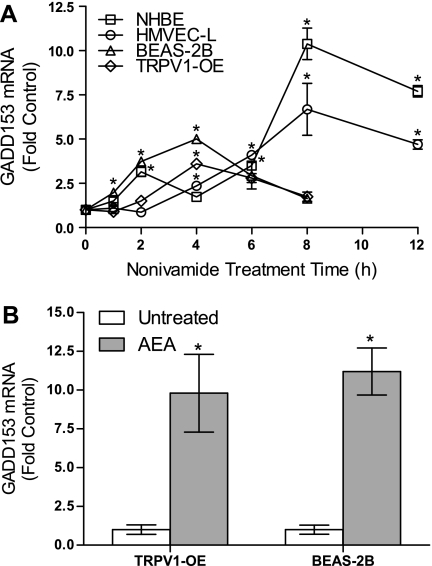
A: temporal changes in GADD153 mRNA expression in NHBE, HMVEC-L, BEAS-2B, and TRPV1-OE cells treated with LC50 concentrations of nonivamide. Data are means and SD for changes in GADD153 PCR product band density relative to β-actin, normalized to the 0-h, untreated control (n = 3). B: changes in GADD153 mRNA expression in TRPV1-OE and BEAS-2B cells treated with 25 μM anandamide (AEA) for 4 h. Data are normalized to the untreated sample. *Significant increases in expression using 1-way ANOVA (α = 0.05) with Dunnett's posttest (P < 0.05).
Fig. 3.
Fig. 3.
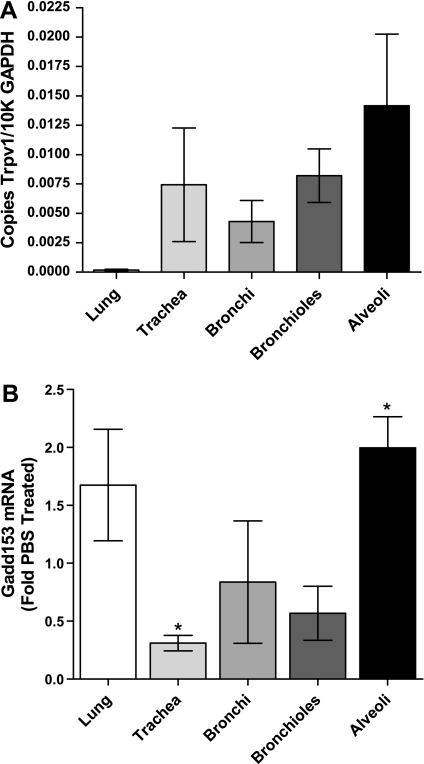
Analysis of Trpv1 and Gadd153 expression in mouse lungs using RT-qPCR. A: expression of Trpv1 in different anatomical regions of the mouse respiratory tract (n = 9). B: expression of Gadd153 4 h post-it instillation of sterile PBS (white bars) or 0.5 mg/kg nonivamide in PBS containing 4% vol/vol ethanol (gray-scaled bars) (n = 3). *Statistical difference (P < 0.05) relative to the corresponding PBS control value for the respective region using Student's t-test (n = 3).
Fig. 4.
Fig. 4.
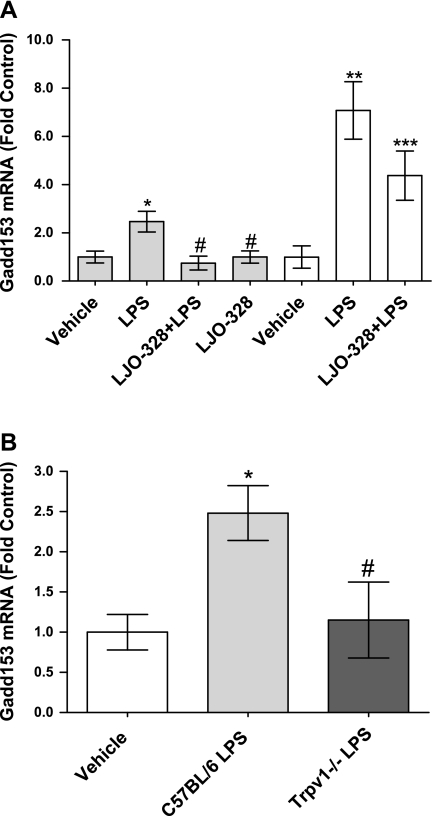
A: changes in Gadd153 mRNA abundance in lipopolysaccharide (LPS)-treated CF-1 mouse lungs 12 h (gray bars) and 18 h (white bars) after LPS treatment. Doses were vehicle, LPS (10 mg/kg ip), LPS (10 mg/kg ip) + LJO-328 (5 mg/kg ip), and LJO-328 (5 mg/kg ip) alone. *Statistical increases relative to the vehicle control (n = 15). #Decrease from LPS treatment (n = 15) in LPS + LJO-328-treated (n = 10) and LJO-328 only (n = 10) groups. ** and ***Statistical differences between the 18-h control (n = 5) compared with LPS treatment (n = 6) and LJO-328 + LPS (n = 6). B: changes in Gadd153 mRNA abundance in LPS-treated C57BL/6 and Trpv1−/− mouse lungs 12 h after LPS treatment. Vehicle injection (white bar, n = 5), LPS (15 mg/kg ip) (light gray bar, n = 5), and LPS (15 mg/kg ip) in Trpv1−/− mice (dark gray bar, n = 3). All data are means and SE, and statistical analysis was performed using 1-way ANOVA (α = 0.05) with Dunnett's posttest (P < 0.05). *Increase relative to the vehicle control group. #Decrease relative to the LPS-treated group.
Fig. 5.
Fig. 5.
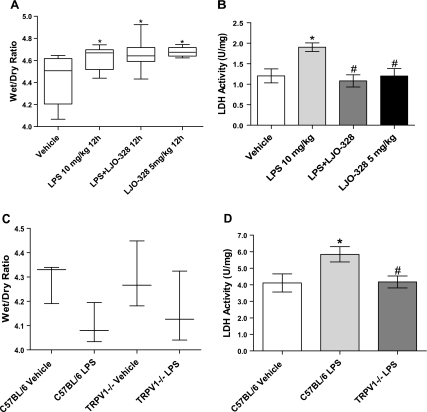
A: quantification of CF-1 mouse lung wet-to-dry weight 12 h following vehicle injection (n = 6), LPS (10 mg/kg ip) (n = 6), LPS (10 mg/kg ip) + LJO-328 (5 mg/kg ip) (n = 6), and LJO-328 (5 mg/kg ip) only (n = 6). B: changes in lactate dehydrogenase (LDH) activity in bronchoalveolar lavage (BAL) of CF-1 mouse lungs 12 h following vehicle injection (white bars, n = 5), LPS (10 mg/kg ip) (light gray bars, n = 5), LPS (10 mg/kg ip) + LJO-328 (5 mg/kg ip) (dark gray bars, n = 5), and LJO-328 (5 mg/kg ip) only (black bars, n = 5). C: changes in lung wet-to-dry weight in C57BL/6 and Trpv1−/− mouse lungs 12 h after saline injection of C57BL/6 mice (n = 3), LPS (15 mg/kg ip) in C57BL/6 mice (n = 5), saline injection of Trpv1−/− mice (n = 3), and LPS (15 mg/kg ip) in Trpv1−/− mice (n = 3). D: changes in LDH activity in BAL of C57BL/6 and Trpv1−/− mice 12 h after saline injection of C57BL/6 mice (white bars, n = 5), LPS (15 mg/kg ip) in C57BL/6 mice (light gray bars, n = 5), and LPS (15 mg/kg) in Trpv1−/− mice (black bars, n = 3). Data are means and SE. *Significant increase relative to the vehicle control group. #Decrease relative to the LPS-treated group using 1-way ANOVA (α = 0.05) with Dunnett's posttest (P < 0.05).
Fig. 6.
Fig. 6.
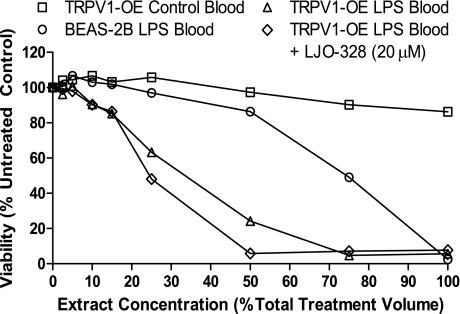
Cytotoxicity of n-butyl chloride + hexane extracts from control and LPS-treated CF-1 mouse blood in TRPV1-OE and BEAS-2B cells, with and without LJO-328 cotreatment (20 μM). Each treatment represents a single treatment well, using extracts prepared from blood pooled from three mice using a 24-h treatment time. Data are from a single experiment, but this trend was replicated on multiple occasions using extract preparations from single and multiple mice from different experiments.

References

    1. Ang SF, Moochhala SM, Bhatia M. Hydrogen sulfide promotes transient receptor potential vanilloid 1-mediated neurogenic inflammation in polymicrobial sepsis. Crit Care Med 38: 619–628 - PubMed
    1. Bessac BF, Jordt SE. Breathtaking TRP channels: TRPA1 and TRPV1 in airway chemosensation and reflex control. Physiology (Bethesda) 23: 360–370, 2008 - PMC - PubMed
    1. Bhatia M, Slavin J, Cao Y, Basbaum AI, Neoptolemos JP. Preprotachykinin-A gene deletion protects mice against acute pancreatitis and associated lung injury. Am J Physiol Gastrointest Liver Physiol 284: G830–G836, 2003 - PubMed
    1. Bhatia M, Wong FL, Fu D, Lau HY, Moochhala SM, Moore PK. Role of hydrogen sulfide in acute pancreatitis and associated lung injury. FASEB J 19: 623–625, 2005 - PubMed
    1. Bhatia M, Zhi L, Zhang H, Ng SW, Moore PK. Role of substance P in hydrogen sulfide-induced pulmonary inflammation in mice. Am J Physiol Lung Cell Mol Physiol 291: L896–L904, 2006 - PubMed

Publication types

MeSH terms

LinkOut - more resources