. 2011 Oct 4;108(40):16565-70.
doi: 10.1073/pnas.1109861108. Epub 2011 Sep 26.

An algorithm-based topographical biomaterials library to instruct cell fate

Affiliations

An algorithm-based topographical biomaterials library to instruct cell fate

Hemant V Unadkat et al. Proc Natl Acad Sci U S A. .

Erratum in

  • Proc Natl Acad Sci U S A. 2012 Apr 10;109(15):5905. Carpenter, Anne E [added]; Wessling, Matthias [added]
  • Proc Natl Acad Sci U S A. 2013 Apr 2;110(14):5731

Abstract

It is increasingly recognized that material surface topography is able to evoke specific cellular responses, endowing materials with instructive properties that were formerly reserved for growth factors. This opens the window to improve upon, in a cost-effective manner, biological performance of any surface used in the human body. Unfortunately, the interplay between surface topographies and cell behavior is complex and still incompletely understood. Rational approaches to search for bioactive surfaces will therefore omit previously unperceived interactions. Hence, in the present study, we use mathematical algorithms to design nonbiased, random surface features and produce chips of poly(lactic acid) with 2,176 different topographies. With human mesenchymal stromal cells (hMSCs) grown on the chips and using high-content imaging, we reveal unique, formerly unknown, surface topographies that are able to induce MSC proliferation or osteogenic differentiation. Moreover, we correlate parameters of the mathematical algorithms to cellular responses, which yield novel design criteria for these particular parameters. In conclusion, we demonstrate that randomized libraries of surface topographies can be broadly applied to unravel the interplay between cells and surface topography and to find improved material surfaces.


Conflict of interest statement

Conflict of interest statement: Jan de Boer, Bernke Papenburg, and Clemens van Blitterswijk are shareholders of Materiomics B.V., which commercializes the TopoChip platform.

Figures
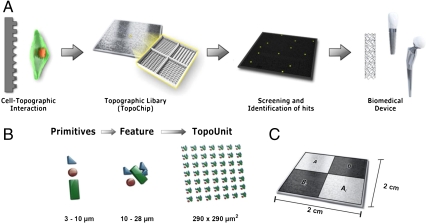
Fig. 1.
Fig. 1.
TopoChip design. (A) A schematic representation of a sequence of events that is proposed to be followed for high-throughput screening of biomedical materials starting from initial design to clinical application. (B) Design of the TopoChip is based on the use of primitives. Three types of primitives, namely circles, triangles, and lines were used to construct features. Repeated features constitute a TopoUnit and two times 2,176 = 4,352 TopoUnits constitute a TopoChip (size ranges are indicated). In addition, four flat control surfaces are included. (C) TopoChip is divided into four quadrants. TopoUnits in quadrant A are repeated in quadrant Ai and similarly TopoUnits in quadrant B are repeated in quadrant Bi in order to exclude site specific or localized effects.
Fig. 2.
Fig. 2.
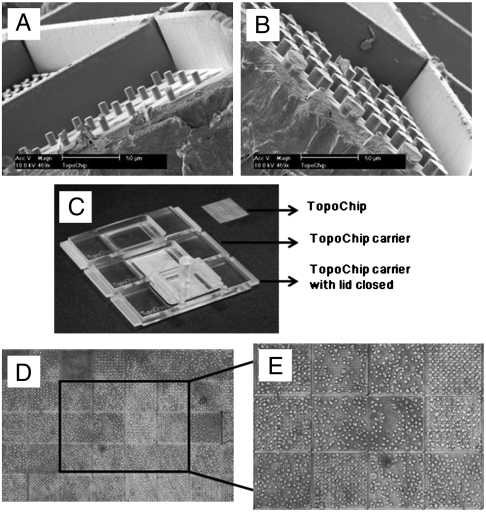
TopoChip fabrication and characterization. (A and B) SEM images of sections of TopoChips, displaying accurate feature replication on the TopoChip. (Scale bar: 50 μm.) (C) The TopoChip carrier, lid, and chip assembly. This chip carrier can even be used as a micro-bioreactor for perfusion culture of cells, or with a second set of attachment (not shown) for static cell culture. (D and E) Light microscopic images of cells seeded using the chip carrier displaying homogeneity of cell distribution within and between TopoUnits.
Fig. 3.
Fig. 3.
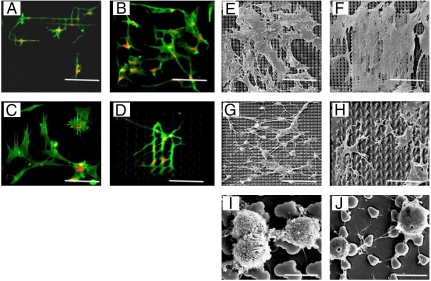
Morphology of hMSCs on different TopoUnits. (AD) Fluorescent microscopic images of spread and elongated cells showing alignment on topographic features (pseudocolored green: actin stained with Alexa Fluor 488 phalloidin; red: nuclear staining with TOTO-3; scale bar: 90 μm). (EH) SEM images of cells showing diverse cellular morphologies. (Scale bar: 90 μm.) (I and J) High magnification SEM images of rounded cells on two distinct TopoUnits showing differences in the texture of cell membrane. (Scale bar: 10 μm.)
Fig. 4.
Fig. 4.
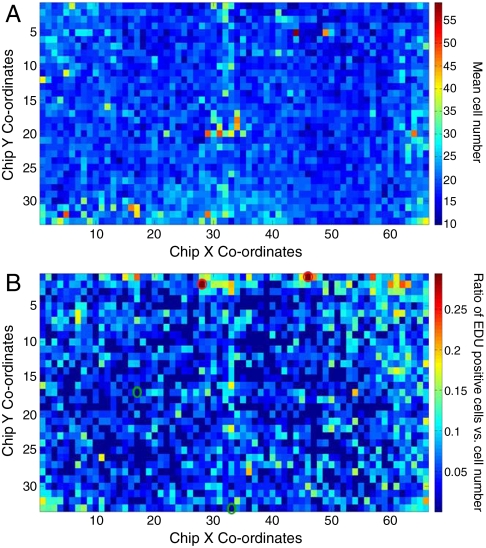
Cell proliferation assay. (A) Heat map of the mean cell number per TopoUnit. The numbers represent the average of 10 TopoUnits on five TopoChips (n = 10). (B) Heat map of the ratio of the mean number of proliferating cells over total cell number. TopoUnits marked with red circles indicate high-scoring units in terms of cell proliferation ratio. Flat TopoUnits (without any features) are indicated with green circles.
Fig. 5.
Fig. 5.
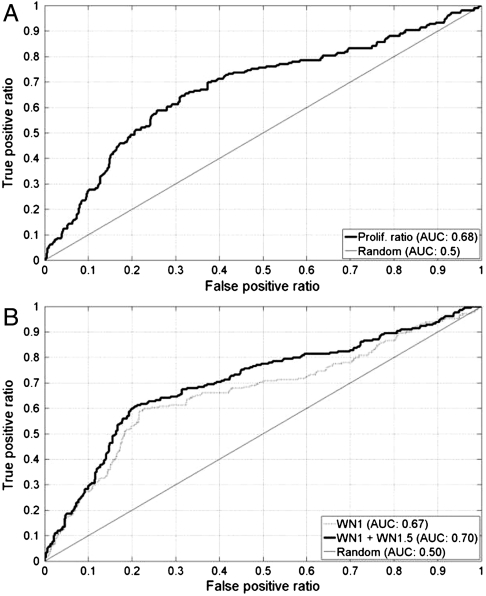
Data validation for the cell proliferation assay. (A) ROC curve to rule out stochastic events for validation of proliferating cell count ratio as a function of surface topography after tenfold cross-validation. (B) ROC curve to determine surface topographic parameters responsible for enhanced proliferation with a machine-learnt model.
Fig. 6.
Fig. 6.
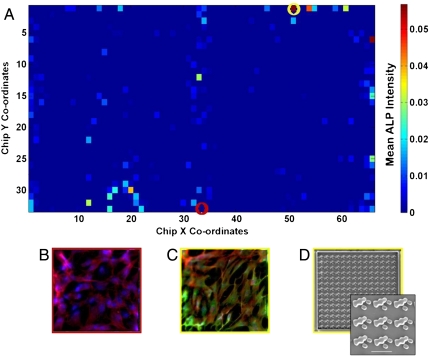
ALP expression on hMSCs. (A) Heatmap of the mean intensity of fluorescently labeled ALP of hMSCs grown on different topographies. (B) Cells on/in a flat TopoUnit not expressing any ALP. In this image, actin staining is pseudocolored in red, ALP expression in green, and nucleic acid staining in blue. (C) Cells on the TopoUnit with the highest ALP expression. The corresponding TopoUnit is marked with a yellow circle on the heat map. (D) SEM image of the TopoUnit showing the highest intensity for ALP staining. The inset shows a higher magnification view of features. (Scale bar: 20 μm.)

Comment in

  • Trying out topographies.
    Baker M. Baker M. Nat Methods. 2011 Nov;8(11):900. doi: 10.1038/nmeth.1760. Nat Methods. 2011. PMID: 22167818 No abstract available.

References

    1. Habibovic P, Barrere F, van Blitterswijk CA, de Groot K, Layrolle P. Biomimetic hydroxyapatite coating on metal implants. J Am Ceram Soc. 2002;85:517–522.
    1. Meredith DO, Eschbach L, Riehle MO, Curtis ASG, Richards RG. Microtopography of metal surfaces influence fibroblast growth by modifying cell shape, cytoskeleton, and adhesion. J Orthop Res. 2007;25:1523–1533. - PubMed
    1. Huebsch N, et al. Harnessing traction-mediated manipulation of the cell/matrix interface to control stem-cell fate. Nat Mater. 2010;9:518–526. - PMC - PubMed
    1. Lutolf MP, Blau HM. Artificial stem cell niches. Adv Mater. 2009;21:3255–3268. - PMC - PubMed
    1. Folkman J, Moscona A. Role of cell shape in growth control. Nature. 1978;273:345–349. (Translated from English) - PubMed

Publication types

LinkOut - more resources