


Inhibition recruitment in prefrontal cortex during sleep spindles and gating of hippocampal inputs
- PMID: 21949372
- PMCID: PMC3193185
- DOI: 10.1073/pnas.1103612108
Inhibition recruitment in prefrontal cortex during sleep spindles and gating of hippocampal inputs
Abstract
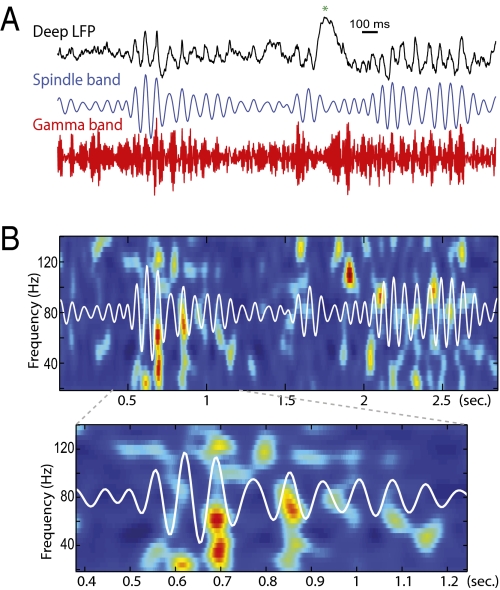
During light slow-wave sleep, the thalamo-cortical network oscillates in waxing-and-waning patterns at about 7 to 14 Hz and lasting for 500 ms to 3 s, called spindles, with the thalamus rhythmically sending strong excitatory volleys to the cortex. Concurrently, the hippocampal activity is characterized by transient and strong excitatory events, Sharp-Waves-Ripples (SPWRs), directly affecting neocortical activity--in particular the medial prefrontal cortex (mPFC)--which receives monosynaptic fibers from the ventral hippocampus and subiculum. Both spindles and SPWRs have been shown to be strongly involved in memory consolidation. However, the dynamics of the cortical network during natural sleep spindles and how prefrontal circuits simultaneously process hippocampal and thalamo-cortical activity remain largely undetermined. Using multisite neuronal recordings in rat mPFC, we show that during sleep spindles, oscillatory responses of cortical cells are different for different cell types and cortical layers. Superficial neurons are more phase-locked and tonically recruited during spindle episodes. Moreover, in a given layer, interneurons were always more modulated than pyramidal cells, both in firing rate and phase, suggesting that the dynamics are dominated by inhibition. In the deep layers, where most of the hippocampal fibers make contacts, pyramidal cells respond phasically to SPWRs, but not during spindles. Similar observations were obtained when analyzing γ-oscillation modulation in the mPFC. These results demonstrate that during sleep spindles, the cortex is functionnaly "deafferented" from its hippocampal inputs, based on processes of cortical origin, and presumably mediated by the strong recruitment of inhibitory interneurons. The interplay between hippocampal and thalamic inputs may underlie a global mechanism involved in the consolidation of recently formed memory traces.
Conflict of interest statement
The authors declare no conflict of interest.
Figures



References
-
- Walker MP, Stickgold R. Sleep, memory, and plasticity. Annu Rev Psychol. 2006;57:139–166. - PubMed
-
- Steriade M. Neuronal Substrates of Sleep and Epilepsy. Cambridge, United Kingdom: Cambridge Univ Press; 2003.
Publication types
MeSH terms
LinkOut - more resources
Full Text Sources
Other Literature Sources
