


Identifying sources of strength: resilience from the perspective of older people receiving long-term community care
- PMID: 21949496
- PMCID: PMC3156942
- DOI: 10.1007/s10433-011-0190-8
Identifying sources of strength: resilience from the perspective of older people receiving long-term community care
Abstract
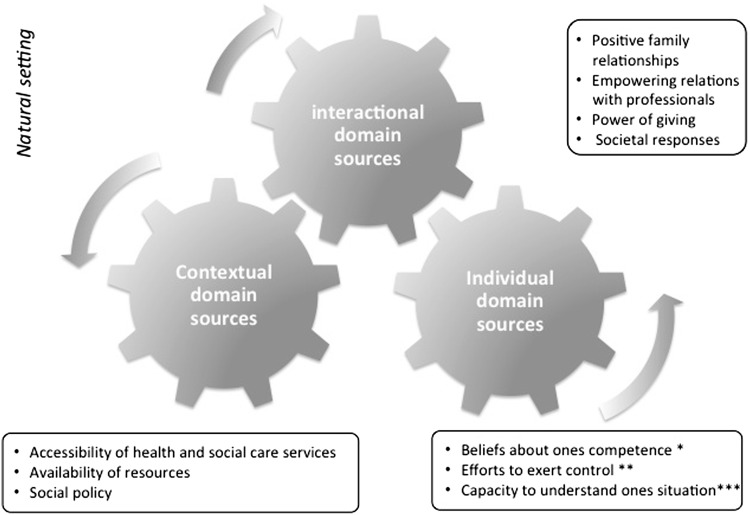
This study seeks to explore the sources of strength giving rise to resilience among older people. Twenty-nine in-depth interviews were conducted with older people who receive long-term community care. The interviews were subjected to a thematic content analysis. The findings suggest that the main sources of strength identified among older people were constituted on three domains of analysis; the individual-, interactional and contextual domain. The individual domain refers to the qualities within older people and comprises of three sub-domains, namely beliefs about one's competence, efforts to exert control and the capacity to analyse and understand ones situation. Within these subdomains a variety of sources of strength were found like pride about ones personality, acceptance and openness about ones vulnerability, the anticipation on future losses, mastery by practising skills, the acceptance of help and support, having a balanced vision on life, not adapting the role of a victim and carpe-diem. The interactional domain is defined as the way older people cooperate and interact with others to achieve their personal goals. Sources of strength on this domain were empowering (in)formal relationships and the power of giving. Lastly, the contextual domain refers to a broader political-societal level and includes sources of strength like the accessibility of care, the availability of material resources and social policy. The three domains were found to be inherently linked to each other. The results can be used for the development of positive, proactive interventions aimed at helping older people build on the positive aspects of their lives.
Figures
References
-
- Antonovsky A. Unraveling the mystery of health: how people manage stress and stay well. San Francisco: Jossey-Bass Publishers; 1987.
-
- Bartky SL. Unplanned obsolescence: some reflections on aging. In: Walker MU, editor. Mother time. Woman, aging and ethics. Oxford: Rowman and Littlefield Publishers, Inc.; 1999.
-
- Blumer H (1969) Symbolic interactionism: perspective and method. University of California Press, Berkeley
-
- Brandtstädter J, Rothermund K. The life course dynamics of goal pursuit and goal adjustment: a two process framework. Dev Rev. 2002;22:117–150. doi: 10.1006/drev.2001.0539. - DOI
LinkOut - more resources
Full Text Sources
