. 2011 Sep;5(9):e1321.
doi: 10.1371/journal.pntd.0001321. Epub 2011 Sep 20.

Utility of repeated praziquantel dosing in the treatment of schistosomiasis in high-risk communities in Africa: a systematic review

Affiliations

Utility of repeated praziquantel dosing in the treatment of schistosomiasis in high-risk communities in Africa: a systematic review

Charles H King et al. PLoS Negl Trop Dis. 2011 Sep.

Abstract

Background: Controversy persists about the optimal approach to drug-based control of schistosomiasis in high-risk communities. In a systematic review of published studies, we examined evidence for incremental benefits from repeated praziquantel dosing, given 2 to 8 weeks after an initial dose, in Schistosoma-endemic areas of Africa.

Methodology/principal findings: We performed systematic searches of electronic databases PubMed and EMBASE for relevant data using search terms 'schistosomiasis', 'dosing' and 'praziquantel' and hand searches of personal collections and bibliographies of recovered articles. In 10 reports meeting study criteria, improvements in parasitological treatment outcomes after two doses of praziquantel were greater for S. mansoni infection than for S. haematobium infection. Observed cure rates (positive to negative conversion in egg detection assays) were, for S. mansoni, 69-91% cure after two doses vs. 42-79% after one dose and, for S. haematobium, 46-99% cure after two doses vs. 37-93% after a single dose. Treatment benefits in terms of reduction in intensity (mean egg count) were also different for the two species-for S. mansoni, the 2-dose regimen yielded an weighted average 89% reduction in standardized egg counts compared to a 83% reduction after one dose; for S. haematobium, two doses gave a 93% reduction compared to a 94% reduction with a single dose. Cost-effectiveness analysis was performed based on Markov life path modeling.

Conclusions/significance: Although schedules for repeated treatment with praziquantel require greater inputs in terms of direct costs and community participation, there are incremental benefits to this approach at an estimated cost of $153 (S. mansoni)-$211 (S. haematobium) per additional lifetime QALY gained by double treatment in school-based programs. More rapid reduction of infection-related disease may improve program adherence, and if, as an externality of the program, transmission can be reduced through more effective coverage, significant additional benefits are expected to accrue in the targeted communities.


Conflict of interest statement

The authors have declared that no competing interests exist.

Figures
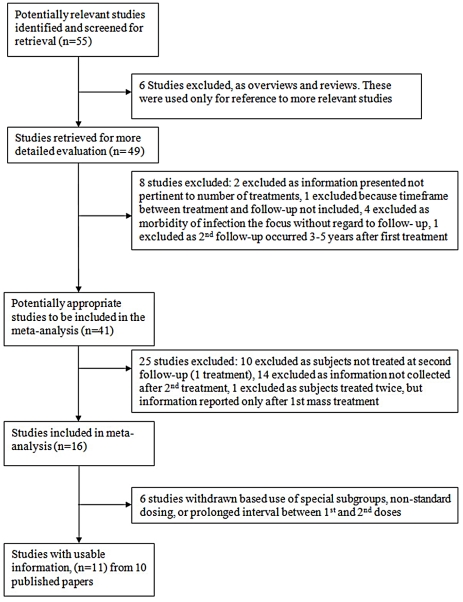
Figure 1
Figure 1. Flow diagram of the study selection process for inclusion in this paper's systematic review.
Overview of the review process for papers reporting on the efficacy of praziquantel repeat dosing for treatment of S. haematobium or S. mansoni infection in Africa. Shown are the reasons for exclusion/inclusion at each step of the systemic review.
Figure 2
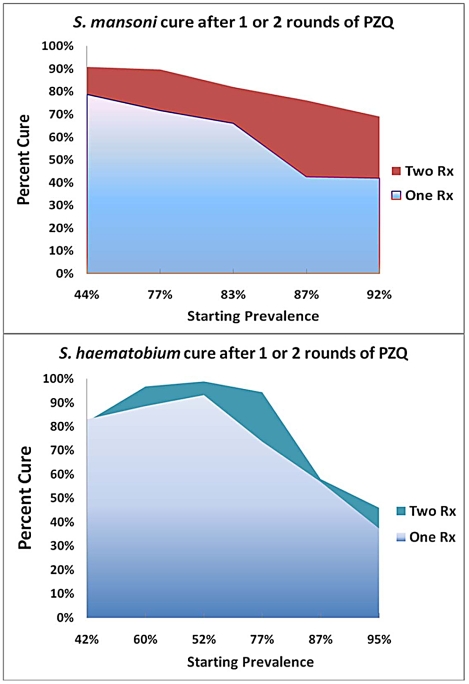
Figure 2. Impact of single vs. repeated praziquantel dosing for cure of Schistosoma in high-risk African communities.
Upper panel shows efficacy of one- and two-dose regimens for treatment of S. mansoni according to the initial pre-treatment infection prevalence of study participants. Lower panel shows the relative efficacy of each treatment schedule for treatment of S. haematobium.
Figure 3
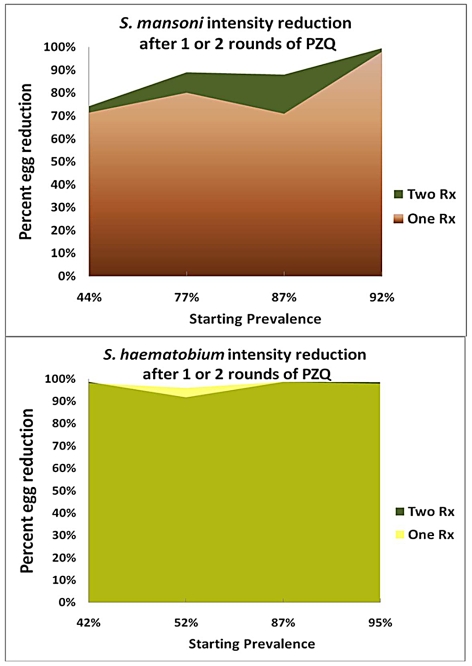
Figure 3. Impact of single vs. repeated praziquantel dosing for intensity (egg output) reduction of Schistosoma infection.
Upper panel shows reported efficacy of one- and two-dose regimens for treatment of S.mansoni according to the initial pre-treatment infection prevalence of study participants. Lower panel shows the relative efficacy for each treatment schedule for treatment of S. haematobium.
Figure 4
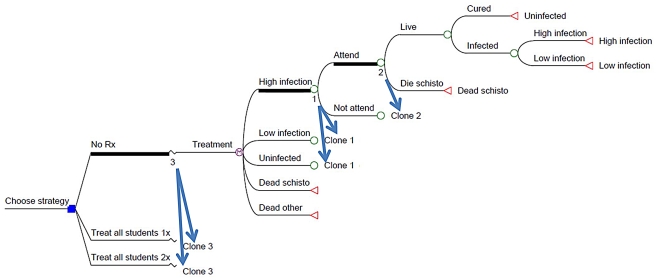
Figure 4. Schematic of the decision tree model used for cost-effectiveness analysis.
For each treatment strategy, individuals were cycled annually between three health states (uninfected, light, or heavy infection) or were lost to infection-related death or competing mortality. Transition was dependent on yearly participation with assigned treatment, or, if untreated, on the likelihood of spontaneous increase or reduction of infection without treatment. Input variables for the Markov model are listed in Tables S1 and S2. This is a simplified schematic of the full decision tree. Blue arrows indicate the places in the tree where ‘clones’ of the indicated sub-branches 1, 2, and 3 would be reproduced in the full tree diagram.
Figure 5
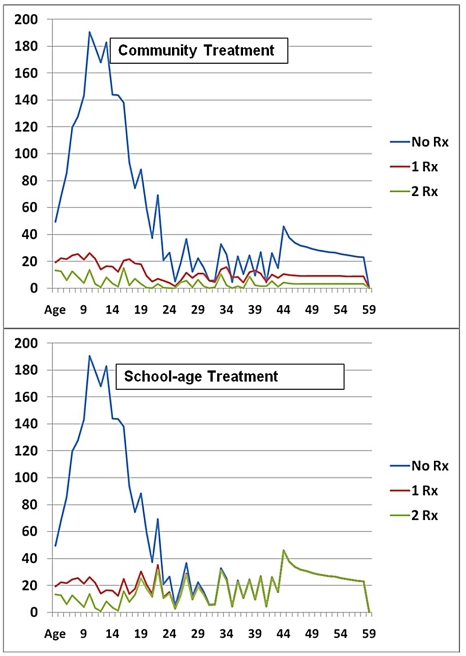
Figure 5. Predicted infection intensity at different ages in a community having continuing Schistosoma transmission during control.
The upper panel indicates the life path experience with infection intensity (annual mean egg output per specimen) without therapy (No Rx), with single-dose annual therapy (1Rx), with or double-dose annual therapy (2 Rx), and 80% annual adherence in a community-based treatment program when there is continuing transmission of Schistosoma during the control intervention. The lower panel indicates the expected lifetime impact of the same regimens in a program treating school-age (5–15 yr) children only.
Figure 6
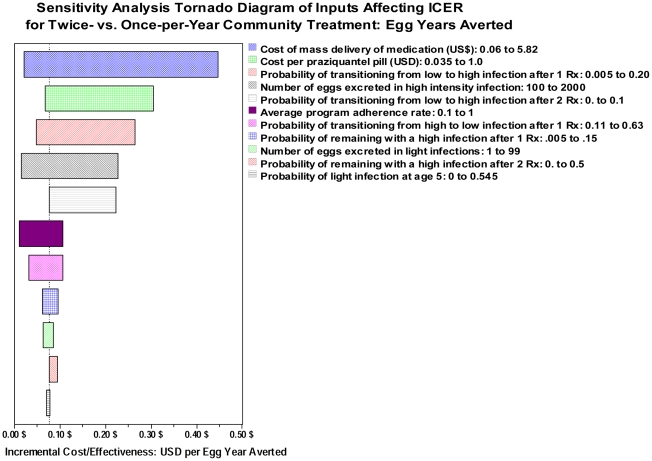
Figure 6. Sensitivity analysis of ICER estimates for egg output reduction in community-based therapy of S. haematobium.
Shown are the 11 most influential inputs to the Markov decision tree model and the effects of their variation on $US cost per cumulative egg-year averted when calculating the incremental cost effectiveness of single-dose vs. double-dose treatment regimens in community-based programs. The base case analysis from Table 4 is indicated by the vertical dotted line.
Figure 7
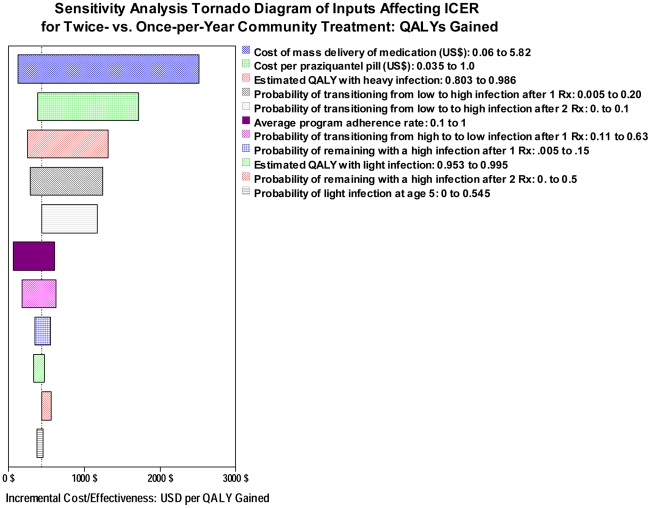
Figure 7. Sensitivity analysis of ICER estimates for QALYs gained in community-based therapy of S. haematobium.
Shown are the 11 most influential inputs to the model and the effects of their variation on $US cost per lifetime QALY gained when calculating the incremental cost effectiveness of single-dose vs. double-dose treatment regimens in community-based programs. The base case analysis from Table 4 is indicated by the vertical dotted line.

References

    1. King CH. Parasites and poverty: the case of schistosomiasis. Acta Trop. 2010;113:95–104. - PMC - PubMed
    1. WHO. Preventive Chemotherapy Databank [online]. 2009. Available from URL: http://www.who.int/neglected_diseases/preventive_chemotherapy/databank/e... [Accessed 2011 Aug 3]
    1. van der Werf MJ, de Vlas SJ. Morbidity and infection with schistosomes or soil-transmitted helminths. Report for WHO Parasitic Diseases and Vector Contol. Rotterdam: Erasmus University; 2001. pp. 1–103.
    1. King CH, Mahmoud AA. Drugs five years later: praziquantel. Ann Intern Med. 1989;110:290–296. - PubMed
    1. Fenwick A, Webster JP, Bosque-Oliva E, Blair L, Fleming FM, et al. The Schistosomiasis Control Initiative (SCI): rationale, development and implementation from 2002–2008. Parasitology. 2009;136:1719–1730. - PubMed

Publication types