. 2012 Mar;165(6):1992-1999.
doi: 10.1111/j.1476-5381.2011.01696.x.

Role of endothelin-1 in the hyper-responsiveness to nitrovasodilators following acute NOS inhibition

Affiliations

Role of endothelin-1 in the hyper-responsiveness to nitrovasodilators following acute NOS inhibition

Stephane L Bourque et al. Br J Pharmacol. 2012 Mar.

Abstract

Background and purpose: Acute NOS inhibition in humans and animals is associated with hypersensitivity to NO donors. The mechanisms underlying this phenomenon have not been fully elucidated. The purpose of the present study was to assess whether hypersensitivity to NOS-blockade is linked to endothelin-1 (ET-1) signalling.

Experimental approach: Sprague Dawley rats were instrumented with indwelling arterial and venous catheters for continuous assessments of haemodynamic parameters and drug delivery, respectively. Mesenteric arteries were isolated and tested for reactivity by wire myography.

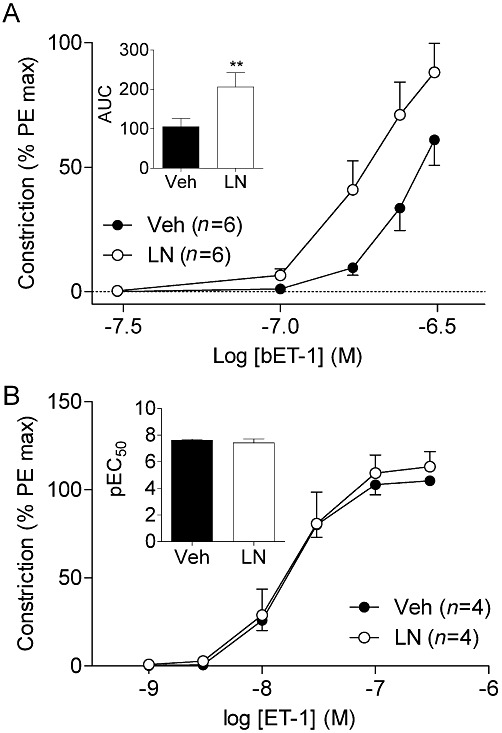
Key results: NOS blockade with L-N(G)-nitroarginine methyl ester (L-NAME) caused a pronounced increase in arterial blood pressure (BP) (∼40 mmHg). In L-NAME-treated animals, the dose of sodium nitroprusside (SNP) required to cause a significant reduction in arterial BP was lower than in vehicle-treated rats (P < 0.001), and the magnitude of the reduction in BP was greater. Similar results were obtained with other NO mimetics, but not isoprenaline; moreover, decreasing the BP back to baseline levels with prazosin after L-NAME treatment did not attenuate the hyper-responsiveness to NO donors. The increased responsiveness to NO donors was abolished by pretreatment with the ET(A/B) receptor antagonist, PD145065, or the ET(A) receptor-specific antagonist ABT627. Ex vivo, L-NAME treatment potentiated the constriction induced by big endothelin-1 (bET-1), the precursor to active ET-1, but had no effect on the ET-1-mediated constriction.

Conclusions and implications: These data suggest that the increased sensitivity to NO donors is mediated, at least in part, by ET-1 in vivo, and the mechanism may involve the conversion of bET-1 to ET-1.


Figures

Figure 1
Figure 1
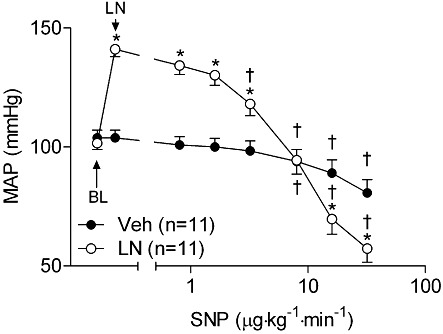
MAP depressor responses to SNP are exaggerated following NOS inhibition in conscious rats. Rats were treated with L-NAME (100 mg·kg−1, i.p.) or saline, and subsequently administered the NO-donor SNP. *P < 0.05 compared with Veh-treated rats at the same dose of vasodilator. †P < 0.05 compared with MAP after administration of either L-NAME or saline in same group. LN, L-NAME.
Figure 2
Figure 2
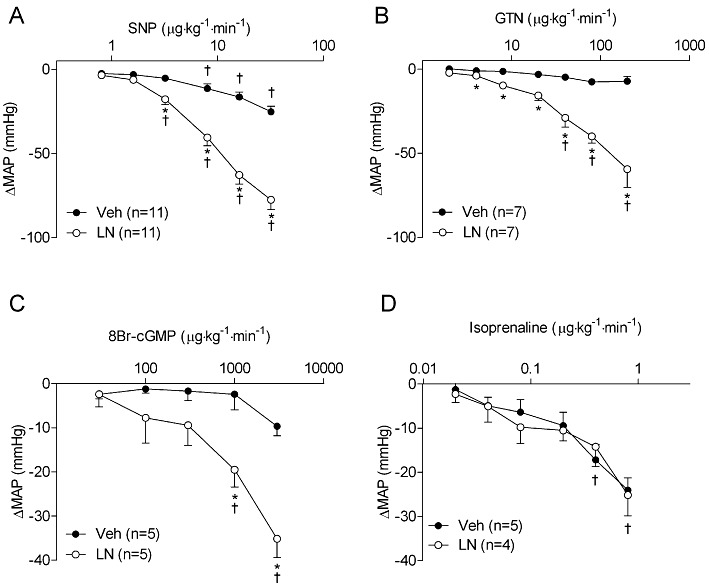
NOS inhibition causes increased BP responsiveness to the vasodilators (A) SNP, (B) GTN, (C) the cGMP analogue 8Br-cGMP, but not (D) isoprenaline. Rats were treated with L-NAME (100 mg·kg−1, i.p.) or saline, and subsequently administered vasodilators. Data are shown as changes from steady state MAP levels after infusion of saline or L-NAME. *P < 0.05 compared with Veh-treated rats at the same dose of vasodilator. †P < 0.05 compared with baseline (BL) in same group. Note that in (D), treatment groups were combined since two-way anova revealed no overall effect of L-NAME; therefore symbols reflect pooled data. GTN, glyceryl trinitrate; LN, L-NAME.
Figure 3
Figure 3
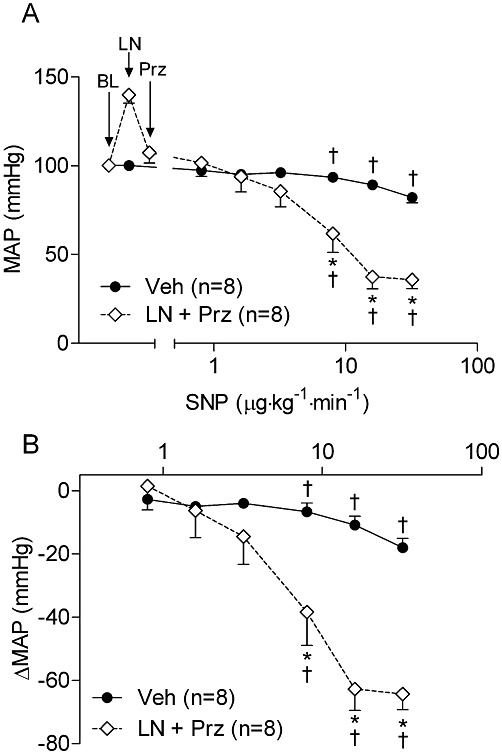
(A) MAP responsiveness to SNP following NOS inhibition is not dependent on initial MAP level. Rats co-treated with α-adrenoceptor antagonist prazosin (Prz; 2 mg·kg−1, i.p.) and L-NAME (100 mg·kg−1, i.p.) had similar MAP levels as Veh-treated rats, and had a similarly exaggerated responsiveness to SNP as L-NAME-treated rats. (B) Data from same experiments in (A) shown as changes from steady state MAP levels after infusion of saline, or combination of L-NAME and prazosin. *P < 0.05 compared with controls at the same dose of vasodilator. †P < 0.05 compared with baseline in same group. BL, baseline MAP; LN, L-NAME.
Figure 4
Figure 4
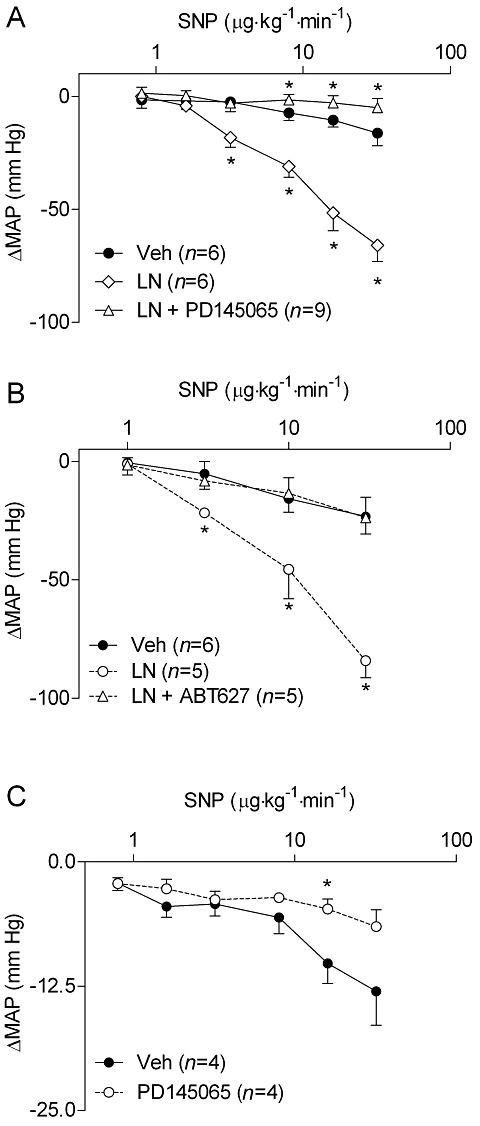
Increased MAP responsiveness to SNP following NOS inhibition with L-NAME (100 mg·kg−1, i.p.) is attenuated after pre-treatment with (A) the dual ETA/B receptor antagonist PD145065 (10 mg kg−1 min−1 i.v.) or (B) the ETA receptor antagonist ABT627 (200 µg·kg−1·min−1 i.v. for 10 min, followed by 100 µg·kg−1·min−1 i.v. thereafter). (C) BP responsiveness to SNP is also attenuated by PD145065 (10 mg·kg−1·min−1 i.v.) in NOS-intact rats. Data are shown as MAP changes from steady state baseline levels after infusion of saline, L-NAME, or combination of L-NAME and ET receptor antagonist. *P < 0.05 compared with controls at the same dose of vasodilator. LN, L-NAME.
Figure 5
Figure 5
(A) bET-1 conversion to vasoactive ET-1 is increased after L-NAME treatment in isolated vessels. Inset: calculated AUC from bET-1 dose–response curves. *P < 0.01 compared with Veh AUC. (B) ET-1 mediated vasoconstriction is not affected by L-NAME (100 µM) treatment. Inset: pEC50 values were derived from ET-1 dose–response curves. AUC, area under the curve; LN, L-NAME; PE, phenylephrine.
Figure 6
Figure 6
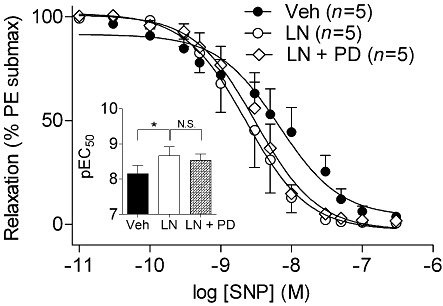
Increased vascular reactivity to SNP following NOS inhibition is not dependent on ET-1 in isolated mesenteric vessels. Isolated vessels were incubated with Veh, L-NAME (100 µM), or a combination of L-NAME (100 µM) and the ETA/B receptor antagonist PD145065 (5 µM). Inset: pEC50 values were derived from dose–response curves. *P < 0.05 compared with Veh-treated vessels. LN, L-NAME, N.S., not significant, PD, PD145065.

References

    1. Alheid U, Dudel C, Forstermann U. Selective inhibition by gossypol of endothelium-dependent relaxations augments relaxations to glyceryl trinitrate in rabbit coeliac artery. Br J Pharmacol. 1987;92:237–240. - PMC - PubMed
    1. Bank N, Aynedjian HS, Khan GA. Mechanism of vasoconstriction induced by chronic inhibition of nitric oxide in rats. Hypertension. 1994;24:322–328. - PubMed
    1. Banting JD, Friberg P, Adams MA. Acute hypertension after nitric oxide synthase inhibition is mediated primarily by increased endothelin vasoconstriction. J Hypertens. 1996;14:975–981. - PubMed
    1. Banting JD, Thompson KE, Friberg P, Adams MA. Blunted cardiovascular growth induction during prolonged nitric oxide synthase blockade. Hypertension. 1997;30:416–421. - PubMed
    1. Bian K, Doursout MF, Murad F. Vascular system: role of nitric oxide in cardiovascular diseases. J Clin Hypertens (Greenwich) 2008;10:304–310. - PMC - PubMed

Publication types

MeSH terms