. 2011 Sep 27:9:64.
doi: 10.1186/1741-7007-9-64.

Double-strand break repair processes drive evolution of the mitochondrial genome in Arabidopsis

Affiliations

Double-strand break repair processes drive evolution of the mitochondrial genome in Arabidopsis

Jaime I Davila et al. BMC Biol. .

Abstract

Background: The mitochondrial genome of higher plants is unusually dynamic, with recombination and nonhomologous end-joining (NHEJ) activities producing variability in size and organization. Plant mitochondrial DNA also generally displays much lower nucleotide substitution rates than mammalian or yeast systems. Arabidopsis displays these features and expedites characterization of the mitochondrial recombination surveillance gene MSH1 (MutS 1 homolog), lending itself to detailed study of de novo mitochondrial genome activity. In the present study, we investigated the underlying basis for unusual plant features as they contribute to rapid mitochondrial genome evolution.

Results: We obtained evidence of double-strand break (DSB) repair, including NHEJ, sequence deletions and mitochondrial asymmetric recombination activity in Arabidopsis wild-type and msh1 mutants on the basis of data generated by Illumina deep sequencing and confirmed by DNA gel blot analysis. On a larger scale, with mitochondrial comparisons across 72 Arabidopsis ecotypes, similar evidence of DSB repair activity differentiated ecotypes. Forty-seven repeat pairs were active in DNA exchange in the msh1 mutant. Recombination sites showed asymmetrical DNA exchange within lengths of 50- to 556-bp sharing sequence identity as low as 85%. De novo asymmetrical recombination involved heteroduplex formation, gene conversion and mismatch repair activities. Substoichiometric shifting by asymmetrical exchange created the appearance of rapid sequence gain and loss in association with particular repeat classes.

Conclusions: Extensive mitochondrial genomic variation within a single plant species derives largely from DSB activity and its repair. Observed gene conversion and mismatch repair activity contribute to the low nucleotide substitution rates seen in these genomes. On a phenotypic level, these patterns of rearrangement likely contribute to the reproductive versatility of higher plants.


Figures
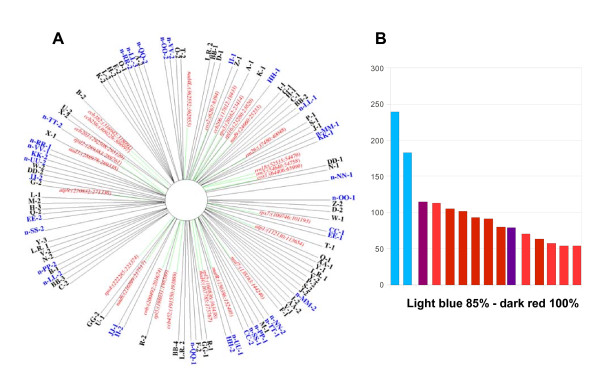
Figure 1
Figure 1
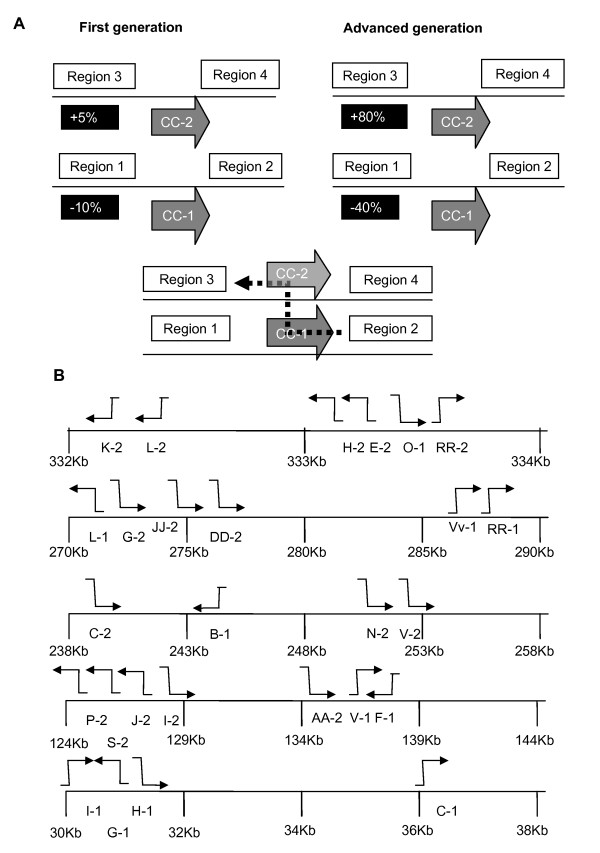
Identification of 14 additional Arabidopsis mitochondrial genome repeat pairs. (A) Map of intermediate mitochondrial repeats that are active in the msh1 mutant. Newly identified repeats are shown in blue. (B) Size (y-axis) and percentage homology (color) distribution of newly identified repeats.
Figure 2
Figure 2
Asymmetrical strand invasion polarity at intermediate mitochondrial repeats. (A) Relative changes from wild type in deep sequence coverage across each environment for repeat CC in msh1 first-generation (left) and advanced-generation (right) mutants were used to define strand invasion polarity. Polarity shown in the lower panel is based on depletion of region 1 relative to region 2 compared to wild type and on an increase in region 3 relative to region 4 compared to wild type. To quantify read depth of flanking regions, we considered all read pairs for which one end mapped to the repeat and the other mapped to the region flanking the repeat. Thus, the length of the flanking sequence is approximately 220 bp. (B) Graphical representation of strand invasion polarities across clusters of repeats in the Arabidopsis Col-0 mitochondrial genome. Polarities were defined by deep sequence analysis using the procedure shown in (A) and confirmed by DNA gel blot analysis. Polarity of strand invasion was established on the basis of which repeat-flanking region displayed an increase in sequence depth and, in the case of class I repeats, a concomitant decrease in sequence depth across the other repeat-flanking region.
Figure 3
Figure 3
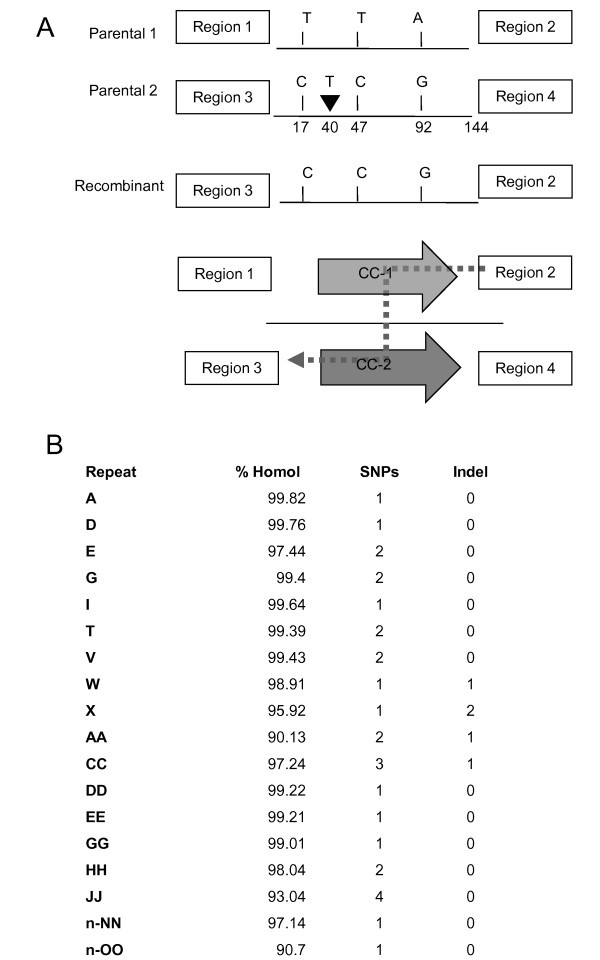
Evidence of mismatch repair associated with DNA exchange at intermediate repeats in the msh1 mutant. (A) Four polymorphisms differentiate repeat CC-1 from CC-2, three SNPs and one single-nucleotide insertion. The recombinant sequence suggests a process of mismatch repair following heteroduplex formation. (B) List of nonidentical repeats where gene conversion was observed in the recombinant product. Homology between copies of each repeat, as well as the number of corrected SNPs and indels, are indicated. In the case of each repeat listed in the table, mismatches were resolved in favor of the putative donor strand, which were calculated using data from the frequencies of SNPs for each of the repeats in the different generations of the msh1 mutant. No clear pattern (donor vs recipient strand) for indel resolution was observed.
Figure 4
Figure 4
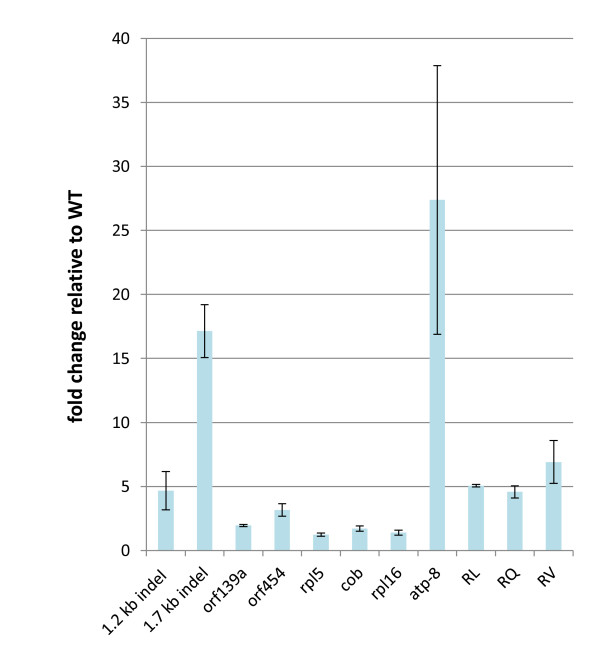
Graphical presentation of results from quantitative PCR to assess changes in relative copy number of 11 different regions of the mitochondrial genome in wild-type (Col-0) and msh1 mutant lines. Error bars show standard errors for three biological replicates with quantitative PCR results from Col-0 set at 1. "HCN" indicates high copy number version of Atp8.
Figure 5
Figure 5
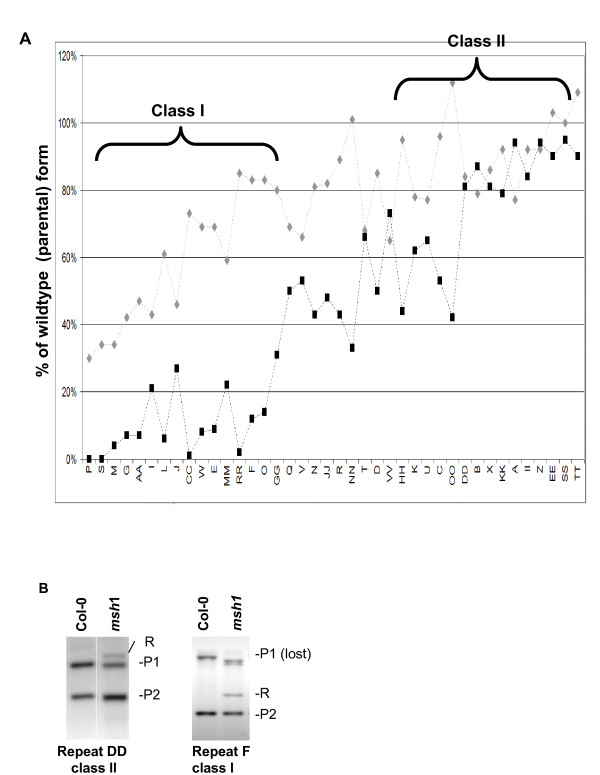
Deducing the fate of the parental form following recombination. (A) Graph depicting deep sequence coverage of the least predominant environment (the invading strand parental form) around each repeat. This is measured by quantifying the changes in read depth across flanking regions compared to wild type. Repeats were sorted by average activity, with first-generation msh1 repeats shown in gray and advanced-generation results shown in black. Class I repeats show significant reduction of the invading strand parental form in the resulting recombinant, and class II repeats retain the parental form in high copy numbers following recombination. Mapping of class I repeats gives the appearance of deletion in the recombinant. (B) DNA gel blot hybridization experiments with repeat DD and repeat F as probes show examples of class I and class II recombination outcomes in an advanced-generation msh1 mutant. P1 and P2 designate parental configurations, and R is the recombinant form. Additional bands in the msh1 lane probed with repeat F represent secondary recombinations, defined as events that depend on novel genomic environments created by primary recombination to occur.
Figure 6
Figure 6
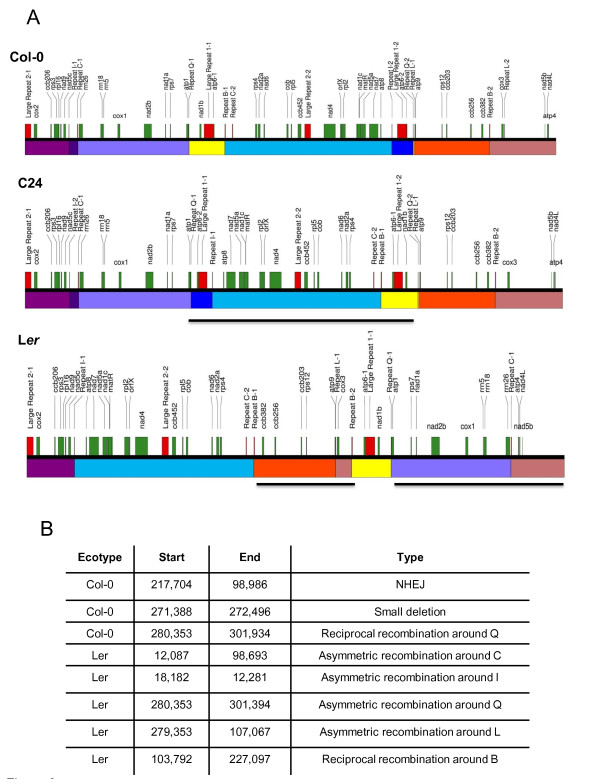
Mitochondrial genome rearrangements in ecotypes Col-0, C24 and Ler. (A) Genome maps are constructed from sequence data. Regions are color-coded, with genes shown in green and selected repeats shown in red. Underlying bars represent regions that are inverted in orientation relative to the genomic map of Col-0. (B) List of structural variations in Col-0 and Landsberg erecta (Ler) genes relative to C24. The position and type of polymorphism are shown.
Figure 7
Figure 7
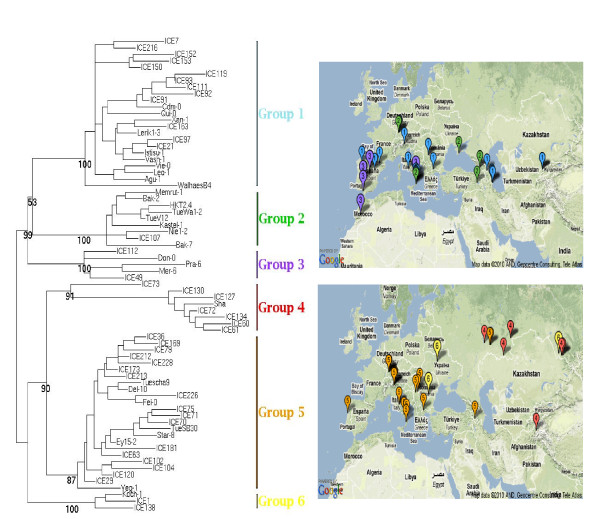
Phylogenetic analysis of 72 ecotypes based on mitochondrial SNPs suggests division into six groups in the left panel. The tree shown is unrooted. The right panel shows the geographic distribution of the depicted groups.
Figure 8
Figure 8
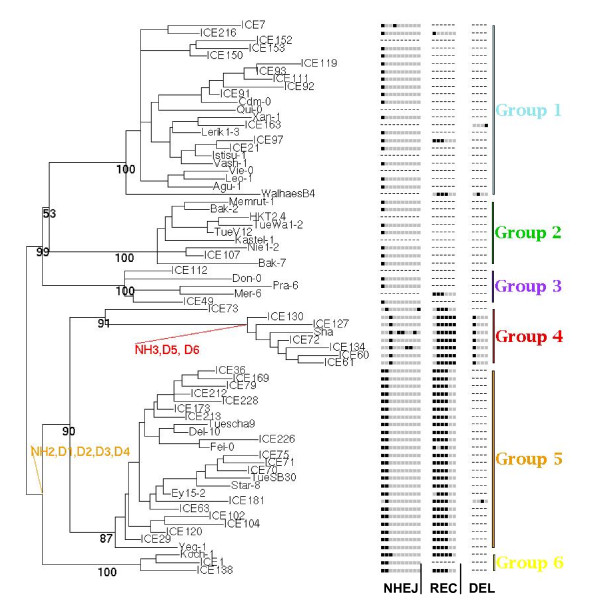
Mitochondrial genome structural changes coincide with SNP-based phylogeny. Structural changes arising by nonhomologous end-joining (NHEJ), deletions caused by recombination at repeats (REC) and small deletions, perhaps arising by replication slippage (DEL), were categorized according to ecotypes, allowing assessment of the relationship of SNP-based phylogeny to changes arising by genomic rearrangement. Putative sites in the tree where some of the changes may have occurred are indicated. The tree shown is unrooted.
Figure 9
Figure 9
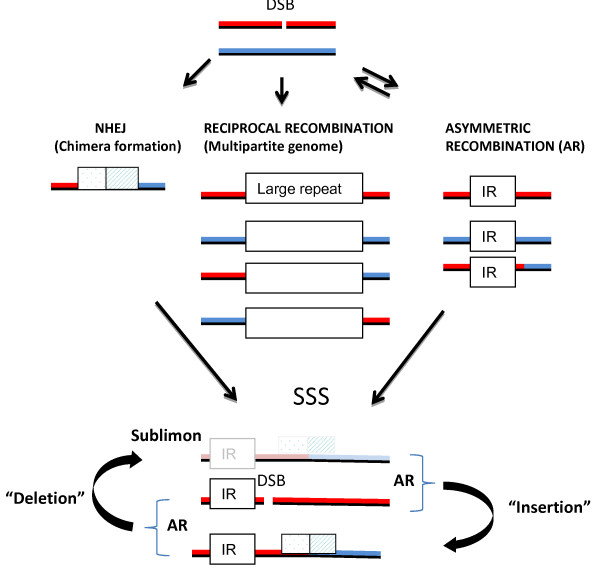
Modeling alternative double-strand break repair outcomes. Sequence analysis suggests three means of double-strand break (DSB) repair, resulting in evidence of nonhomologous end-joining (NHEJ), reciprocal recombination at large repeats and asymmetrical recombination at intermediate repeats (IRs). Asymmetrical recombination activity at IRs residing on molecules containing gene chimeras can result in substoichiometric shifting (SSS) for relative copy number suppression or amplification of the genomic environment surrounding the chimera.

Comment in

References

    1. Bendich AJ. Structural analysis of mitochondrial DNA molecules from fungi and plants using moving pictures and pulsed-field gel electrophoresis. J Mol Biol. 1996;255:564–588. doi: 10.1006/jmbi.1996.0048. - DOI - PubMed
    1. Oldenburg DJ, Bendich AJ. Mitochondrial DNA from the liverwort Marchantia polymorpha: circularly permuted linear molecules, head-to-tail concatemers, and a 5' protein. J Mol Biol. 2001;310:549–562. doi: 10.1006/jmbi.2001.4783. - DOI - PubMed
    1. Sugiyama Y, Watase Y, Nagase M, Makita N, Yagura S, Hirai A, Sugiura M. The complete nucleotide sequence and multipartite organization of the tobacco mitochondrial genome: comparative analysis of mitochondrial genomes in higher plants. Mol Gen Genomics. 2005;272:603–615. doi: 10.1007/s00438-004-1075-8. - DOI - PubMed
    1. Backert S, Dörfel P, Lurz R, Börner T. Rolling-circle replication of mitochondrial DNA in the higher plant Chenopodium album (L.) Mol Cell Biol. 1996;16:6285–6294. - PMC - PubMed
    1. Arrieta-Montiel MP, Mackenzie SA. In: Advances in Plant Biology: Plant Mitochondria. Kempen F, editor. New York: Springer; 2010. Plant mitochondrial genomes and recombination; pp. 65–84.

Publication types

MeSH terms

Substances

Associated data

LinkOut - more resources