Funding grant proposals for scientific research: retrospective analysis of scores by members of grant review panel
- PMID: 21951756
- PMCID: PMC3181233
- DOI: 10.1136/bmj.d4797
Funding grant proposals for scientific research: retrospective analysis of scores by members of grant review panel
Abstract
Objective: To quantify randomness and cost when choosing health and medical research projects for funding.
Design: Retrospective analysis.
Setting: Grant review panels of the National Health and Medical Research Council of Australia.
Participants: Panel members' scores for grant proposals submitted in 2009.
Main outcome measures: The proportion of grant proposals that were always, sometimes, and never funded after accounting for random variability arising from differences in panel members' scores, and the cost effectiveness of different size assessment panels.
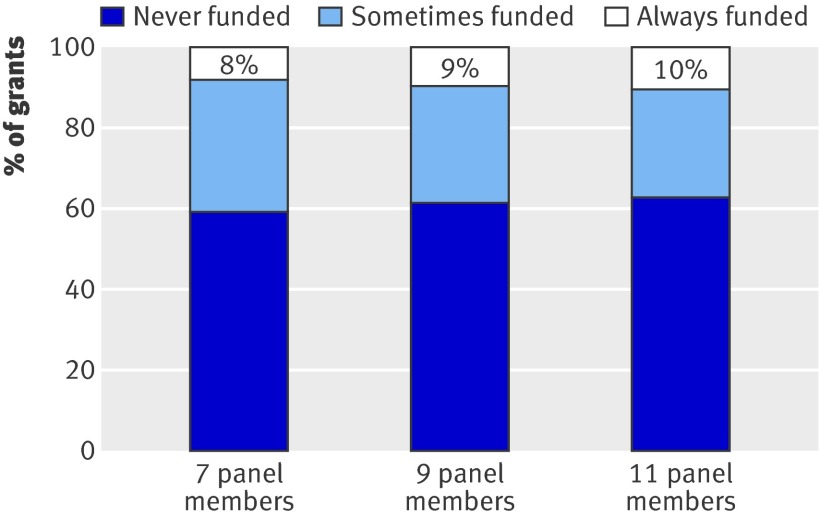
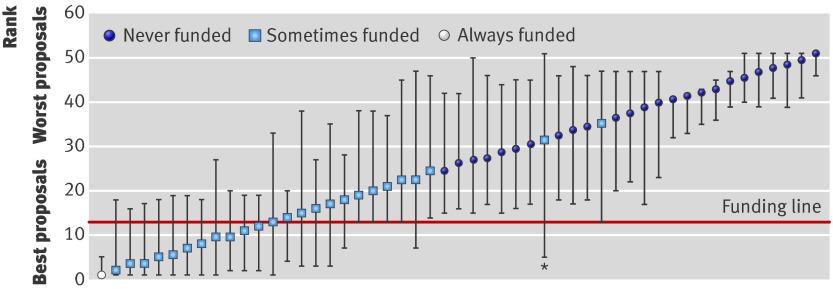
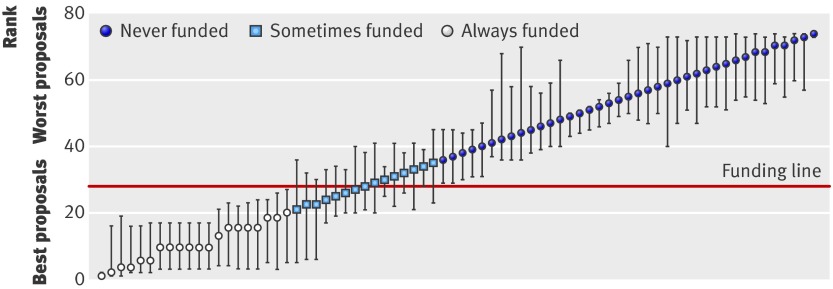
Results: 59% of 620 funded grants were sometimes not funded when random variability was taken into account. Only 9% (n = 255) of grant proposals were always funded, 61% (n = 1662) never funded, and 29% (n=788) sometimes funded. The extra cost per grant effectively funded from the most effective system was $A18,541 (£11,848; €13,482; $19,343).
Conclusions: Allocating funding for scientific research in health and medicine is costly and somewhat random. There are many useful research questions to be addressed that could improve current processes.
Conflict of interest statement
Competing interests: All authors have completed the ICMJE uniform disclosure form at
Figures
References
-
- Baxt WG, Waeckerle JF, Berlin JA, Callaham ML. Who reviews the reviewers? Feasibility of using a fictitious manuscript to evaluate peer reviewer performance. Ann Emerg Med 1998;32:310-7. - PubMed
-
- Godlee F, Gale CR, Martyn CN. Effect on the quality of peer review of blinding reviewers and asking them to sign their reports: a randomized controlled trial. JAMA 1998;280:237-40. - PubMed
-
- Schroter S, Tite L, Hutchings A, Black N. Differences in review quality and recommendations for publication between peer reviewers suggested by authors or by editors. JAMA 2006;295:314-7. - PubMed
MeSH terms
LinkOut - more resources
Full Text Sources