


Comparison of two modes of vitamin B12 supplementation on neuroconduction and cognitive function among older people living in Santiago, Chile: a cluster randomized controlled trial. a study protocol [ISRCTN 02694183]
- PMID: 21952034
- PMCID: PMC3195703
- DOI: 10.1186/1475-2891-10-100
Comparison of two modes of vitamin B12 supplementation on neuroconduction and cognitive function among older people living in Santiago, Chile: a cluster randomized controlled trial. a study protocol [ISRCTN 02694183]
Abstract
Background: Older people have a high risk of vitamin B12 deficiency; this can lead to varying degrees of cognitive and neurological impairment. CBL deficiency may present as macrocytic anemia, subacute combined degeneration of the spinal cord, or as neuropathy, but is often asymptomatic in older people. Less is known about subclinical vitamin B12 deficiency and concurrent neuroconduction and cognitive impairment. A Programme of Complementary Feeding for the Older Population (PACAM) in Chile delivers 2 complementary fortified foods that provide approximately 1.4 μg/day of vitamin B12 (2.4 μg/day elderly RDA). The aim of the present study is to assess whether supplementation with vitamin B12 will improve neuroconduction and cognitive function in older people who have biochemical evidence of vitamin B12 insufficiency in the absence of clinical deficiency.
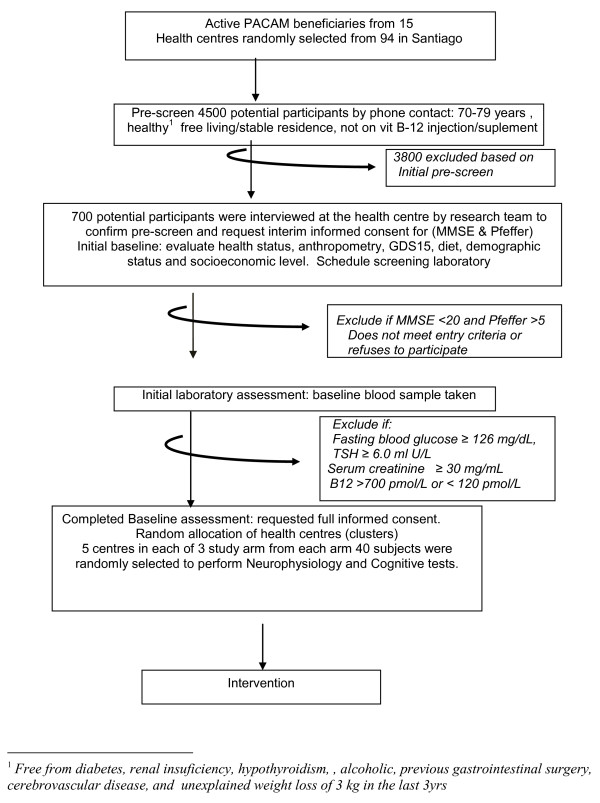
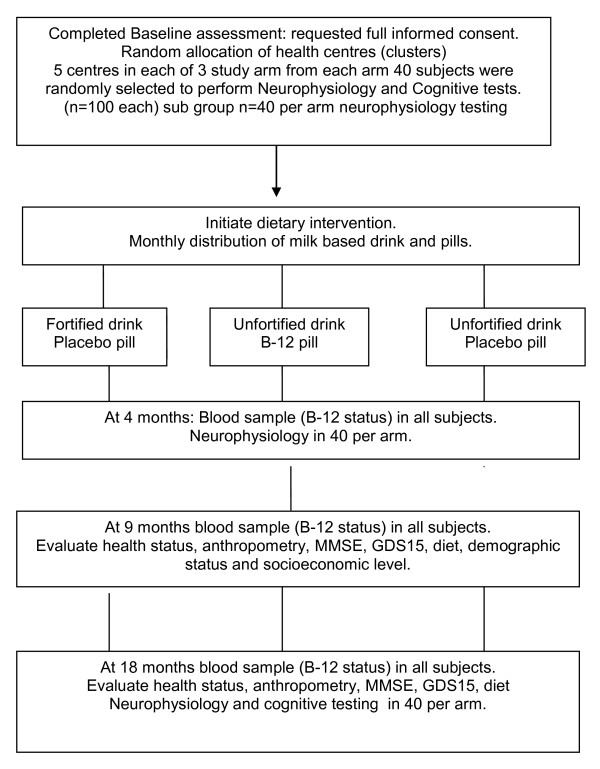
Methods: We designed a cluster double-blind placebo-controlled trial involving community dwelling people aged 70-79 living in Santiago, Chile. We randomized 15 clusters (health centers) involving 300 people (20 per cluster). Each cluster will be randomly assigned to one of three arms: a) a 1 mg vitamin B12 pill taken daily and a routine PACAM food; b) a placebo pill and the milk-PACAM food fortified to provide 1 mg of vitamin B12; c) the routine PACAM food and a placebo pill.The study has been designed as an 18 month follow up period. The primary outcomes assessed at baseline, 4, 9 and 18 months will be: serum levels of vitamin B12, neuroconduction and cognitive function.
Conclusions: In view of the high prevalence of vitamin B12 deficiency in later life, the present study has potential public health interest because since it will measure the impact of the existing program of complementary feeding as compared to two options that provide higher vitamin B12 intakes that might potentially may contribute in preserving neurophysiologic and cognitive function and thus improve quality of life for older people in Chile.
Trial registration: ISRCTN: ISRCTN02694183.
Figures
Similar articles
-
Effectiveness of the National Program of Complementary Feeding for older adults in Chile on vitamin B12 status in older adults; secondary outcome analysis from the CENEX Study (ISRCTN48153354).Nutr J. 2013 Sep 9;12:124. doi: 10.1186/1475-2891-12-124. Nutr J. 2013. PMID: 24016218 Free PMC article. Clinical Trial.
-
A randomised controlled trial investigating the effect of vitamin B12 supplementation on neurological function in healthy older people: the Older People and Enhanced Neurological function (OPEN) study protocol [ISRCTN54195799].Nutr J. 2011 Mar 11;10:22. doi: 10.1186/1475-2891-10-22. Nutr J. 2011. PMID: 21396086 Free PMC article. Clinical Trial.
-
Impact of baseline vitamin B12 status on the effect of vitamin B12 supplementation on neurologic function in older people: secondary analysis of data from the OPEN randomised controlled trial.Eur J Clin Nutr. 2017 Oct;71(10):1166-1172. doi: 10.1038/ejcn.2017.7. Epub 2017 Feb 22. Eur J Clin Nutr. 2017. PMID: 28225050 Clinical Trial.
-
Vitamin B12 and cognitive function: an evidence-based analysis.Ont Health Technol Assess Ser. 2013 Nov 1;13(23):1-45. eCollection 2013. Ont Health Technol Assess Ser. 2013. PMID: 24379897 Free PMC article. Review.
-
If high folic acid aggravates vitamin B12 deficiency what should be done about it?Nutr Rev. 2007 Oct;65(10):451-8. doi: 10.1111/j.1753-4887.2007.tb00270.x. Nutr Rev. 2007. PMID: 17972439 Review.
Cited by
-
Effectiveness of the National Program of Complementary Feeding for older adults in Chile on vitamin B12 status in older adults; secondary outcome analysis from the CENEX Study (ISRCTN48153354).Nutr J. 2013 Sep 9;12:124. doi: 10.1186/1475-2891-12-124. Nutr J. 2013. PMID: 24016218 Free PMC article. Clinical Trial.
-
Vitamin and mineral supplementation for maintaining cognitive function in cognitively healthy people in mid and late life.Cochrane Database Syst Rev. 2018 Dec 17;12(12):CD011906. doi: 10.1002/14651858.CD011906.pub2. Cochrane Database Syst Rev. 2018. PMID: 30556597 Free PMC article.
-
The Human Serum Metabolome of Vitamin B-12 Deficiency and Repletion, and Associations with Neurological Function in Elderly Adults.J Nutr. 2017 Oct 1;147(10):1839-1849. doi: 10.3945/jn.117.248278. J Nutr. 2017. PMID: 28794205 Free PMC article.
-
Iron, Zinc, Folate, and Vitamin B-12 Status Increased among Women and Children in Yaoundé and Douala, Cameroon, 1 Year after Introducing Fortified Wheat Flour.J Nutr. 2017 Jul;147(7):1426-1436. doi: 10.3945/jn.116.245076. Epub 2017 Jun 7. J Nutr. 2017. PMID: 28592513 Free PMC article.
-
Vitamin and mineral supplementation for preventing dementia or delaying cognitive decline in people with mild cognitive impairment.Cochrane Database Syst Rev. 2018 Nov 1;11(11):CD011905. doi: 10.1002/14651858.CD011905.pub2. Cochrane Database Syst Rev. 2018. PMID: 30383288 Free PMC article.
References
-
- Shane B. Folate and vitamin B12 metabolism: Overview and interaction with riboflavin, vitamin B6 and polymorphisms. Food Nutr Bull. 2008;29(Suppl 2):5–16. - PubMed
-
- Clarke R, Grimley Evans J, Schneede J, Nexo E, Bates C, Fletcher A, Prentice A, Johnston C, Ueland PM, Refsum H. et al. Vitamin B12 and folate deficiency in later life. Age Ageing. 2004;33(Suppl 1):34–41. - PubMed
-
- Suter PM, Golner BB, Goldin BR, Morrow FD, Russell RM. Reversal of proteinbound vitamin B12 malabsorption with antibiotics in atrophic gastritis. Gastroenterology. 1991;101(4):1039–1045. - PubMed
Publication types
MeSH terms
Substances
Associated data
LinkOut - more resources
Full Text Sources
Medical
Miscellaneous
