


Beneficial effects of albuterol in congenital endplate acetylcholinesterase deficiency and Dok-7 myasthenia
- PMID: 21952943
- PMCID: PMC3196786
- DOI: 10.1002/mus.22176
Beneficial effects of albuterol in congenital endplate acetylcholinesterase deficiency and Dok-7 myasthenia
Abstract
Introduction: Congenital myasthenic syndromes (CMS) are disabling but treatable disorders. Anticholinesterase therapy is effective in most of them, but is contraindicated in endplate (EP) acetylcholinesterase (AChE) deficiency, the slow-channel syndrome, Dok-7 myasthenia, and β(2) -laminin deficiency, and is not useful in CMS due to defects in muscle-specific kinase (MuSK), agrin, and plectin. EP AChE, Dok-7, and β(2)-laminin deficiencies respond favorably to ephedrine, but ephedrine can no longer be prescribed in the USA.
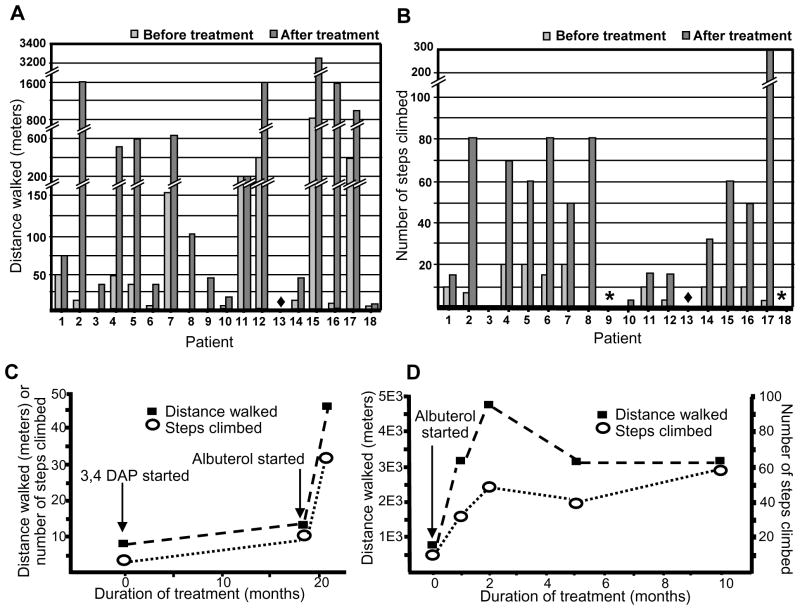
Methods: We used albuterol, another sympathomimetic agent, to treat 3 patients with EP AChE deficiency and 15 with Dok-7 myasthenia. Response to therapy was evaluated by a 9-point questionnaire pertaining to activities of daily life.
Results: Comparison of the pre- and posttreatment responses indicated a beneficial response to albuterol (P < 0.001) in both patient groups. The adverse effects of therapy were like those of ephedrine.
Conclusion: Our observations should spur controlled, prospective clinical trials of albuterol in these as well as other CMS.
Copyright © 2011 Wiley Periodicals, Inc.
Figures
References
-
- Chevessier F, Faraut B, Ravel-Chapuis A, Richard P, Gaudon K, Bauche S, et al. MUSK, a new target for mutations causing congenital myasthenic syndrome. Hum Mol Genet. 2004;13:3229–3240. - PubMed
-
- Mihaylova V, Salih MA, Mukhtar MM, Abuzeid HA, El-Sadig SM, von der Hagen M, Huebner A, et al. Refinement of the clinical phenotype in musk-related congenital myasthenic syndromes. Neurology. 2009;73:1926–1928. - PubMed
Publication types
MeSH terms
Substances
Grants and funding
LinkOut - more resources
Full Text Sources
Other Literature Sources
