


MALDI mass spectrometric imaging of lipids in rat brain injury models
- PMID: 21953042
- PMCID: PMC4537074
- DOI: 10.1007/s13361-011-0122-z
MALDI mass spectrometric imaging of lipids in rat brain injury models
Abstract
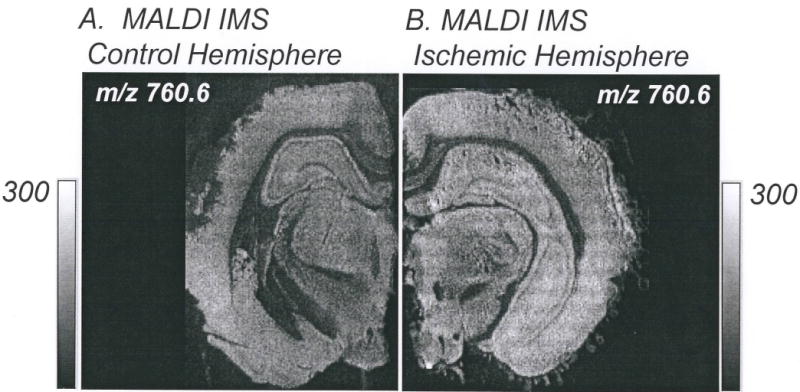
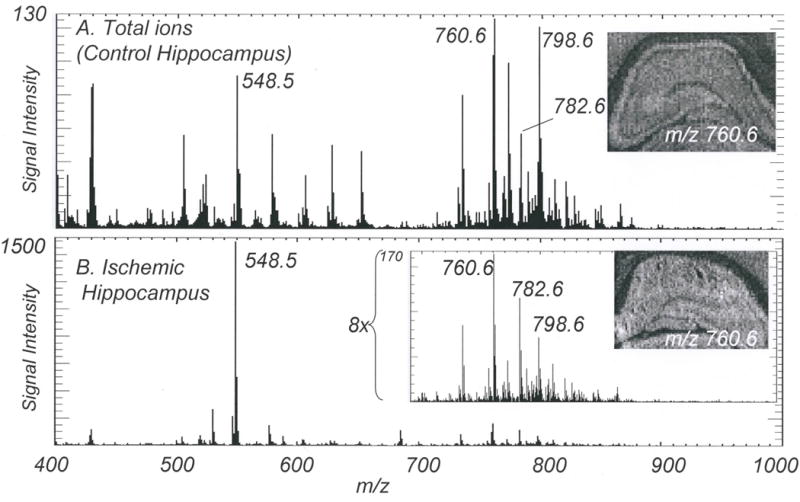
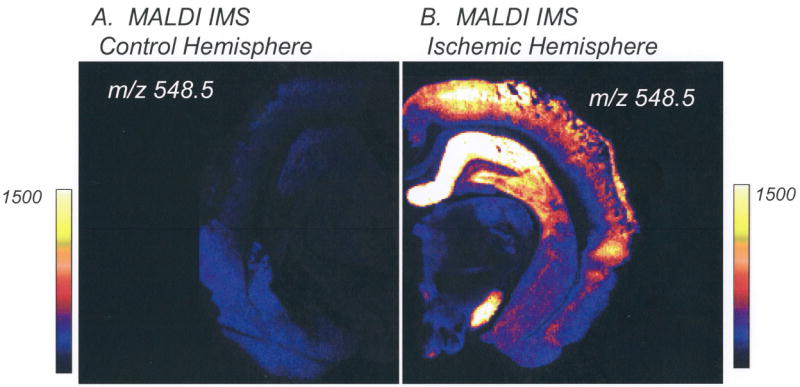
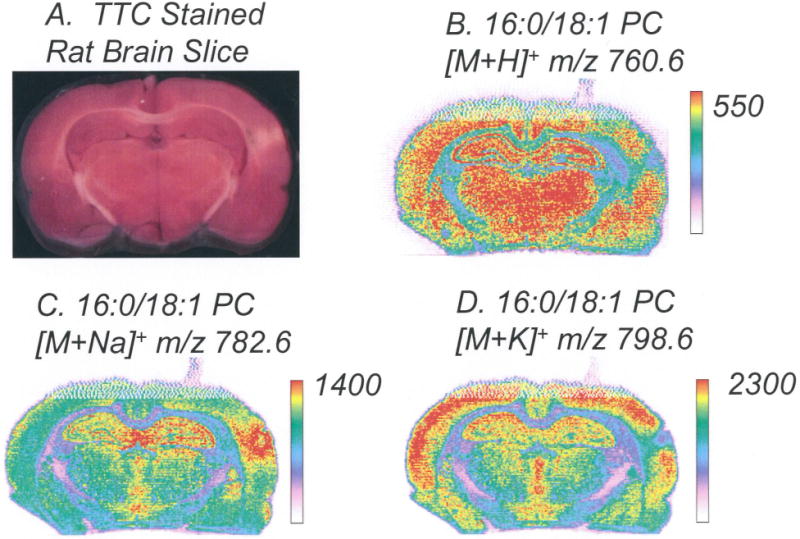
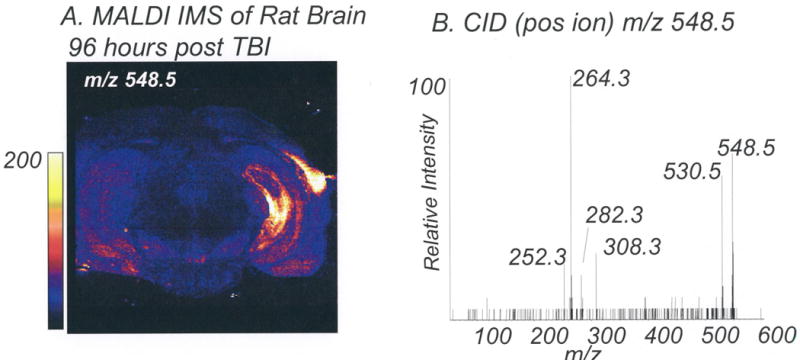
Matrix-assisted laser desorption ionization/ionization imaging mass spectrometry (MALDI IMS) with a time-of-flight analyzer was used to characterize the distribution of lipid molecular species in the brain of rats in two injury models. Ischemia/reperfusion injury of the rat brain after bilateral occlusion of the carotid artery altered appearance of the phospholipids present in the hippocampal region, specifically the CA1 region. These brain regions also had a large increase in the ion abundance at m/z 548.5 and collisional activation supported identification of this ion as arising from ceramide (d18:1/18:0), a lipid known to be associated with cellular apoptosis. Traumatic brain injury model in the rat was examined by MALDI IMS and the area of damage also showed an increase in ceramide (d18:1/18:0) and a remarkable loss of signal for the potassium adduct of the most abundant phosphocholine molecular species 16:0/18:1 (PC) with a corresponding increase in the sodium adduct ion. This change in PC alkali attachment ion was suggested to be a result of edema and influx of extracellular fluid likely through a loss of Na/K-ATPase caused by the injury. These studies reveal the value of MALDI IMS to examine tissues for changes in lipid biochemistry and will provide data needed to eventually understand the biochemical mechanisms relevant to tissue injury.
Figures
References
-
- Cornett DS, Reyzer ML, Chaurand P, Caprioli RM. MALDI imaging mass spectrometry: molecular snapshots of biochemical systems. Nat Methods. 2007;4:828–833. - PubMed
-
- Schwamborn K, Caprioli RM. Molecular imaging by mass spectrometry–looking beyond classical histology. Nat Rev Cancer. 2010;10:639–646. - PubMed
-
- Koizumi S, Yamamoto S, Hayasaka T, Konishi Y, Yamaguchi-Okada M, Goto-Inoue N, Sugiura Y, Setou M, Namba H. Imaging mass spectrometry revealed the production of lyso-phosphatidylcholine in the injured ischemic rat brain. Neuroscience. 2010;168:219–225. - PubMed
-
- Wisztorski M, Croix D, Macagno E, Fournier I, Salzet M. Molecular MALDI imaging: an emerging technology for neuroscience studies. Dev Neurobiol. 2008;68:845–858. - PubMed
-
- Drexler DM, Garrett TJ, Cantone JL, Diters RW, Mitroka JG, Prieto Conaway MC, Adams SP, Yost RA, Sanders M. Utility of imaging mass spectrometry (IMS) by matrix-assisted laser desorption ionization (MALDI) on an ion trap mass spectrometer in the analysis of drugs and metabolites in biological tissues. J Pharmacol Toxicol Methods. 2007;55:279–288. - PubMed
Publication types
MeSH terms
Substances
Grants and funding
LinkOut - more resources
Full Text Sources
Miscellaneous
