


Target-decoy approach and false discovery rate: when things may go wrong
- PMID: 21953092
- PMCID: PMC3220955
- DOI: 10.1007/s13361-011-0139-3
Target-decoy approach and false discovery rate: when things may go wrong
Abstract
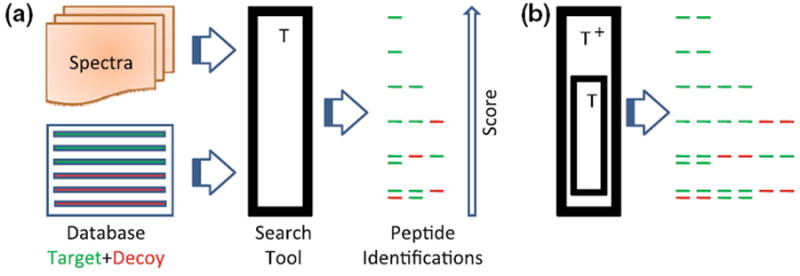
The target-decoy approach (TDA) has done the field of proteomics a great service by filling in the need to estimate the false discovery rates (FDR) of peptide identifications. While TDA is often viewed as a universal solution to the problem of FDR evaluation, we argue that the time has come to critically re-examine TDA and to acknowledge not only its merits but also its demerits. We demonstrate that some popular MS/MS search tools are not TDA-compliant and that it is easy to develop a non-TDA compliant tool that outperforms all TDA-compliant tools. Since the distinction between TDA-compliant and non-TDA compliant tools remains elusive, we are concerned about a possible proliferation of non-TDA-compliant tools in the future (developed with the best intentions). We are also concerned that estimation of the FDR by TDA awkwardly depends on a virtual coin toss and argue that it is important to take the coin toss factor out of our estimation of the FDR. Since computing FDR via TDA suffers from various restrictions, we argue that TDA is not needed when accurate p-values of individual Peptide-Spectrum Matches are available.
Figures
References
-
- Elias JE, Gygi SP. Target-decoy search strategy for increased confidence in large-scale protein identifications by mass spectrometry. Nat Methods. 2007;4:207–214. - PubMed
-
- Balgley BM, Laudeman T, Yang L, Song T, Lee CS. Comparative evaluation of tandem MS search algorithms using a target-decoy search strategy. Mol Cell Proteom. 2007;6:1599–1608. - PubMed
-
- Nesvizhskii AI, Vitek O, Aebersold R. Analysis and validation of proteomic data generated by tandem mass spectrometry. Nature methods. 2007;4:787–797. - PubMed
-
- Kall L, Canterbury JD, Weston J, Noble WS, MacCoss MJ. Semi-supervised learning for peptide identification from shotgun proteomics datasets. Nature Methods. 2007;4:923–926. - PubMed
Publication types
MeSH terms
Substances
Grants and funding
LinkOut - more resources
Full Text Sources
