Competing risks and the clinical community: irrelevance or ignorance?
- PMID: 21953401
- PMCID: PMC3575691
- DOI: 10.1002/sim.4384
Competing risks and the clinical community: irrelevance or ignorance?
Abstract
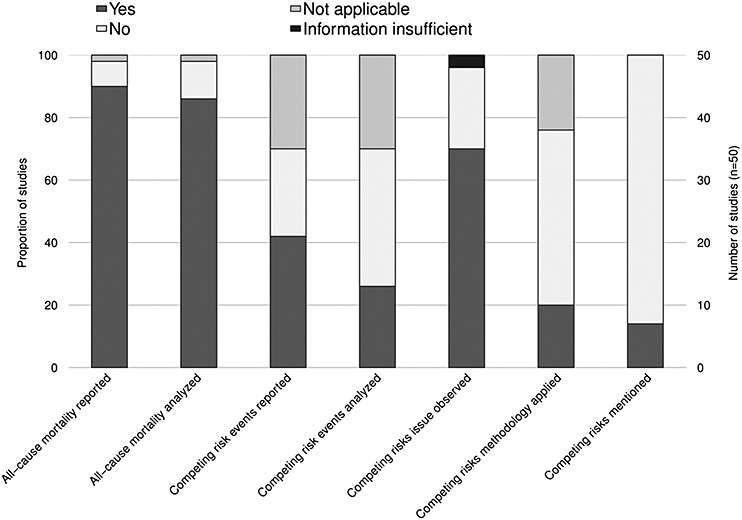
Life expectancy has dramatically increased in industrialized nations over the last 200 hundred years. The aging of populations carries over to clinical research and leads to an increasing representation of elderly and multimorbid individuals in study populations. Clinical research in these populations is complicated by the fact that individuals are likely to experience several potential disease endpoints that prevent some disease-specific endpoint of interest from occurrence. Large developments in competing risks methodology have been achieved over the last decades, but we assume that recognition of competing risks in the clinical community is still marginal. It is the aim of this article to address translational aspects of competing risks to the clinical community. We describe clinical populations where competing risks issues may arise. We then discuss the importance of agreement between the competing risks methodology and the study aim, in particular the distinction between etiologic and prognostic research questions. In a review of 50 clinical studies performed in individuals susceptible to competing risks published in high-impact clinical journals, we found competing risks issues in 70% of all articles. Better recognition of issues related to competing risks and of statistical methods that deal with competing risks in accordance with the aim of the study is needed.
Copyright © 2011 John Wiley & Sons, Ltd.
Figures


References
-
- Varadhan R, Weiss CO, Segal JB, Wu AW, Scharfstein D, Boyd C. Evaluating health outcomes in the presence of competing risks: a review of statistical methods and clinical applications. Medical Care. 2010;48(6 Suppl):S96–S105. - PubMed
-
- Statistics Norway Life expectancy - remaining years for males and females at selected ages. 1866-2009, 2009. Accessed 14.11.2010.
-
- Spillman BC, Lubitz J. The effect of longevity on spending for acute and long-term care. The New England Journal of Medicine. 2000;342(19):1409–1415. - PubMed
Publication types
MeSH terms
LinkOut - more resources
Full Text Sources
Medical