


Association between white matter microstructure, executive functions, and processing speed in older adults: the impact of vascular health
- PMID: 21954054
- PMCID: PMC3830829
- DOI: 10.1002/hbm.21412
Association between white matter microstructure, executive functions, and processing speed in older adults: the impact of vascular health
Abstract
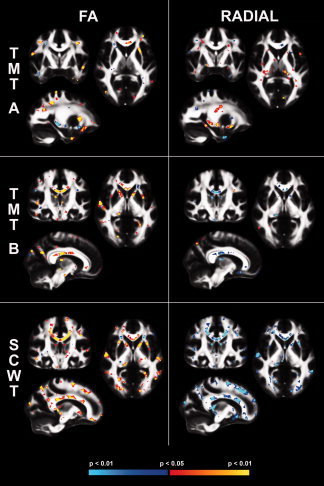
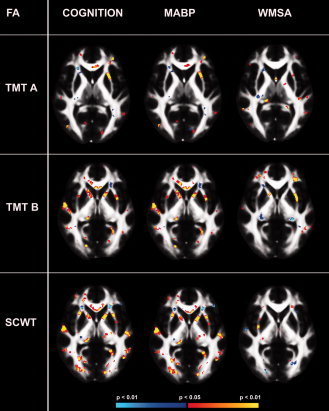
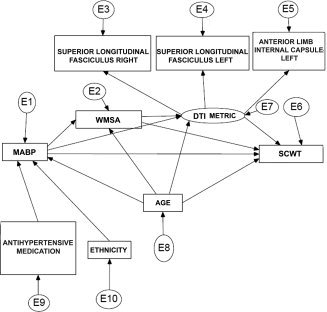
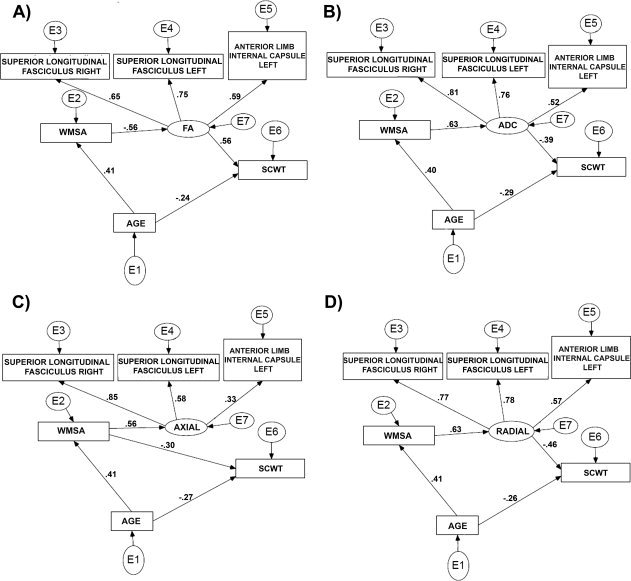
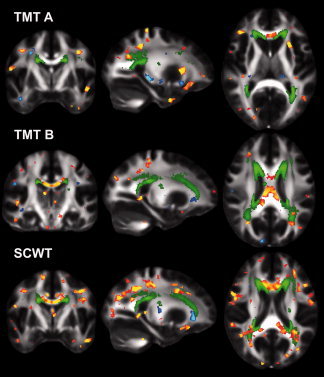
Cerebral white matter damage is not only a commonly reported consequence of healthy aging, but is also associated with cognitive decline and dementia. The aetiology of this damage is unclear; however, individuals with hypertension have a greater burden of white matter signal abnormalities (WMSA) on MR imaging than those without hypertension. It is therefore possible that elevated blood pressure (BP) impacts white matter tissue structure which in turn has a negative impact on cognition. However, little information exists about whether vascular health indexed by BP mediates the relationship between cognition and white matter tissue structure. We used diffusion tensor imaging to examine the impact of vascular health on regional associations between white matter integrity and cognition in healthy older adults spanning the normotensive to moderate-severe hypertensive BP range (43-87 years; N = 128). We examined how white matter structure was associated with performance on tests of two cognitive domains, executive functioning (EF) and processing speed (PS), and how patterns of regional associations were modified by BP and WMSA. Multiple linear regression and structural equation models demonstrated associations between tissue structure, EF and PS in frontal, temporal, parietal, and occipital white matter regions. Radial diffusivity was more prominently associated with performance than axial diffusivity. BP only minimally influenced the relationship between white matter integrity, EF and PS. However, WMSA volume had a major impact on neurocognitive associations. This suggests that, although BP and WMSA are causally related, these differential metrics of vascular health may act via independent pathways to influence brain structure, EF and PS.
Copyright © 2011 Wiley Periodicals, Inc.
Figures
References
-
- American Diabetes Association , 2009.
-
- American Heart Association , 2009.
-
- Anson O, Paran E ( 2005): Hypertension and cognitive functioning among the elderly: An overview. Am J Ther 12: 359–365. - PubMed
-
- Arbuthnott K, Frank J ( 2000): Trail making test, part B as a measure of executive control: Validation using a set‐switching paradigm. J Clin Exp Neuropsychol 22: 518–528. - PubMed
Publication types
MeSH terms
Grants and funding
LinkOut - more resources
Full Text Sources
Medical
