Buffer management to solve bed-blocking in the Netherlands 2000-2010. Cooperation from an integrated care chain perspective as a key success factor for managing patient flows
- PMID: 21954373
- PMCID: PMC3180700
- DOI: 10.5334/ijic.650
Buffer management to solve bed-blocking in the Netherlands 2000-2010. Cooperation from an integrated care chain perspective as a key success factor for managing patient flows
Abstract
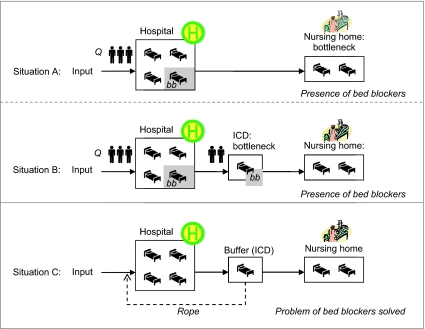
Introduction: Bed-blocking problems in hospitals reflect how difficult and complex it is to move patients smoothly through the chain of care. In the Netherlands, during the first decade of the 21st century, some hospitals attempted to tackle this problem by using an Intermediate Care Department (ICD) as a buffer for bed-blockers. However, research has shown that ICDs do not sufficiently solve the bed-blocking problem and that bed-blocking is often caused by a lack of buffer management. TOOL: Buffer management (BM) is a tool that endeavors to balance patient flow in the hospital to nursing home chain of care.
Results: Additional research has indicated that the absence of BM is not the result of providers' thinking that BM is unnecessary, unethical or impossible because of unpredictable patient flows. Instead, BM is hampered by a lack of cooperation between care providers.
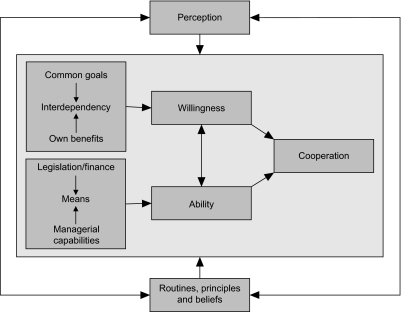
Conclusion: Although stakeholders recognize that cooperation is imperative, they often fail to take the actions necessary to realize cooperation. Our assumption is that this lack of willingness and ability to cooperate is the result of several impeding conditions as well as stakeholders' perceptions of these conditions and the persistence of their current routines, principles and beliefs (RPBs).
Discussion: We recommend simultaneously working on improving the conditions and changing stakeholders' perceptions and RPBs.
Keywords: bed-blocking; buffer management; care chain; cooperation; integrated care; patient flow; theory of constraints.
Figures
References
-
- Ackerman III. The movement to vertically integrated regional health systems. Health Care Management Review. 1992;17(3):81–8. - PubMed
-
- Ahgren B. Chain of care development in Sweden: results of a national study. International Journal of Integrated Care. [serial online] 2003 Oct 7;3. [Cited 2011 8 June]. Available from: http://www.ijic.org. URN:NBN:NL:UI:10-1-100330. - PMC - PubMed
-
- Hardy B, Mur-Veeman I, Steenbergen M, Wistow G. Inter-agency services in England and The Netherlands. A comparative study of integrated care development and delivery. Health Policy. 1999;48:87–105. - PubMed
-
- Minkman MMN, Schouten LMT, Huijsman R, van Splinteren PT. Integrated care for patients with a stroke in the Netherlands: results and experiences from a national breakthrough collaborative improvement project. International Journal of Integrated Care [serial online] 2005 Mar 23;5 [Cited 2011 8 June]. Available from: http://www.ijic.org. URN:NBN:NL:UI:10-1-100360. - PMC - PubMed
-
- Raak A van, Mur-Veeman I, Hardy B, Steenbergen M, Paulus A, editors. Integrated care in Europe. Description and comparison of integrated care in six EU countries. Maarssen: Reed Business Information; 2003.
LinkOut - more resources
Full Text Sources