


Frequency of impulse control behaviours associated with dopaminergic therapy in restless legs syndrome
- PMID: 21955669
- PMCID: PMC3195705
- DOI: 10.1186/1471-2377-11-117
Frequency of impulse control behaviours associated with dopaminergic therapy in restless legs syndrome
Abstract
Background: Low doses of dopamine agonists (DA) and levodopa are effective in the treatment of restless legs syndrome (RLS). A range of impulse control and compulsive behaviours (ICBs) have been reported following the use of DAs and levodopa in patients with Parkinson's disease. With this study we sought to assess the cross-sectional prevalence of impulse control behaviours (ICBs) in restless legs syndrome (RLS) and to determine factors associated with ICBs in a population cohort in Germany.
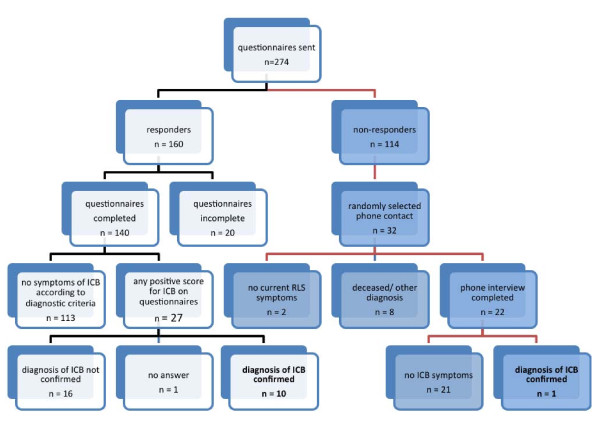
Methods: Several questionnaires based on validated and previously used instruments for assessment of ICBs were mailed out to patients being treated for RLS. Final diagnoses of ICBs were based on stringent diagnostic criteria after psychiatric interviews were performed.
Results: 10/140 RLS patients of a clinical cohort (7.1%) were finally diagnosed with ICBs, 8 of 10 on dopamine agonist (DA) therapy, 2 of 10 on levodopa. 8 of the 10 affected patients showed more than one type of abnormal behaviour. Among those who responded to the questionnaires 6/140 [4.3%] revealed binge eating, 5/140 [3.6%] compulsive shopping, 3/140 [2.1%] pathological gambling, 3/140 [2.1%] punding, and 2/140 [1.4%] hypersexuality in psychiatric assessments. Among those who did not respond to questionnaires, 32 were randomly selected and interviewed: only 1 patient showed positive criteria of ICBs with compulsive shopping and binge eating. ICBs were associated with higher DA dose (p = 0.001), younger RLS onset (p = 0.04), history of experimental drug use (p = 0.002), female gender (p = 0.04) and a family history of gambling disorders (p = 0.02), which accounted for 52% of the risk variance.
Conclusion: RLS patients treated with dopaminergic agents and dopamine agonists in particular, should be forewarned of potential side effects. A careful history of risk factors should be taken.
References
-
- Allen RP, Picchietti D, Hening WA, Trenkwalder C, Walters AS, Montplaisir J. Restless legs syndrome: diagnostic criteria, special considerations, and epidemiology. A report from the restless legs syndrome diagnosis and epidemiology workshop at the National Institutes of Health. Sleep Med. 2003;4:101–119. doi: 10.1016/S1389-9457(03)00010-8. - DOI - PubMed
-
- Allen RP, Earley CJ. The role of iron in restless legs syndrome. Mov Disord. 2007. - PubMed
MeSH terms
Substances
LinkOut - more resources
Full Text Sources
Medical
