


Influence of DFNB1 status on expressive language in deaf children with cochlear implants
- PMID: 21956600
- PMCID: PMC3219822
- DOI: 10.1097/MAO.0b013e31823387f9
Influence of DFNB1 status on expressive language in deaf children with cochlear implants
Abstract
Objective: The objective of this study was to compare the language growth of children with connexin-related deafness (DFNB1) who received cochlear implants versus the language growth of implanted children with non-DFNB1 deafness.
Study design: A prospective longitudinal observational study and analysis.
Setting: Two tertiary referral centers.
Patients: There were 37 children with severe-to-profound hearing loss who received cochlear implants before the age of 5 years.
Interventions: A standardized language measure, the section for expressive language of the Reynell Developmental Language Scale was used to assess expressive language skills at 2 times postimplantation (14 and 57 mo postimplantation). Molecular screening for DFNB1 gene variants.
Main outcome measures: Language quotient (LQ) scores (i.e., age-equivalent score obtained on the Reynell Developmental Language Scale divided by the child's chronological age), results of genotyping.
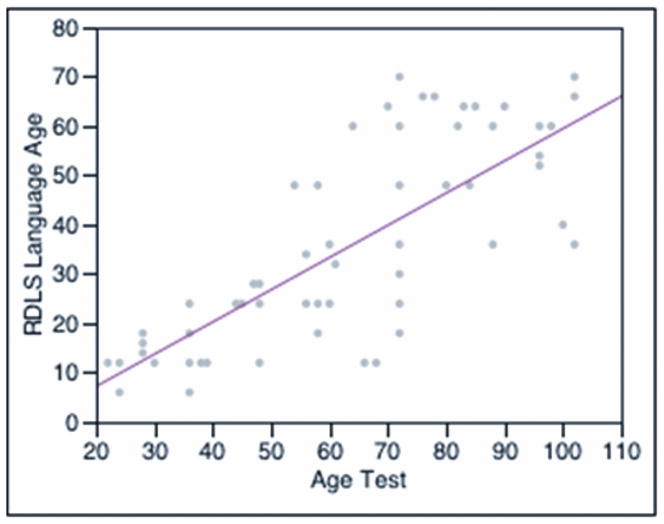
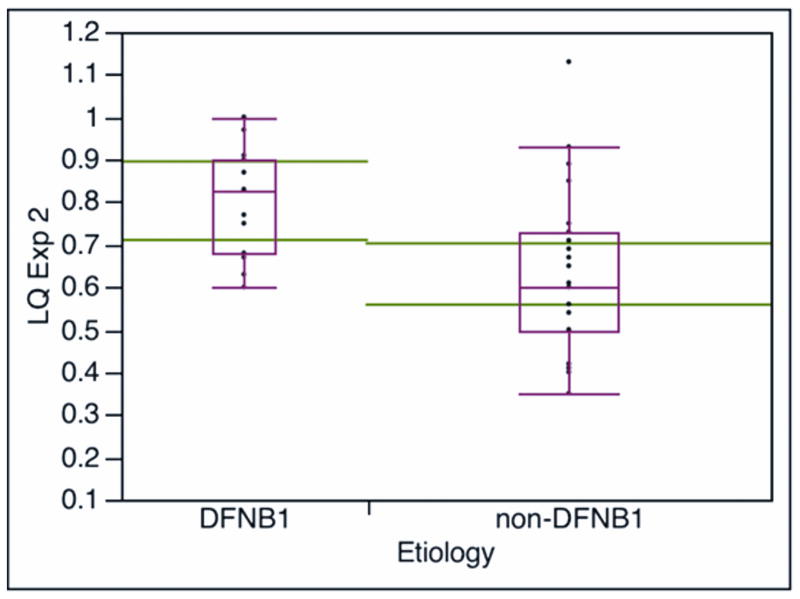
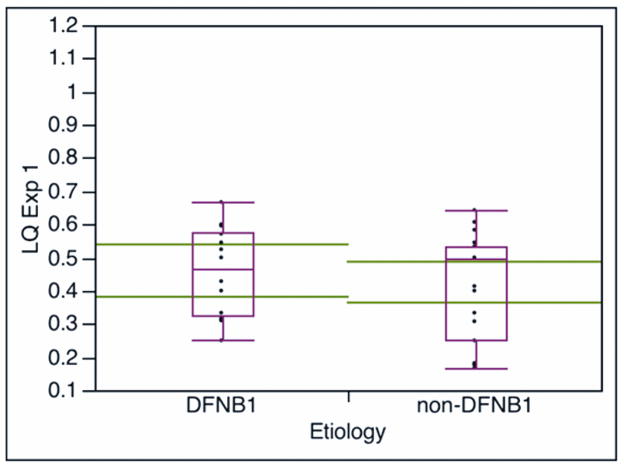
Results: The mean language age at the second time interval (mean ± standard deviation, 51.8 ± 13 mo) was greater than at the first testing session (mean ± standard deviation, 19 ± 8 mo, p < 0.001, Wilcoxon signed rank test). When divided by genotype, DFNB1 children exhibited a higher LQ and less variability in scores than non-DFNB1 children at the second testing interval (Wilcoxon sign rank test, p = 0.0034). A regression analysis (linear-fit by least squares) conducted on 26 children with preimplantation audiometric data showed that DFNB1 status was the independent variable with greater predictive effect on LQ at the second testing interval, followed by age at implantation (R2 = 0.35, p = 0.0479).
Conclusion: Deaf children who received cochlear implants before the age of 5 years and use oral communication show substantial improvement in language abilities. In this study, DFNB1 children who use cochlear implants show greater gains in expressive language than non-DFNB1 children, independent of residual hearing, age at implantation, and duration of implant use.
Figures
References
-
- Moog J, Geers A. EPIC: A program to accelerate academic progress in profoundly hearing-impaired children. Volta Review. 1985;87:259–77.
-
- Svirsky MA, Teoh SW, Neuburger H. Development of language and speech perception in congenitally, profoundly deaf children as a function of age at cochlear implantation. Audiol Neurotol. 2004;9(4):224–33. - PubMed
-
- Geers AE. Factors influencing spoken language outcomes in children following early cochlear implantation. Adv Otorhinolaryngol. 2006;64:50–65. - PubMed
MeSH terms
Substances
Grants and funding
LinkOut - more resources
Full Text Sources
Other Literature Sources
Medical
