. 2011 Nov;29(11):1886-97.
doi: 10.1002/stem.746.

Rho GTPases mediate the mechanosensitive lineage commitment of neural stem cells

Affiliations

Rho GTPases mediate the mechanosensitive lineage commitment of neural stem cells

Albert J Keung et al. Stem Cells. 2011 Nov.

Abstract

Adult neural stem cells (NSCs) play important roles in learning and memory and are negatively impacted by neurological disease. It is known that biochemical and genetic factors regulate self-renewal and differentiation, and it has recently been suggested that mechanical and solid-state cues, such as extracellular matrix (ECM) stiffness, can also regulate the functions of NSCs and other stem cell types. However, relatively little is known of the molecular mechanisms through which stem cells transduce mechanical inputs into fate decisions, the extent to which mechanical inputs instruct fate decisions versus select for or against lineage-committed blast populations, or the in vivo relevance of mechanotransductive signaling molecules in native stem cell niches. Here we demonstrate that ECM-derived mechanical signals act through Rho GTPases to activate the cellular contractility machinery in a key early window during differentiation to regulate NSC lineage commitment. Furthermore, culturing NSCs on increasingly stiff ECMs enhances RhoA and Cdc42 activation, increases NSC stiffness, and suppresses neurogenesis. Likewise, inhibiting RhoA and Cdc42 or downstream regulators of cellular contractility rescues NSCs from stiff matrix- and Rho GTPase-induced neurosuppression. Importantly, Rho GTPase expression and ECM stiffness do not alter proliferation or apoptosis rates indicating that an instructive rather than selective mechanism modulates lineage distributions. Finally, in the adult brain, RhoA activation in hippocampal progenitors suppresses neurogenesis, analogous to its effect in vitro. These results establish Rho GTPase-based mechanotransduction and cellular stiffness as biophysical regulators of NSC fate in vitro and RhoA as an important regulatory protein in the hippocampal stem cell niche.


Conflict of interest statement

DISCLOSURE OF POTENTIAL CONFLICTS OF INTEREST

The authors indicate no potential conflicts of interest.

Figures
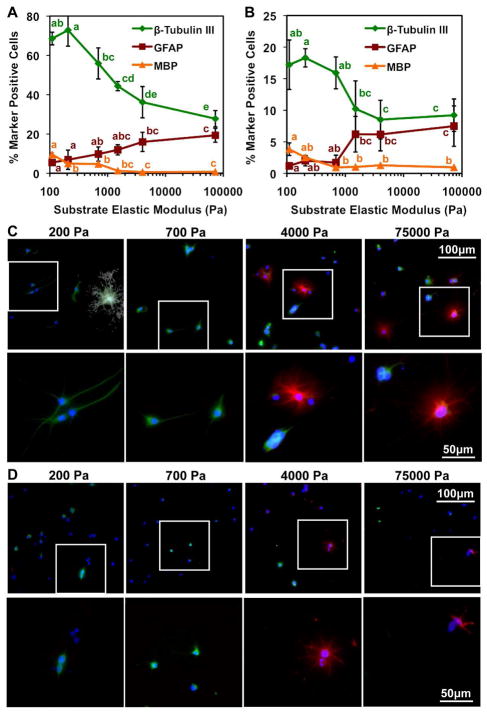
Figure 1
Figure 1
ECM elastic modulus biases relative proportions of neurons versus astrocytes. (A)(C) mixed and (B)(D) survival conditions. Error bars are 95% confidence intervals, n = 6. Means compared by analysis of variance, Tukey-Kramer post hoc (ANOVA-TK), p < 0.05. (C)(D) Neurons, β-tubulin III (green); astrocytes, GFAP (red); nuclei, DAPI (blue); oligodendrocytes, MBP (white). Insets (white boxes) are shown in bottom rows.
Figure 2
Figure 2
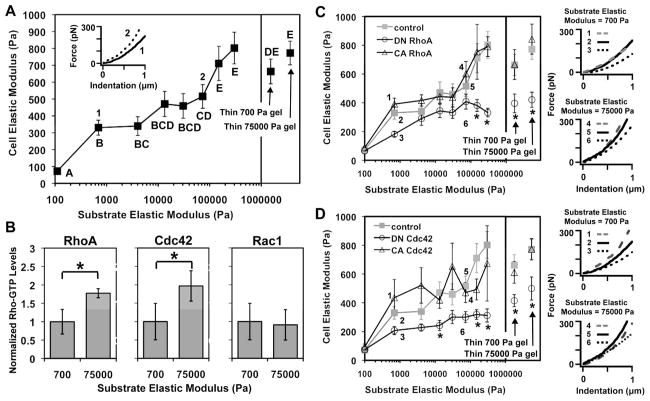
NSCs are mechanically and biochemically responsive to ECM stiffness through Rho GTPase activity. (A)(C)(D) NSC stiffnesses measured by AFM. Error bars are 95% confidence intervals for n = 14–50 cells. Means compared by ANOVA-TK, p < 0.05. (Insets) Representative AFM force-indentation curves for NSCs. (B) Rho-GTP levels of NSCs normalized to the soft gel (700 Pa) value. *p < 0.05, Student’s unpaired two-tailed t-test.
Figure 3
Figure 3
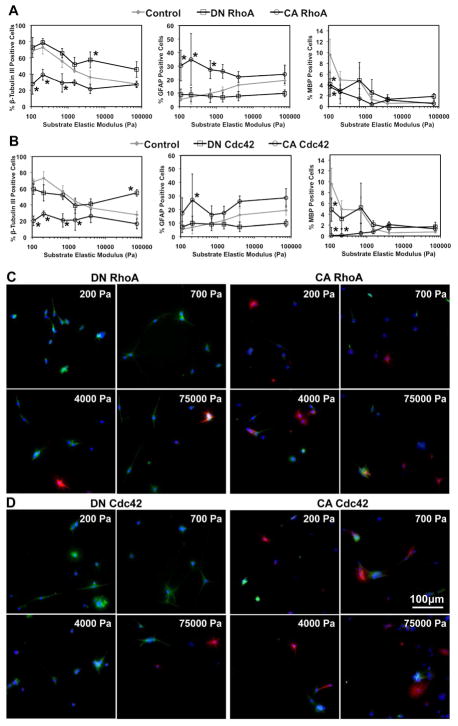
Rho GTPases modulate the effect of ECM elastic modulus on the proportions of neurons and astrocytes in mixed conditions. Error bars are 95% confidence intervals, n = 5–6. *p < 0.05 for comparisons to control for each substrate elastic modulus (control data previously shown in Figure 1A) (ANOVA-TK). β-tubulin III (green), GFAP (red), DAPI (blue), MBP (white). See Figure S4 for higher power images of (C) and (D).
Figure 4
Figure 4
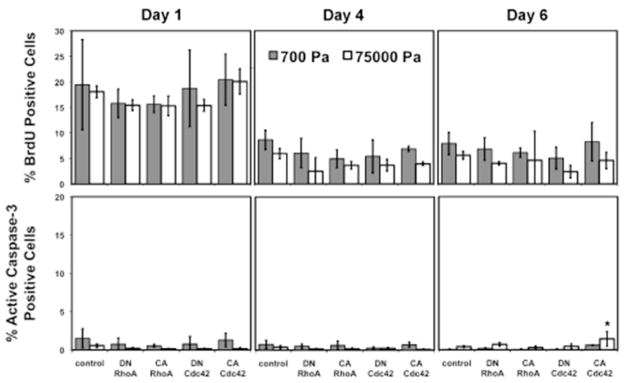
Rho GTPases and ECM stiffness do not affect proliferation and apoptosis rates during differentiation. Error bars are 95% confidence intervals, n = 3–6. *p < 0.05 for comparisons to control for each substrate elastic modulus for each day (ANOVA-TK).
Figure 5
Figure 5
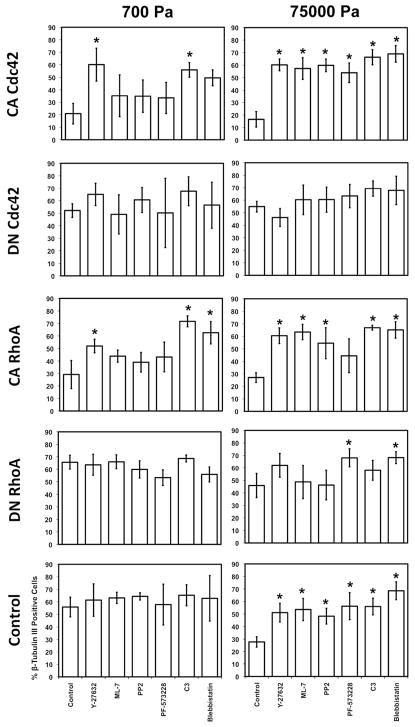
Inhibition of proteins that regulate cellular contractility rescues neuronal differentiation in mixed conditions on soft and stiff ECMs. Error bars are 95% confidence intervals, n = 5–6. *p < 0.05 for comparisons to NSCs in control media conditions expressing the same Rho GTPase mutant and on the same stiffness (control data previously shown in Figure 1A) (ANOVA-TK).
Figure 6
Figure 6
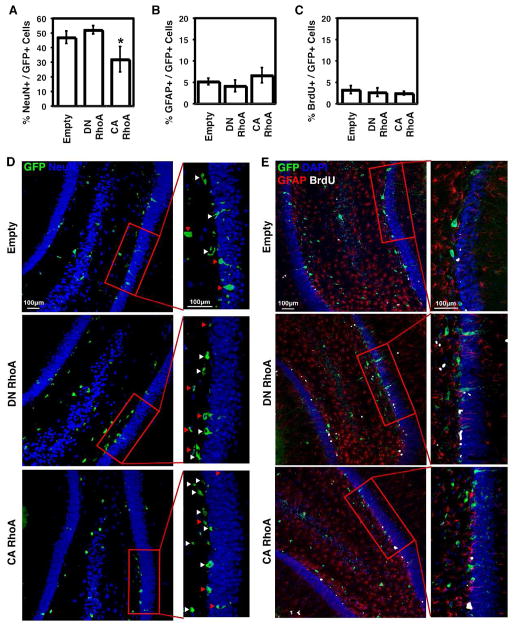
RhoA suppresses neurogenesis in vivo in the adult rat hippocampus. Error bars are 95% confidence intervals, n = 4 rats. *p < 0.05 for comparison to empty vector control (ANOVA-TK). Red arrows indicate cells double positive for GFP and NeuN. White arrows indicate cells positive for GFP only.

References

    1. Palmer TD, Takahashi J, Gage FH. The Adult Rat Hippocampus Contains Primordial Neural Stem Cells. Molecular and Cellular Neuroscience. 1997;8(6):389–404. - PubMed
    1. Suh H, et al. In Vivo Fate Analysis Reveals the Multipotent and Self-Renewal Capacities of Sox2+ Neural Stem Cells in the Adult Hippocampus. Cell Stem Cell. 2007;1(5):515–528. - PMC - PubMed
    1. Balu DT, Lucki I. Adult hippocampal neurogenesis: Regulation, functional implications, and contribution to disease pathology. Neuroscience & Biobehavioral Reviews. 2009;33(3):232–252. - PMC - PubMed
    1. Blurton-Jones M, et al. Neural stem cells improve cognition via BDNF in a transgenic model of Alzheimer disease. Proceedings of the National Academy of Sciences. 2009 - PMC - PubMed
    1. Sahay A, et al. Increasing adult hippocampal neurogenesis is sufficient to improve pattern separation. Nature. 2011 advance online publication. - PMC - PubMed

Publication types

MeSH terms

Substances