


Review
doi: 10.1002/wrna.77.
Epub 2011 Feb 18.
Functions and mechanisms of spliceosomal small nuclear RNA pseudouridylation
Affiliations
- PMID: 21957045
- PMCID: PMC4161978
- DOI: 10.1002/wrna.77
Item in Clipboard
Review
Functions and mechanisms of spliceosomal small nuclear RNA pseudouridylation
Wiley Interdiscip Rev RNA.
2011 Jul-Aug.
Abstract
Pseudouridines are the most abundant and highly conserved modified nucleotides identified in spliceosomal small nuclear RNAs (snRNAs). Most pseudouridines are also clustered in functionally important regions of spliceosomal snRNAs. Experiments carried out in several independent experimental systems show that the pseudouridines in spliceosomal snRNAs are functionally important for pre-messenger RNA (mRNA) splicing. Experimental data also indicate that spliceosomal snRNA pseudouridylation can be catalyzed by both RNA-dependent (box H/ACA Ribonucleoproteins) and RNA-independent (protein-only enzymes) mechanisms.
Copyright © 2011 John Wiley & Sons, Ltd.
Figures

Isomerization of uridine into pseudouridine. The reaction begins with the breakage of the glycosidic bond (N1–C1′) between the base and the sugar ring. The base is then rotated 180° along the C6–N3 axis, leading to the formation of a new bond (C5–C1′) linking the base to the sugar. a, hydrogen bond acceptor; d, hydrogen bond donor.

Primary sequences and secondary structures of spliceosomal small nuclear RNAs (snRNAs). Shown are five complete vertebrate spliceosomal snRNA sequences and structures (U1, U2, U4, U5, and U6). The 5′ cap and the internal pseudouridines (boxed) are also shown. Some regions in U1, U2, U5 (loop), and U6 (ΨACAGAG), which are important for splicing, are indicated by the thick lines immediately above or below the sequences. U1 5′ end, 5′ end region of U1; U2 BSRR, branch site recognition region of U2; U5 loop, loop region of U5; U6 (Ψ)ACAGAGA, a U6 region believed to be part of the catalytic center of the spliceosome. The sequences of the 5′ end region of yeast U1, the BSRR of yeast U2, and the loop region of yeast U5 are also shown.
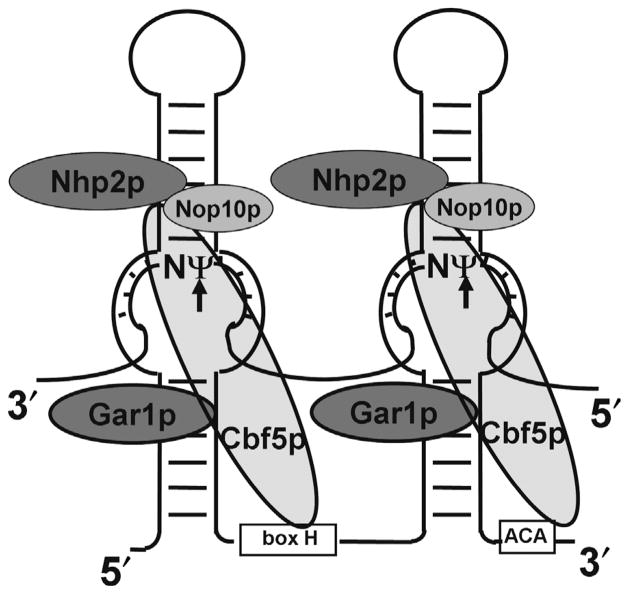
Schematic representation of eukaryotic box H/ACA RNP. The core components of a box H/ACA RNP, including a box H/ACA RNA, and four proteins (Nhp2p, Cbf5p, Gar1p, and Nop10p), are shown. Also shown is an RNA substrate paired with the two internal loops of the box H/ACA RNA. The arrows indicate the target nucleotides for pseudouridylation. The H box and ACA box of the box H/ACA RNA are indicated.

Pseudouridylation of U2 small nuclear RNA (snRNA) and 25S ribosomal rRNA (rRNA) by snR81 box H/ACA RNP. The sequence and structure of snR81 box H/ACA RNA are shown. The H box and ACA box are indicated (shaded boxes). As depicted by arrows, the internal loop (pseudouridylation pocket) within the 5′ stem of snR81 RNA is specific for Ψ42 of U2, and the internal loop within the 3′ stem is specific for Ψ1051 of 25S rRNA. The base-pairing interactions between the snR81 internal loops and the substrate sequences (U2 and 25S rRNA) are also shown.
References
-
- Cohn WE, Volkin W. Nucleoside-5′-phosphates from ribonucleic acid. Nature (London) 1951;167:483–484.
-
- Davis FF, Allen FW. Ribonucleic acids from yeast which contain a fifth nucleotide. J Biol Chem. 1957;227:907–915. - PubMed
-
- Lane BG. Historical perspectives on RNA nucleoside modifications. In: Grosjean H, Benne R, editors. Modification and Editing of RNA. Washington, DC: ASM Press; 1998. pp. 1–20.
-
- Arnez JG, Steitz TA. Crystal structure of unmodified tRNA(Gln) complexed with glutaminyl-tRNA synthetase and ATP suggests a possible role for pseudouridines in stabilization of RNA structure. Biochemistry. 1994;33:7560–7567. - PubMed
Publication types
MeSH terms
Substances
Grants and funding
LinkOut - more resources
Full Text Sources
Molecular Biology Databases
