


Titanocene-phosphine derivatives as precursors to cytotoxic heterometallic TiAu2 and TiM (M = Pd, Pt) compounds. Studies of their interactions with DNA
- PMID: 21958150
- PMCID: PMC3205237
- DOI: 10.1021/ic201647h
Titanocene-phosphine derivatives as precursors to cytotoxic heterometallic TiAu2 and TiM (M = Pd, Pt) compounds. Studies of their interactions with DNA
Abstract
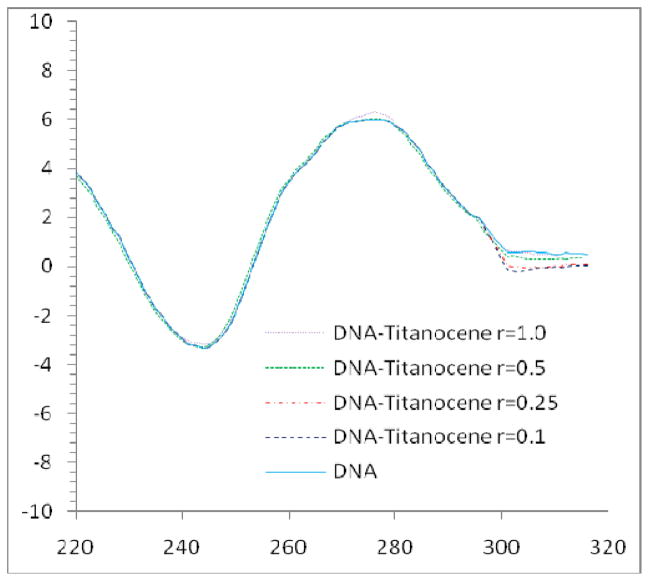
A series of tri- and bimetallic titanium-gold, titanium-palladium, and titanium-platinum derivatives of the general formulas [Ti{η(5)-C(5)H(4)(CH(2))(n)PPh(2)(AuCl)}(2)]·2THF [n = 0 (1); n = 2 (2); n = 3 (3)] and [TiCl(2){η(5)-C(5)H(4)κ-(CH(2))(n)PPh(2)}(2)(MCl(2))]·2THF [M = Pd, n = 0 (4); n = 2 (5); n = 3 (6) ; M = Pt, n = 0 (7); n = 2 (8); n = 3 (9)] have been synthesized and characterized by different spectroscopic techniques and mass spectrometry. The molecular structures of compounds 1-9 have been investigated by means of density functional theory calculations. The calculated IR spectra of the optimized structures fit well with the experimental IR data obtained for 1-9. The stability of the heterometallic compounds in deuterated solvents [CDCl(3), dimethyl sulfoxide (DMSO)-d(6), and mixtures 50:50 DMSO-d(6)/D(2)O and 1:99 DMSO-d(6)/D(2)O at acidic and neutral pH] has been evaluated by (31)P and (1)H NMR spectroscopy showing a higher stability for these compounds than for Cp(2)TiCl(2) or precursors [Ti{η(5)-C(5)H(4)(CH(2))(n)PPh(2)}(2)]. The new compounds display a lower acidity (1-2 units) than Cp(2)TiCl(2). The decomposition products have been identified over time. Complexes 1-9 have been tested as potential anticancer agents, and their cytotoxicity properties were evaluated in vitro against HeLa human cervical carcinoma and DU-145 human prostate cancer cells. TiAu(2) and TiPd compounds were highly cytotoxic for these two cell lines. The interactions of the compounds with calf thymus DNA have been evaluated by thermal denaturation (1-9) and by circular dichroism (1, 3, 4, and 7) spectroscopic methods. All of these complexes show a stronger interaction with DNA than that displayed by Cp(2)TiCl(2) at neutral pH. The data are consistent with electrostatic interactions with DNA for TiAu(2) compounds and for a covalent binding mode for TiM (M = Pd, Pt) complexes.
© 2011 American Chemical Society
Figures




References
-
-
Harding MM, Mokdsi G. Current Med Chem. 2000;7:1289.and refs. therein.
-
-
- Köpf-Maier P, Köpf H. Angew Chem, Int Ed Engl. 1979;18:477. - PubMed
-
- Berdel WE, Schmoll, Scheulen ME, Korfel A, Knoche MF, Harstrick A, Bach F, Saβ G. J Cancer Res Clin Oncol. 1994;120(Suppl):R172.
-
-
Abeysinghe PM, Harding MM. Dalton Trans. 2007:3474.and refs. therein.
-
-
-
Olszewski U, Hamilton G. Anti-Cancer Agents in Med Chem. 2010;10:320.and refs. therein.
-
Publication types
MeSH terms
Substances
Grants and funding
LinkOut - more resources
Full Text Sources
Other Literature Sources
Miscellaneous
