


Racial, ethnic, and insurance status disparities in use of posthospitalization care after trauma
- PMID: 21958511
- PMCID: PMC3684147
- DOI: 10.1016/j.jamcollsurg.2011.08.017
Racial, ethnic, and insurance status disparities in use of posthospitalization care after trauma
Abstract
Background: Posthospitalization care is important for recovery after trauma. Disadvantaged populations, like racial or ethnic minorities and the uninsured, make up substantial percentages of trauma patients, but their use of posthospitalization facilities is unknown.
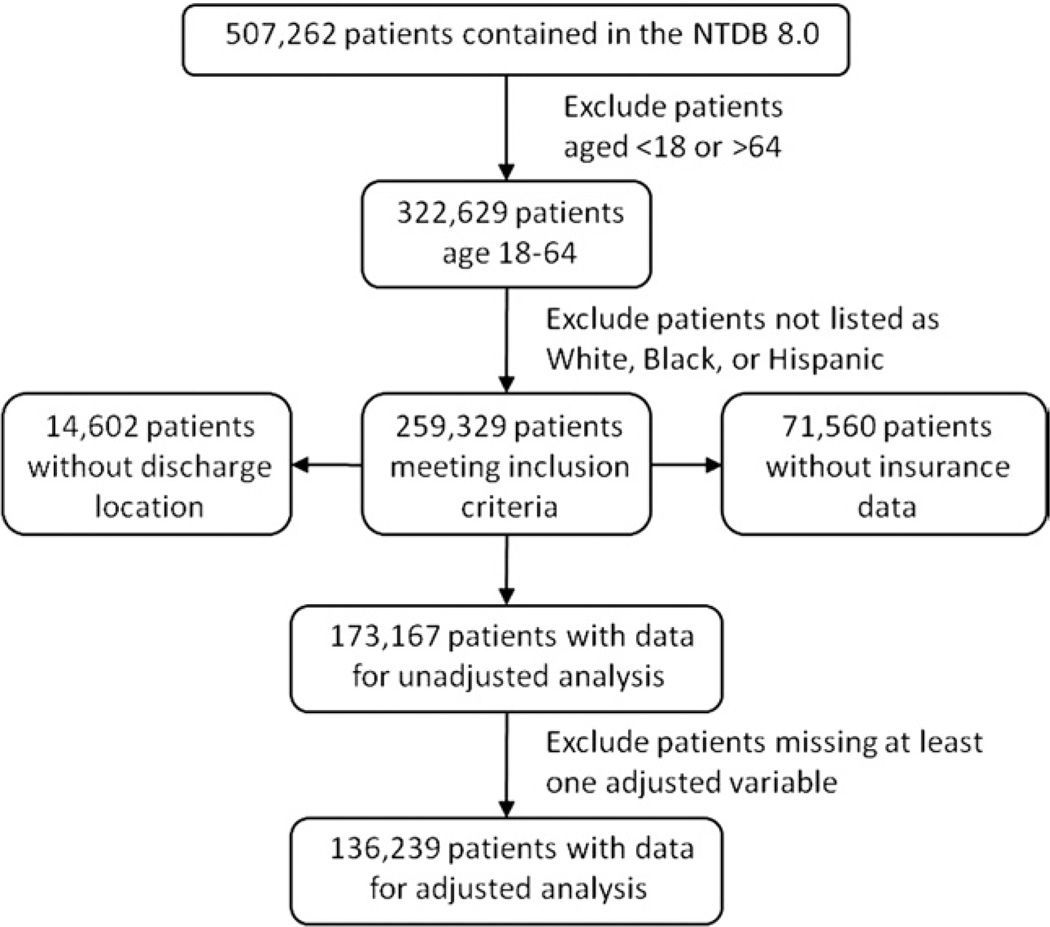
Study design: This study analyzed National Trauma Data Bank admissions from 2007 for 18- to 64-year-olds and estimated relative risk ratios (RRR) of discharge to posthospitalization facilities--home, home health, rehabilitation, or nursing facility--by race, ethnicity, and insurance. Multinomial logistic regression adjusted for patient characteristics including age, sex, Injury Severity Score, mechanism of injury, and length of stay, among others.
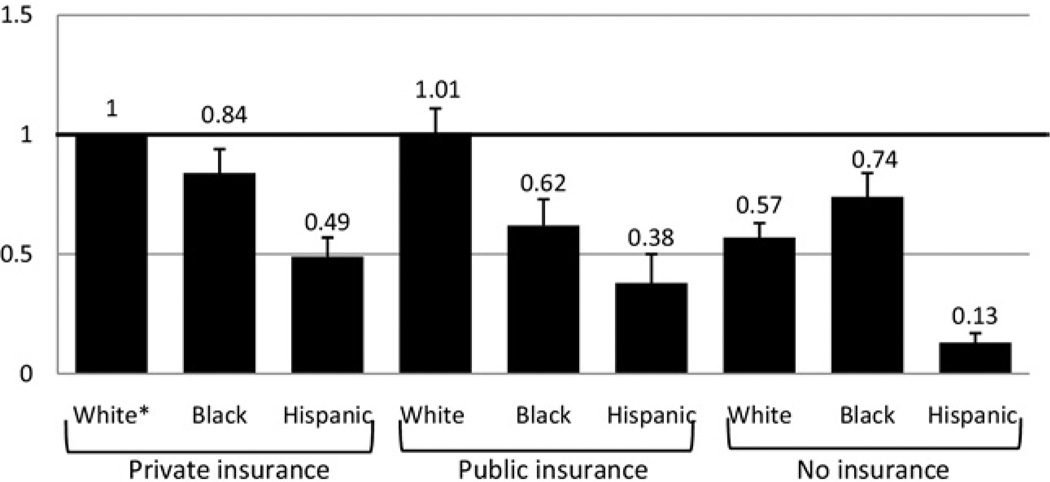
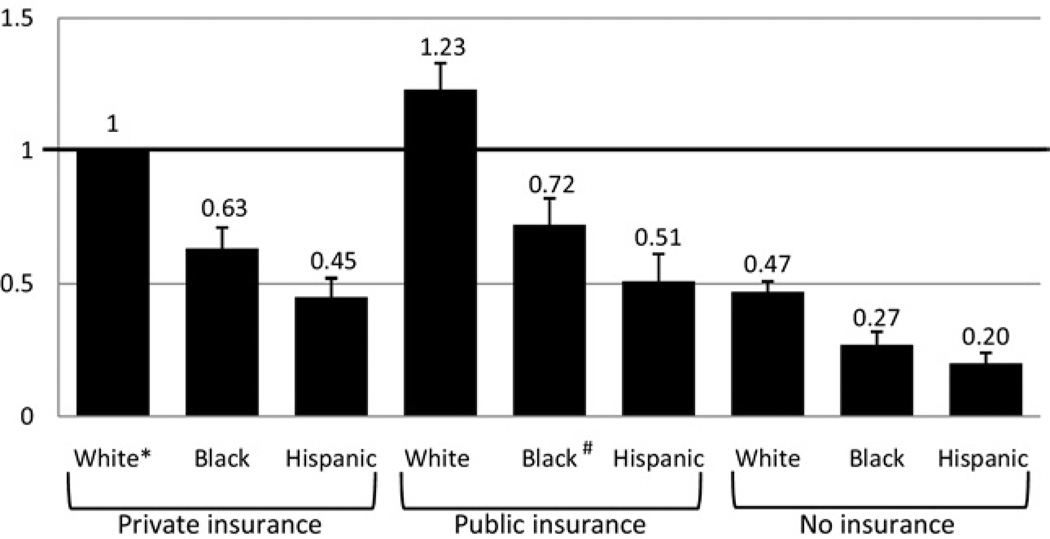
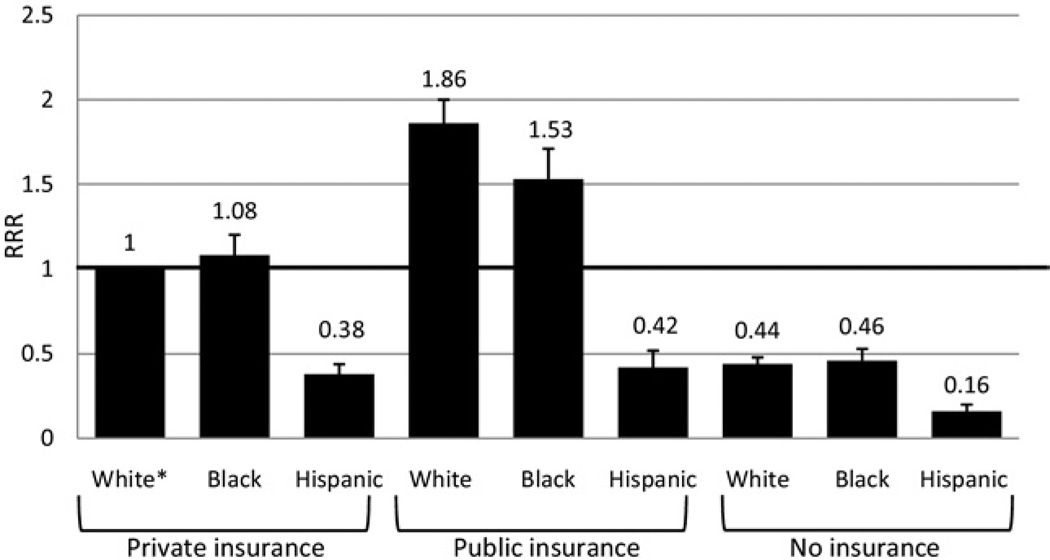
Results: There were 136,239 patients who met inclusion criteria with data for analysis. Most patients were discharged home (78.9%); fewer went to home health (3.3%), rehabilitation (5.0%), and nursing facilities (5.4%). When compared with white patients in adjusted analysis, relative risk ratios of discharge to rehabilitation were 0.61 (95% CI 0.56, 0.66) and 0.44 (95% CI 0.40, 0.49) for blacks and Hispanics, respectively. Compared with privately insured white patients, Hispanics had lower rates of discharge to rehabilitation whether privately insured (RRR 0.45, 95% CI 0.40, 0.52), publicly insured (RRR 0.51, 95% CI 0.42, 0.61), or uninsured (RRR 0.20, 95% CI 0.17, 0.24). Black patients had similarly low rates: private (RRR 0.63, 95% CI 0.56, 0.71), public (RRR 0.72, 95% CI 0.63, 0.82), or uninsured (RRR 0.27, 95% CI 0.23, 0.32). Relative risk ratios of discharge to home health or nursing facilities showed similar trends among blacks and Hispanics regardless of insurance, except for black patients with insurance whose discharge to nursing facilities was similar to their white counterparts.
Conclusions: Disadvantaged populations have more limited use of posthospitalization care such as rehabilitation after trauma, suggesting a potential improvement in trauma care for the underprivileged.
Copyright © 2011. Published by Elsevier Inc.
Figures
References
-
- MacKenzie EJ. Epidemiology of injuries: Current trends and future challenges. Epidemiol Rev. 2000;22:112–119. - PubMed
-
- Holbrook TL, Anderson JP, Sieber WJ, et al. Outcome after major trauma: 12-month and 18-month follow-up results from the trauma recovery project. J Trauma. 1999;46:765–771. discussion 771–773. - PubMed
-
- Agency for Healthcare Research and Quality. Rockville, MD: Agency for Healthcare Quality and Research; 2008. National healthcare disparities report.
-
- Fiscella K, Franks P, Gold MR, Clancy CM. Inequality in quality: Addressing socioeconomic, racial, and ethnic disparities in health care. JAMA. 2000;283:2579–2584. - PubMed
-
- Marquez de la Plata C, Hewlitt M, de Oliveira A, et al. Ethnic differences in rehabilitation placement and outcome after TBI. J Head Trauma Rehabil. 2007;22:113–121. - PubMed
Publication types
MeSH terms
Grants and funding
LinkOut - more resources
Full Text Sources
Medical
Miscellaneous
