Review
. 2012 Jan;19(1):42-50.
doi: 10.1038/cdd.2011.121. Epub 2011 Sep 30.

Fas death receptor signalling: roles of Bid and XIAP

Affiliations
Review

Fas death receptor signalling: roles of Bid and XIAP

T Kaufmann et al. Cell Death Differ. 2012 Jan.

Abstract

Fas (also called CD95 or APO-1), a member of a subgroup of the tumour necrosis factor receptor superfamily that contain an intracellular death domain, can initiate apoptosis signalling and has a critical role in the regulation of the immune system. Fas-induced apoptosis requires recruitment and activation of the initiator caspase, caspase-8 (in humans also caspase-10), within the death-inducing signalling complex. In so-called type 1 cells, proteolytic activation of effector caspases (-3 and -7) by caspase-8 suffices for efficient apoptosis induction. In so-called type 2 cells, however, killing requires amplification of the caspase cascade. This can be achieved through caspase-8-mediated proteolytic activation of the pro-apoptotic Bcl-2 homology domain (BH)3-only protein BH3-interacting domain death agonist (Bid), which then causes mitochondrial outer membrane permeabilisation. This in turn leads to mitochondrial release of apoptogenic proteins, such as cytochrome c and, pertinent for Fas death receptor (DR)-induced apoptosis, Smac/DIABLO (second mitochondria-derived activator of caspase/direct IAP binding protein with low Pi), an antagonist of X-linked inhibitor of apoptosis (XIAP), which imposes a brake on effector caspases. In this review, written in honour of Juerg Tschopp who contributed so much to research on cell death and immunology, we discuss the functions of Bid and XIAP in the control of Fas DR-induced apoptosis signalling, and we speculate on how this knowledge could be exploited to develop novel regimes for treatment of cancer.


Figures
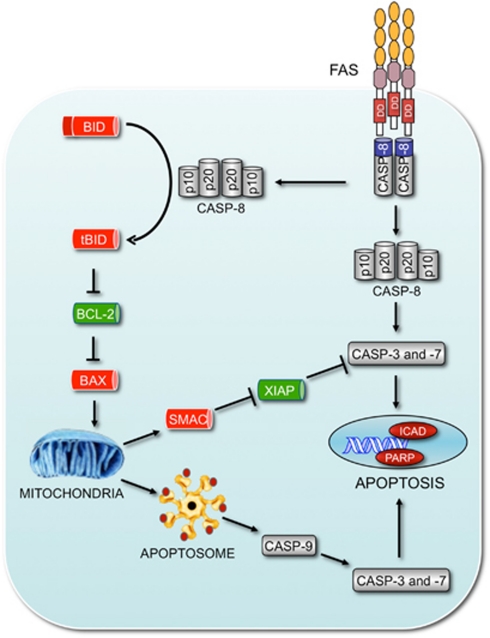
Figure 1
Figure 1
Fas-induced apoptotic signalling pathway. Whereas in the so-called type 1 cells (e.g. thymocytes, resting T lymphocytes), activation of Fas rapidly proceeds from caspase-8 activation to effector caspases (-3 and -7) activation and cell demolition, this direct pathway is relatively ineffective in type 2 cells (e.g. hepatocytes, pancreatic β-cells). In the latter, Fas-induced apoptosis requires caspase-8-mediated proteolytic processing of Bid into tBid, which transmits the apoptotic signal to the Bcl-2-regulated apoptotic pathway, activating Bax/Bak, thereby triggering MOMP with release of apoptogenic proteins. These include cytochrome c, required for apoptosome formation and caspase-9 activation, as well as Smac/DIABLO, an antagonist of XIAP. XIAP is a potent inhibitor of active effector caspases, and thus constitutes an important attenuator of Fas-induced apoptosis signalling in type 2 cells
Figure 2
Figure 2
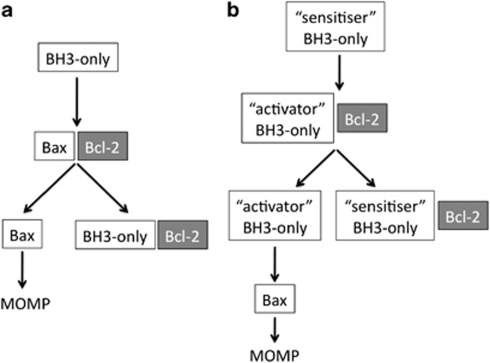
Models of how BH3-only proteins lead to Bax/Bak-activation. (a) In the indirect model, anti-apoptotic Bcl-2 family members neutralise (repress) Bax and Bak by direct interaction in healthy cells. Upon an apoptotic stimulus, one or several subsets of BH3-only proteins become activated and compete with Bax-like proteins for the binding pocket on Bcl-2-like proteins, thereby derepressing Bax and/or Bak. (b) In the direct model, BH3-only proteins are divided into two subgroups: direct activators, including Bid and Bim (and possibly also Puma), which, besides neutralising Bcl-2-like proteins, can also directly activate Bax and/or Bak, and sensitisers, including Bad, Noxa, Harakiri, Bik and Bmf, which act only by neutralising Bcl-2-like proteins. The sensitisers thus act by lowering the threshold for Bax/Bak activation through activator BH3-only proteins. If the activators are already bound to Bcl-2-like proteins in healthy cells, sensitiser BH3-only proteins act as derepressors for activator BH3-only proteins
Figure 3
Figure 3
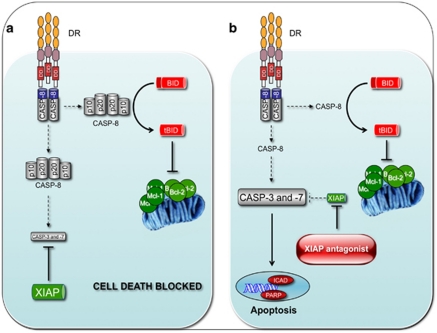
Sensitisation of type 2 cancer cells towards DR-induced killing by synthetic IAP antagonists. (a) This image represents a type-2 cancer cell that, through overexpression of anti-apoptotic Bcl-2 proteins (e.g. Bcl-2 or Mcl-1) and/or XIAP, has become highly resistant towards FasL- or TRAIL-induced apoptosis. (b) Addition of an IAP-antagonistic small molecular Smac-mimetic, ideally an XIAP-selective inhibitor to minimise side effects, uncouples the DR-induced apoptotic pathway from its mandatory crosstalk to the mitochondrial apoptotic pathway, thereby sensitising the cancer cells towards FasL-, TRAIL- or TNF-induced killing. Combination therapy with additional standard chemotherapeutic drugs, or direct targeting of anti-apoptotic Bcl-2 proteins by BH3 mimetics, thereby triggering MOMP, might further sensitise the cancer cell to undergo apoptosis

References

    1. Aggarwal BB. Signalling pathways of the TNF superfamily: a double-edged sword. Nat Rev Immunol. 2003;3:745–756. - PubMed
    1. Strasser A, Jost PJ, Nagata S. The many roles of FAS receptor signaling in the immune system. Immunity. 2009;30:180–192. - PMC - PubMed
    1. Holler N, Zaru R, Micheau O, Thome M, Attinger A, Valitutti S, et al. Fas triggers an alternative, caspase-8-independent cell death pathway using the kinase RIP as effector molecule. Nat Immunol. 2000;1:489–495. - PubMed
    1. Vanden Berghe T, van Loo G, Saelens X, Van Gurp M, Brouckaert G, Kalai M, et al. Differential signaling to apoptotic and necrotic cell death by Fas-associated death domain protein FADD. J Biol Chem. 2004;279:7925–7933. - PubMed
    1. Geserick P, Hupe M, Moulin M, Wong WW, Feoktistova M, Kellert B, et al. Cellular IAPs inhibit a cryptic CD95-induced cell death by limiting RIP1 kinase recruitment. J Cell Biol. 2009;187:1037–1054. - PMC - PubMed

Publication types

MeSH terms