


Depot naltrexone decreases rewarding properties of sugar in patients with opioid dependence
- PMID: 21960180
- PMCID: PMC3302938
- DOI: 10.1007/s00213-011-2503-1
Depot naltrexone decreases rewarding properties of sugar in patients with opioid dependence
Abstract
Background: Opioid neurotransmission mediates hedonic value of sweet tastants; their intake may be exaggerated by the consumption of exogenous opioids (e.g., opioid dependence). Sweet Taste Test (STT) is a validated quantitative instrument assessing taste perception and hedonic features of sugar (sucrose) using a randomized and double-blind administration at five different sucrose concentrations ranging from 0.05 to 0.83 M.
Methods: The STT and cue-induced craving procedure were administered to opioid-dependent patients (n = 15) before and 1 week after the injection of a long-acting depot naltrexone (XRNT) preparation.
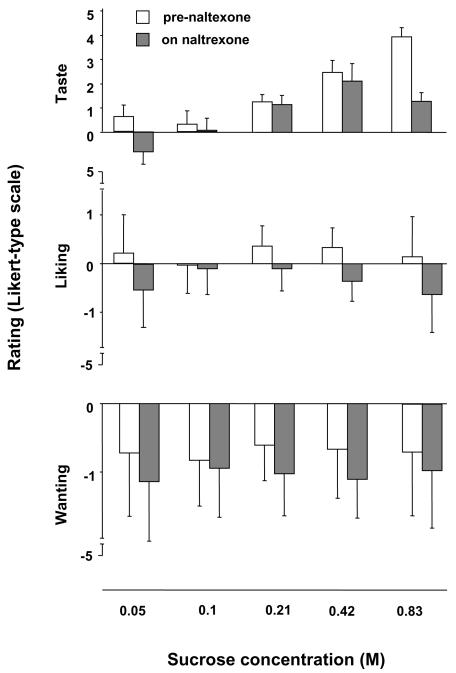
Results: Analyses of covariance, employing sucrose concentration and its perceived taste as covariates, showed that XRNT therapy significantly reduced the self-reported hedonic and motivational characteristics of sucrose. Greater reductions in both these characteristics were associated with more diminution in the cue-induced opioid craving.
Conclusions: Opioid antagonism in opioid-dependent subjects leads to a smaller sweet taste reward, which, in turn, may be proportional to decreased opioid craving. These pilot results support the heuristic value of the STT as a potential marker of the XRNT treatment response and call for further inquiry into potential clinical applications of the test.
Figures
References
-
- Arbisi PA, Billington CJ, Levine AS. The effect of naltrexone on taste detection and recognition threshold. Appetite. 1999;32:241–9. - PubMed
-
- Berridge KC. The debate over dopamine’s role in reward: the case for incentive salience. Psychopharmacology (Berl) 2007;191:391–431. - PubMed
-
- Berridge KC, Robinson TE. Parsing reward. Trends in Neurosciences. 2003;26:507–13. - PubMed
-
- Berthoud HR. Neural systems controlling food intake and energy balance in the modern world. Current Opinion in Clinical Nutrition and Metabolic Care. 2003;6:615–20. - PubMed
Publication types
MeSH terms
Substances
Grants and funding
LinkOut - more resources
Full Text Sources
Other Literature Sources
Medical
Miscellaneous
