


Phenobarbital and temperature profile during hypothermia for hypoxic-ischemic encephalopathy
- PMID: 21960671
- PMCID: PMC3530920
- DOI: 10.1177/0883073811419317
Phenobarbital and temperature profile during hypothermia for hypoxic-ischemic encephalopathy
Abstract
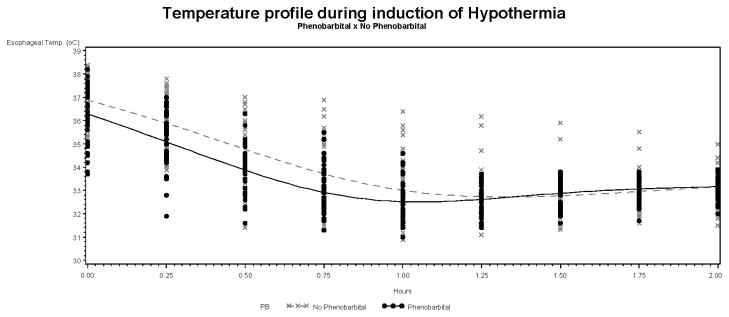
Data from the whole-body hypothermia trial was analyzed to examine the effects of phenobarbital administration prior to cooling (+PB) on the esophageal temperature (T (e)) profile, during the induction phase of hypothermia. A total of 98 infants were analyzed. At enrollment, +PB infants had a higher rate of severe hypoxic-ischemic encephalopathy and clinical seizures and lower T (e) and cord pH than infants that have not received phenobarbital (-PB). There was a significant effect of phenobarbital itself and an interaction between phenobarbital and time in the T (e) profile. Mean T (e) in the +PB group was lower than in the -PB group, and the differences decreased over time. In +PB infants, the time to surpass target T (e) of 33.5°C and to reach the minimum T (e) during overshoot were shorter. In conclusion, the administration of phenobarbital before cooling was associated with changes that may reflect a reduced thermogenic response associated with barbiturates.
Conflict of interest statement
Authors disclose no commercial, financial, or other associations that could pose a conflict of interest in connection with the submitted article.
Figures
References
-
- Gluckman PD, Wyatt JS, Azzopardi D, et al. Selective head cooling with mild systemic hypothermia after neonatal encephalopathy: multicentre randomised trial. Lancet. 2005;365(9460):663–670. - PubMed
-
- Shankaran S, Laptook AR, Ehrenkranz RA, et al. Whole-body hypothermia for neonates with hypoxic-ischemic encephalopathy. N Engl J Med. 2005;353(15):1574–1584. - PubMed
-
- Azzopardi DV, Strohm B, Edwards AD, et al. Moderate hypothermia to treat perinatal asphyxial encephalopathy. N Engl J Med. 2009;361(14):1349–1358. - PubMed
-
- Zhou WH, Cheng GQ, Shao XM, et al. Selective head cooling with mild systemic hypothermia after neonatal hypoxic-ischemic encephalopathy: a multicenter randomized controlled trial in china. J Pediatr. 2010;157(3):367–372. 372. - PubMed
-
- Simbruner G, Mittal RA, Rohlmann F, Muche R. Systemic Hypothermia After Neonatal Encephalopathy: Outcomes of neo. nEURO. network RCT. Pediatrics. 2010 - PubMed
Publication types
MeSH terms
Substances
Grants and funding
- U10 HD021385/HD/NICHD NIH HHS/United States
- U01 HD036790/HD/NICHD NIH HHS/United States
- U10 HD021364/HD/NICHD NIH HHS/United States
- M01 RR000039/RR/NCRR NIH HHS/United States
- M01 RR008084/RR/NCRR NIH HHS/United States
- UG1 HD034216/HD/NICHD NIH HHS/United States
- U10 HD027851/HD/NICHD NIH HHS/United States
- UG1 HD027880/HD/NICHD NIH HHS/United States
- M01 RR000070/RR/NCRR NIH HHS/United States
- U10 HD034216/HD/NICHD NIH HHS/United States
- U10 HD027856/HD/NICHD NIH HHS/United States
- U10 HD021373/HD/NICHD NIH HHS/United States
- U10 HD027880/HD/NICHD NIH HHS/United States
- U10 HD040521/HD/NICHD NIH HHS/United States
- U10 HD040461/HD/NICHD NIH HHS/United States
- M01 RR000044/RR/NCRR NIH HHS/United States
- M01 RR016587/RR/NCRR NIH HHS/United States
- M01 RR000750/RR/NCRR NIH HHS/United States
- U10 HD040689/HD/NICHD NIH HHS/United States
- U10 HD040492/HD/NICHD NIH HHS/United States
- U10 HD027853/HD/NICHD NIH HHS/United States
- U10 HD027904/HD/NICHD NIH HHS/United States
- U10 HD021397/HD/NICHD NIH HHS/United States
- UL1 TR000454/TR/NCATS NIH HHS/United States
- U10 HD027871/HD/NICHD NIH HHS/United States
- U10 HD040498/HD/NICHD NIH HHS/United States
- UG1 HD068278/HD/NICHD NIH HHS/United States
- M01 RR000125/RR/NCRR NIH HHS/United States
- M01 RR006022/RR/NCRR NIH HHS/United States
LinkOut - more resources
Full Text Sources
