


Evaluating complex interventions and health technologies using normalization process theory: development of a simplified approach and web-enabled toolkit
- PMID: 21961827
- PMCID: PMC3205031
- DOI: 10.1186/1472-6963-11-245
Evaluating complex interventions and health technologies using normalization process theory: development of a simplified approach and web-enabled toolkit
Abstract
Background: Normalization Process Theory (NPT) can be used to explain implementation processes in health care relating to new technologies and complex interventions. This paper describes the processes by which we developed a simplified version of NPT for use by clinicians, managers, and policy makers, and which could be embedded in a web-enabled toolkit and on-line users manual.
Methods: Between 2006 and 2010 we undertook four tasks. (i) We presented NPT to potential and actual users in multiple workshops, seminars, and presentations. (ii) Using what we discovered from these meetings, we decided to create a simplified set of statements and explanations expressing core constructs of the theory (iii) We circulated these statements to a criterion sample of 60 researchers, clinicians and others, using SurveyMonkey to collect qualitative textual data about their criticisms of the statements. (iv) We then reconstructed the statements and explanations to meet users' criticisms, embedded them in a web-enabled toolkit, and beta tested this 'in the wild'.
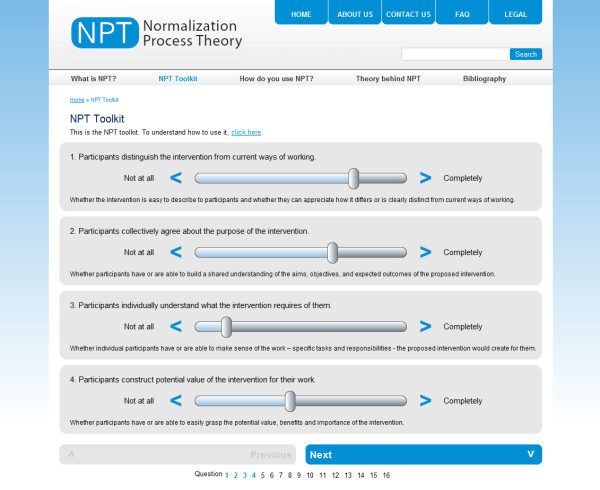
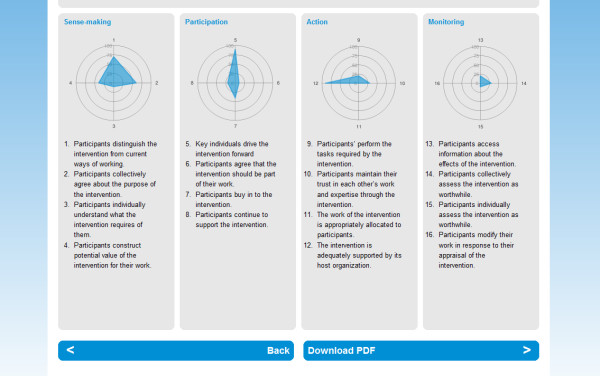
Results: On-line data collection was effective: over a four week period 50/60 participants responded using SurveyMonkey (40/60) or direct phone and email contact (10/60). An additional nine responses were received from people who had been sent the SurveyMonkey form by other respondents. Beta testing of the web enabled toolkit produced 13 responses, from 327 visits to http://www.normalizationprocess.org. Qualitative analysis of both sets of responses showed a high level of support for the statements but also showed that some statements poorly expressed their underlying constructs or overlapped with others. These were rewritten to take account of users' criticisms and then embedded in a web-enabled toolkit. As a result we were able translate the core constructs into a simplified set of statements that could be utilized by non-experts.
Conclusion: Normalization Process Theory has been developed through transparent procedures at each stage of its life. The theory has been shown to be sufficiently robust to merit formal testing. This project has provided a user friendly version of NPT that can be embedded in a web-enabled toolkit and used as a heuristic device to think through implementation and integration problems.
Figures
References
-
- Campbell NC, Murray E, Darbyshire J, Emery J, Farmer A, Griffiths F, Guthrie B, Lester H, Wilson P, Kinmonth AL. Designing and evaluating complex interventions to improve health care. Brit Med J. 2007;334(7591):455–459. doi: 10.1136/bmj.39108.379965.BE. - DOI - PMC - PubMed
-
- Goldthorpe JH. On Sociology: Critique and Program. Stanford: Stanford University Press; 2006.
Publication types
MeSH terms
LinkOut - more resources
Full Text Sources
Medical
Research Materials
