


Evolutionary relationships of the old world fruit bats (Chiroptera, Pteropodidae): another star phylogeny?
- PMID: 21961908
- PMCID: PMC3199269
- DOI: 10.1186/1471-2148-11-281
Evolutionary relationships of the old world fruit bats (Chiroptera, Pteropodidae): another star phylogeny?
Abstract
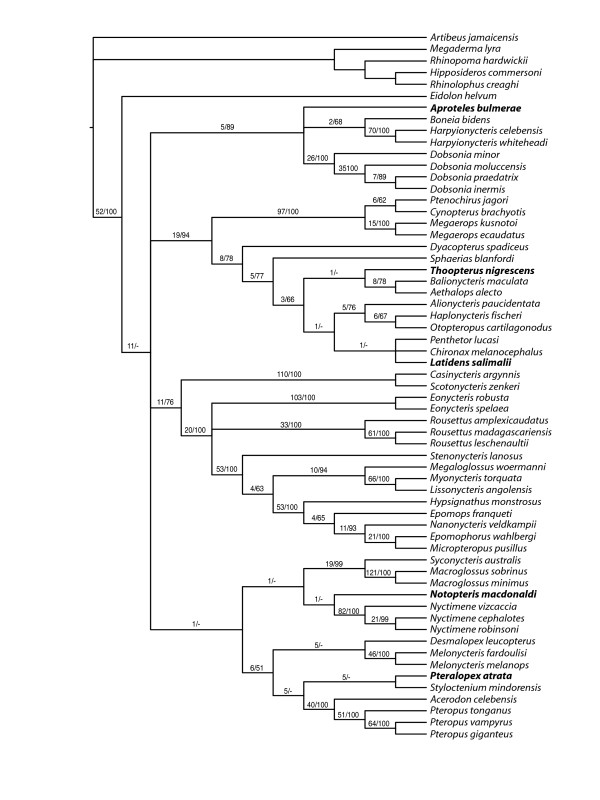
Background: The family Pteropodidae comprises bats commonly known as megabats or Old World fruit bats. Molecular phylogenetic studies of pteropodids have provided considerable insight into intrafamilial relationships, but these studies have included only a fraction of the extant diversity (a maximum of 26 out of the 46 currently recognized genera) and have failed to resolve deep relationships among internal clades. Here we readdress the systematics of pteropodids by applying a strategy to try to resolve ancient relationships within Pteropodidae, while providing further insight into subgroup membership, by 1) increasing the taxonomic sample to 42 genera; 2) increasing the number of characters (to >8,000 bp) and nuclear genomic representation; 3) minimizing missing data; 4) controlling for sequence bias; and 5) using appropriate data partitioning and models of sequence evolution.
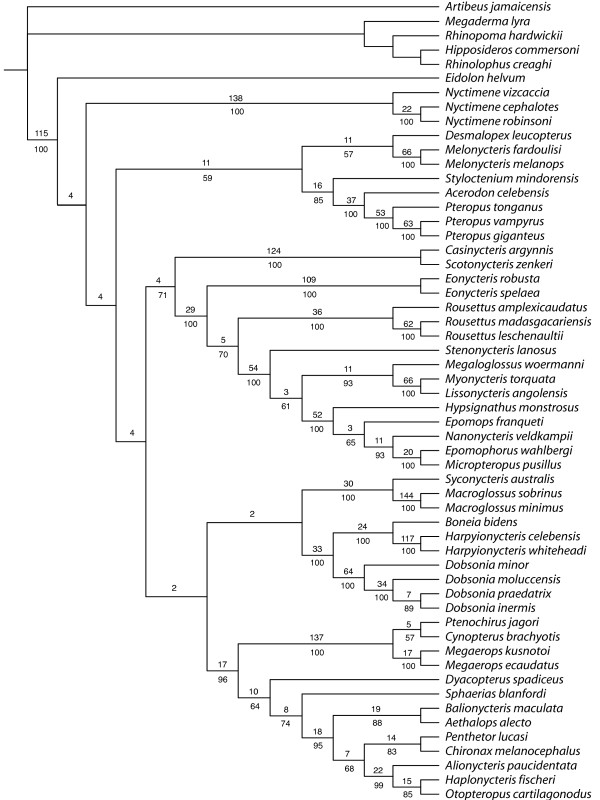
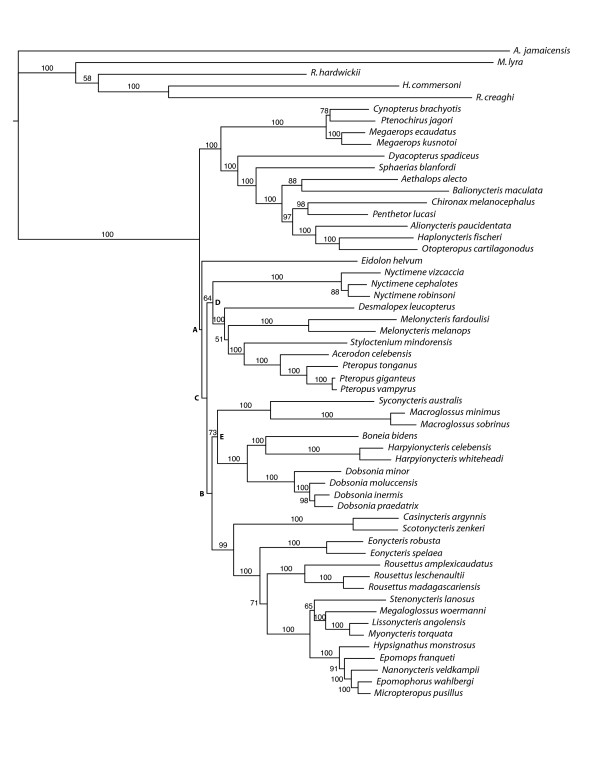
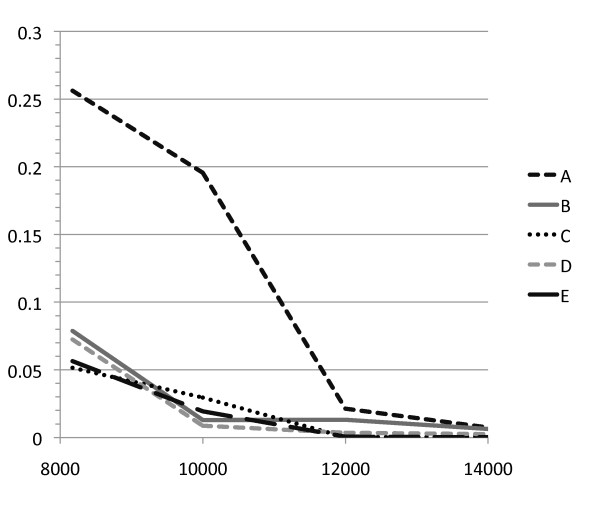
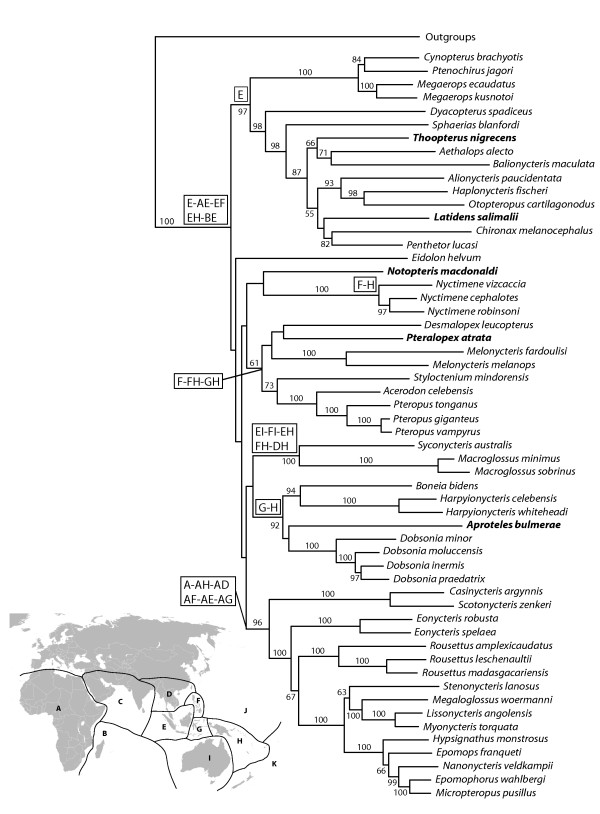
Results: Our analyses recovered six principal clades and one additional independent lineage (consisting of a single genus) within Pteropodidae. Reciprocal monophyly of these groups was highly supported and generally congruent among the different methods and datasets used. Likewise, most relationships within these principal clades were well resolved and statistically supported. Relationships among the 7 principal groups, however, were poorly supported in all analyses. This result could not be explained by any detectable systematic bias in the data or incongruence among loci. The SOWH test confirmed that basal branches' lengths were not different from zero, which points to closely-spaced cladogenesis as the most likely explanation for the poor resolution of the deep pteropodid relationships. Simulations suggest that an increase in the amount of sequence data is likely to solve this problem.
Conclusions: The phylogenetic hypothesis generated here provides a robust framework for a revised cladistic classification of Pteropodidae into subfamilies and tribes and will greatly contribute to the understanding of character evolution and biogeography of pteropodids. The inability of our data to resolve the deepest relationships of the major pteropodid lineages suggests an explosive diversification soon after origin of the crown pteropodids. Several characteristics of pteropodids are consistent with this conclusion, including high species diversity, great morphological diversity, and presence of key innovations in relation to their sister group.
Figures
References
-
- Simmons NB. In: Mammal species of the world: a taxonomic and geographic reference. Wilson DE, Reeder DM, editor. Baltimore, MD: Johns Hopkins University Press; 2005. Order Chiroptera; pp. 312–529.
-
- Nowak RM. Walker's bats of the World. Baltimore and London: The Johns Hopkins University Press; 1994.
-
- Mickleburgh SP, Hutson AM, Racey PA. Old World fruit bats: an action plan for their conservation. Gland, Switzerland: IUCN; 1992.
-
- Simmons NB. Bat relationships and the origin of flight. Symposium of the Zoological Society of London. 1995;67:27–43.
Publication types
MeSH terms
Substances
LinkOut - more resources
Full Text Sources
