Autologous haemopoietic stem-cell transplantation followed by allogeneic or autologous haemopoietic stem-cell transplantation in patients with multiple myeloma (BMT CTN 0102): a phase 3 biological assignment trial
- PMID: 21962393
- PMCID: PMC3611089
- DOI: 10.1016/S1470-2045(11)70243-1
Autologous haemopoietic stem-cell transplantation followed by allogeneic or autologous haemopoietic stem-cell transplantation in patients with multiple myeloma (BMT CTN 0102): a phase 3 biological assignment trial
Abstract
Background: Autologous haemopoietic stem-cell transplantation (HSCT) improves survival in patients with multiple myeloma, but disease progression remains an issue. Allogeneic HSCT might reduce disease progression, but can be associated with high treatment-related mortality. Thus, we aimed to assess effectiveness of allogeneic HSCT with non-myeloablative conditioning after autologous HSCT compared with tandem autologous HSCT.
Methods: In our phase 3 biological assignment trial, we enrolled patients with multiple myeloma attending 37 transplant centres in the USA. Patients (<70 years old) with adequate organ function who had completed at least three cycles of systemic antimyeloma therapy within the past 10 months were eligible for inclusion. We assigned patients to receive an autologous HSCT followed by an allogeneic HSCT (auto-allo group) or tandem autologous HSCTs (auto-auto group) on the basis of the availability of an HLA-matched sibling donor. Patients in the auto-auto group subsequently underwent a random allocation (1:1) to maintenance therapy (thalidomide plus dexamethasone) or observation. To avoid enrolment bias, we classified patients as standard risk or high risk on the basis of cytogenetics and β2-microglobulin concentrations. We used the Kaplan-Meier method to estimate differences in 3-year progression-free survival (PFS; primary endpoint) between patients with standard-risk disease in the auto-allo group and the best results from the auto-auto group (maintenance, observation, or pooled). This study is registered with ClinicalTrials.gov, number NCT00075829.
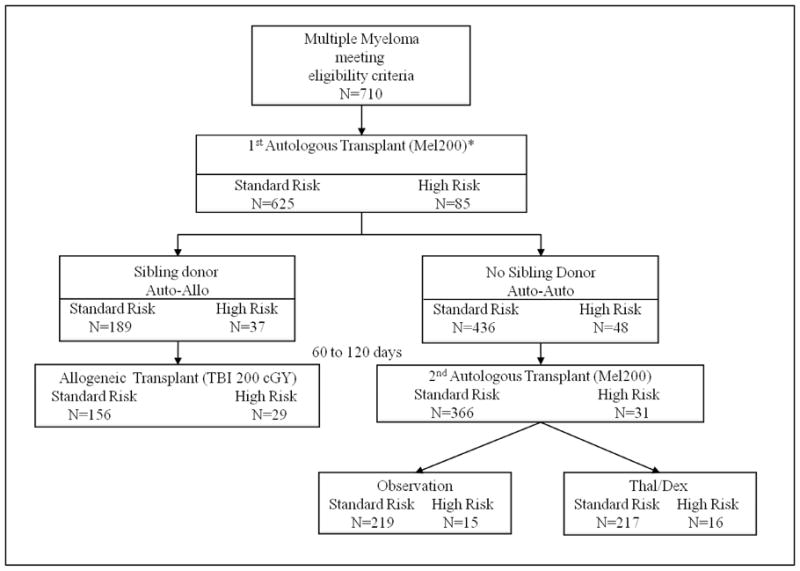
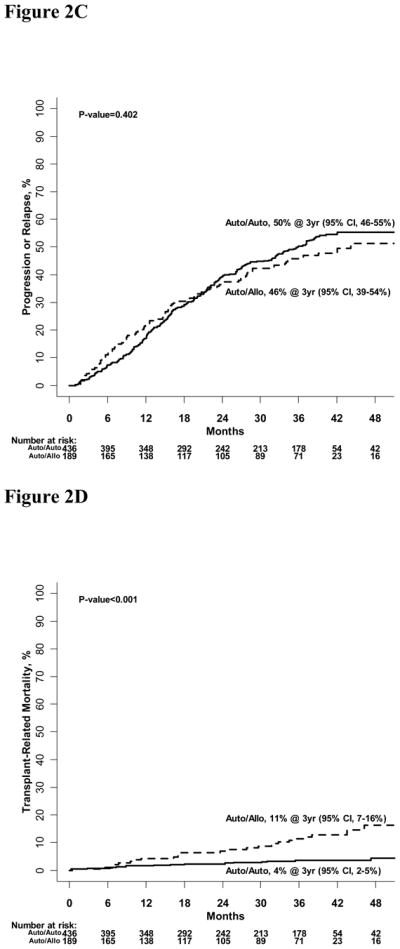
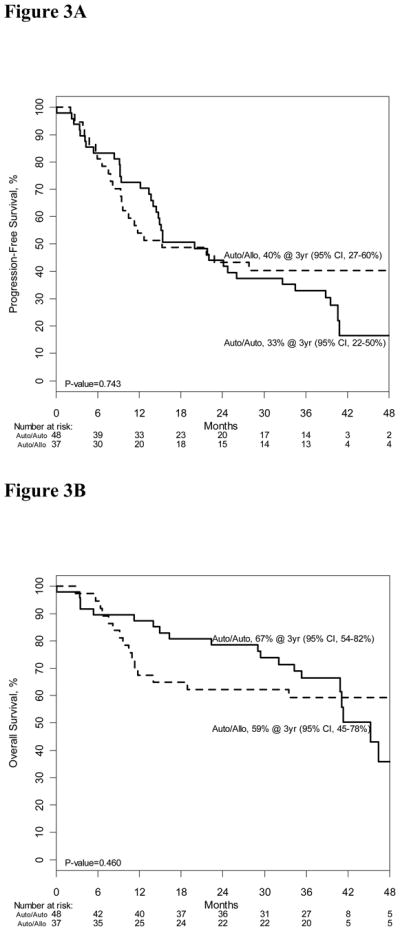
Findings: Between Dec 17, 2003, and March 30, 2007, we enrolled 710 patients, of whom 625 had standard-risk disease and received an autologous HSCT. 156 (83%) of 189 patients with standard-risk disease in the auto-allo group and 366 (84%) of 436 in the auto-auto group received a second transplant. 219 patients in the auto-auto group were randomly assigned to observation and 217 to receive maintenance treatment, of whom 168 (77%) completed this treatment. PFS and overall survival did not differ between maintenance and observation groups and pooled data were used. Kaplan-Meier estimates of 3-year PFS were 43% (95% CI 36-51) in the auto-allo group and 46% (42-51) in the auto-auto group (p=0·671); overall survival also did not differ at 3 years (77% [95% CI 72-84] vs 80% [77-84]; p=0·191). Within 3 years, 87 (46%) of 189 patients in the auto-allo group had grade 3-5 adverse events as did 185 (42%) of 436 patients in the auto-auto group. The adverse events that differed most between groups were hyperbilirubinaemia (21 [11%] patients in the auto-allo group vs 14 [3%] in the auto-auto group) and peripheral neuropathy (11 [6%] in the auto-allo group vs 52 [12%] in the auto-auto group).
Interpretation: Non-myeloablative allogeneic HSCT after autologous HSCT is not more effective than tandem autologous HSCT for patients with standard-risk multiple myeloma. Further enhancement of the graft versus myeloma effect and reduction in transplant-related mortality are needed to improve the allogeneic HSCT approach.
Funding: US National Heart, Lung, and Blood Institute and the National Cancer Institute.
Copyright © 2011 Elsevier Ltd. All rights reserved.
Conflict of interest statement
Authors declared no conflict of interest: MCP, BL, EAS, ME, JW, SC, NLG, MMH, DTV, DW
Potential conflict of interest declared:
Celgene Pharmaceutics: Speakers Bureau and Consultant - AK
Celgene Consultant - DGM
Millenium Pharmaceutics: Speakers Bureau - AK
Figures

Comment in
-
Is there a future for auto-allo HSCT in multiple myeloma?Lancet Oncol. 2011 Dec;12(13):1176-7. doi: 10.1016/S1470-2045(11)70258-3. Epub 2011 Sep 29. Lancet Oncol. 2011. PMID: 21962392 No abstract available.
References
-
- Attal M, Harousseau JL, Stoppa AM, Sotto JJ, Fuzibet JG, Rossi JF, et al. A prospective, randomized trial of autologous bone marrow transplantation and chemotherapy in multiple myeloma. Intergroupe Francais du Myelome. N Engl J Med. 1996 Jul 11;335(2):91–7. - PubMed
-
- Child JA, Morgan GJ, Davies FE, Owen RG, Bell SE, Hawkins K, et al. High-dose chemotherapy with hematopoietic stem-cell rescue for multiple myeloma. N Engl J Med. 2003 May 8;348(19):1875–83. - PubMed
-
- Attal M, Harousseau JL, Facon T, Guilhot F, Doyen C, Fuzibet JG, et al. Single versus double autologous stem-cell transplantation for multiple myeloma. N Engl J Med. 2003 Dec 25;349(26):2495–502. - PubMed
-
- Attal M, Harousseau JL, Leyvraz S, Doyen C, Hulin C, Benboubker L, et al. Maintenance therapy with thalidomide improves survival in patients with multiple myeloma. Blood. 2006 Nov 15;108(10):3289–94. - PubMed
-
- Barlogie B, Tricot G, Anaissie E, Shaughnessy J, Rasmussen E, van Rhee F, et al. Thalidomide and hematopoietic-cell transplantation for multiple myeloma. N Engl J Med. 2006 Mar 9;354(10):1021–30. - PubMed
Publication types
MeSH terms
Substances
Associated data
Grants and funding
- U10 HL069294/HL/NHLBI NIH HHS/United States
- UG1 HL069286/HL/NHLBI NIH HHS/United States
- U10 HL069301/HL/NHLBI NIH HHS/United States
- U10 HL069330/HL/NHLBI NIH HHS/United States
- U10 HL069291/HL/NHLBI NIH HHS/United States
- U01 HL069294/HL/NHLBI NIH HHS/United States
- P01 CA078902/CA/NCI NIH HHS/United States
- U10 HL069315/HL/NHLBI NIH HHS/United States
- U10 HL069348/HL/NHLBI NIH HHS/United States
- P01 CA018029/CA/NCI NIH HHS/United States
- U10 HL069290/HL/NHLBI NIH HHS/United States
- U24 CA076518/CA/NCI NIH HHS/United States
- U10 HL069286/HL/NHLBI NIH HHS/United States
- U10 HL069249/HL/NHLBI NIH HHS/United States
- U10 HL069334/HL/NHLBI NIH HHS/United States
LinkOut - more resources
Full Text Sources
Other Literature Sources
Medical
Research Materials
Miscellaneous