


Stress and skin leukocyte trafficking as a dual-stage process
- PMID: 21963875
- PMCID: PMC3253878
- DOI: 10.1016/j.bbi.2011.09.007
Stress and skin leukocyte trafficking as a dual-stage process
Abstract
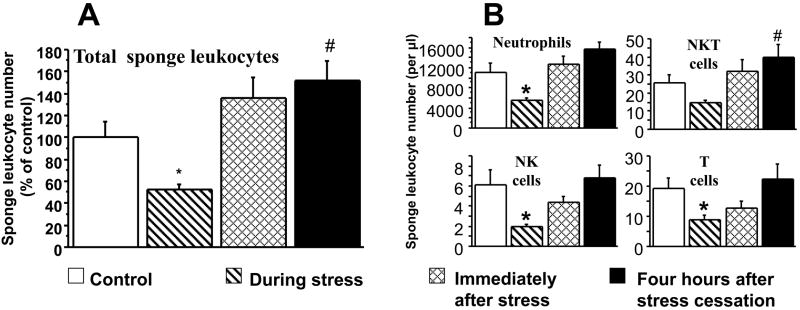
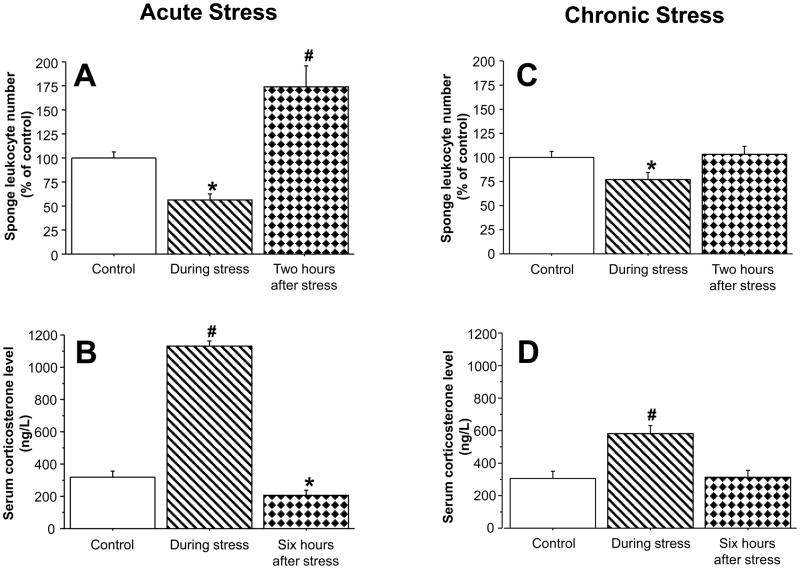
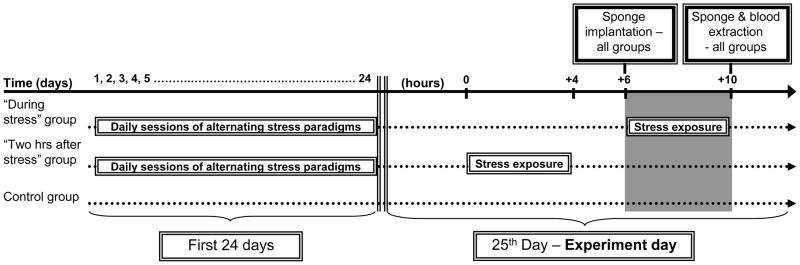
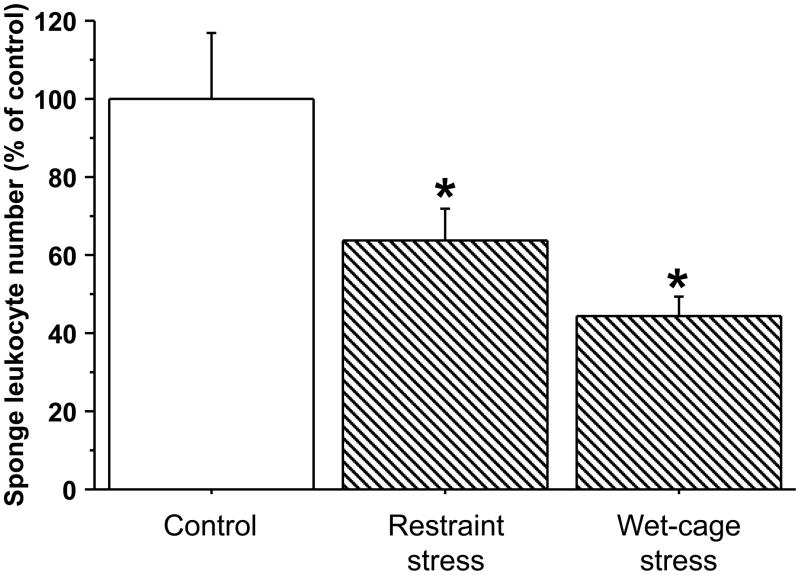
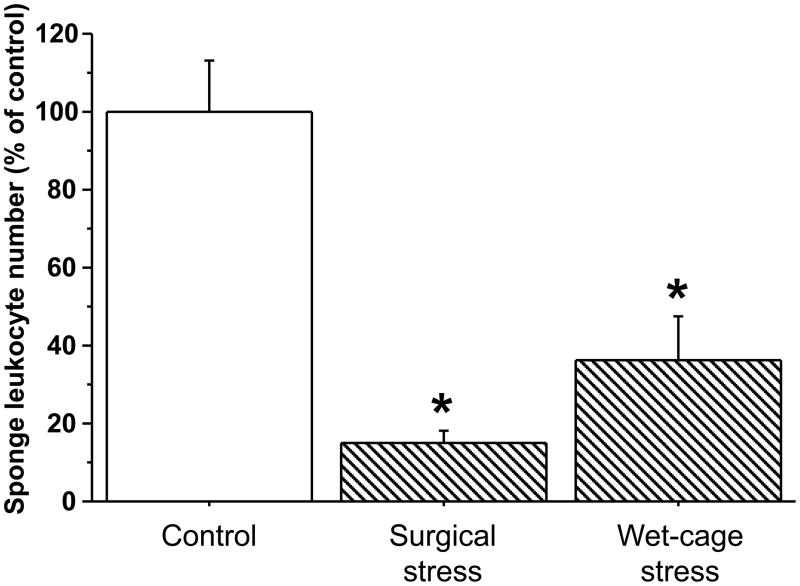
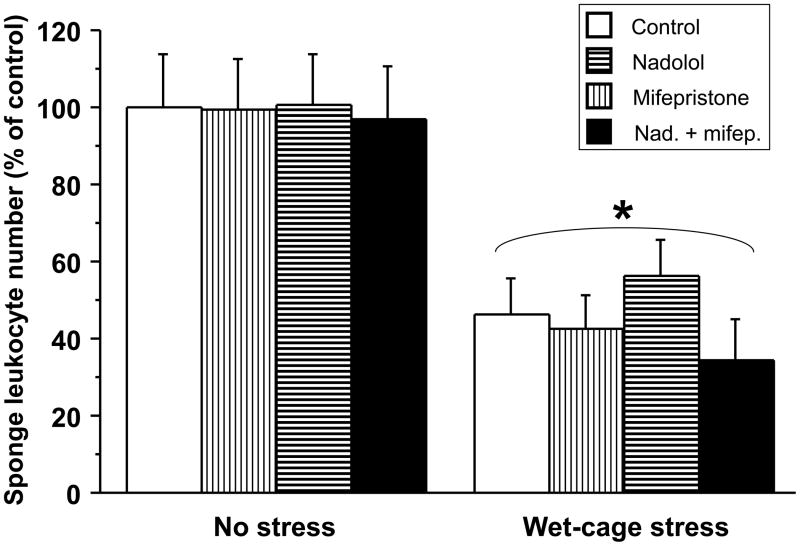
Stress responses are known to modulate leukocyte trafficking. In the skin, stress was reported both to enhance and reduce skin immunity, and the chronicity of stress exposure was suggested as a key determining factor. We here propose a dual-stage hypothesis, suggesting that stress, of any duration, reduces skin immunity during its course, while its cessation is potentially followed by a period of enhanced skin immunity. To start testing this hypothesis, rats were subcutaneously implanted with sterile surgical sponges for four-hours, during or after exposure to one of several acute stress paradigms, or to a chronic stress paradigm. Our findings, in both males and females, indicate that numbers of sponge-infiltrating leukocytes, and their specific subsets, were reduced during acute or chronic stress, and increased after stress cessation. Studying potential mediating mechanisms of the reduction in leukocyte numbers during acute stress, we found that neither adrenalectomy nor the administration of beta-adrenergic or glucocorticoid antagonists prevented this reduction. Additionally, administration of corticosterone or epinephrine to adrenalectomized rats did not impact skin leukocyte numbers, whereas, in the blood, these treatments did affect numbers of leukocytes and their specific subsets, as was also reported previously. Overall, our findings support the proposed dual-stage hypothesis, which can be evolutionally rationalized and accounts for most of the apparent inconsistencies in the literature regarding stress and skin immunity. Other aspects of the hypothesis should be tested, also using additional methodologies, and its predictions may bear clinical significance in treatment of skin disorders related to hyper- or hypo-immune function.
Copyright © 2011 Elsevier Inc. All rights reserved.
Conflict of interest statement
All authors declare that there are no conflicts of interest
Figures


References
-
- Aberer E. Epidemiologic, socioeconomic and psychosocial aspects in lupus erythematosus. Lupus. 2010;19:1118–24. - PubMed
-
- Altemus M, Dhabhar FS, Yang R. Immune function in PTSD. Ann N Y Acad Sci. 2006;1071:167–83. - PubMed
-
- Bartrop RW, Luckhurst E, Lazarus L, Kiloh LG, Penny R. Depressed lymphocyte function after bereavement. Lancet. 1977;1:834–6. - PubMed
-
- Ben-Eliyahu S, Page GG, Yirmiya R, Shakhar G. Evidence that stress and surgical interventions promote tumor development by suppressing natural killer cell activity. Int J Cancer. 1999;80:880–8. - PubMed
MeSH terms
Substances
Grants and funding
LinkOut - more resources
Full Text Sources
Medical
