Review
. 2011 Dec;55(4):363-9.
doi: 10.1016/j.ymeth.2011.09.009. Epub 2011 Sep 20.

Structure determination of membrane proteins in five easy pieces

Affiliations
Review

Structure determination of membrane proteins in five easy pieces

Francesca M Marassi et al. Methods. 2011 Dec.

Abstract

Rotational Alignment (RA) solid-state NMR provides the basis for a general method for determining the structures of membrane proteins in phospholipid bilayers under physiological conditions. Membrane proteins are high priority targets for structure determination, and are challenging for existing experimental methods. Because membrane proteins reside in liquid crystalline phospholipid bilayer membranes it is important to study them in this type of environment. The RA solid-state NMR approach we have developed can be summarized in five steps, and incorporates methods of molecular biology, biochemistry, sample preparation, the implementation of NMR experiments, and structure calculations. It relies on solid-state NMR spectroscopy to obtain high-resolution spectra and residue-specific structural restraints for membrane proteins that undergo rotational diffusion around the membrane normal, but whose mobility is otherwise restricted by interactions with the membrane phospholipids. High resolution spectra of membrane proteins alone and in complex with other proteins and ligands set the stage for structure determination and functional studies of these proteins in their native, functional environment.


Figures

Figure 1
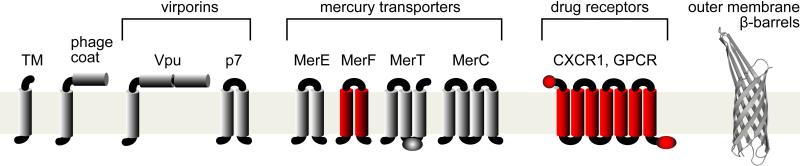
Figure 1. Membrane proteins that have been expressed, purified, and demonstrated to give high-resolution solid-state NMR spectra in lipid bilayers
This panel provides a series of targets for the development of NMR spectroscopy and structure determination methods. From left to right they have increasing size and complexity, ranging from a 35-residue, single transmembrane, α-helical domain, to a full-length 350-residue protein with seven transmembrane helices, and an outer membrane protein with β-barrel architecture. Solid-state NMR can be used to determine the structures of these membrane proteins in native-like membrane environments and conditions. This is demonstrated here with MerFt, a truncated construct of MerF with 60 residues and two transmembrane helices, and with CXCR1, a G-protein coupled receptor with 350 residues and seven transmembrane helices.
Figure 2
Figure 2. The effects of rotational diffusion on the chemical shift anisotropy powder pattern from 13C’ labeled membrane proteins in proteoliposomes using simulated spectra
(A, B) 13C’ chemical shift powder patterns for a residue in a transmembrane helix approximately parallel to the membrane normal, rotationally averaged by rotational diffusion (A) or static (B). (C, D) Same as (A, B), respectively, except that the sample is undergoing slow (5 kHz) magic angle spinning. No sideband intensity is observed in (C) because of the narrow frequency breadth of the motionally averaged powder pattern. (D) A family of sidebands is observed because of the broad frequency breadth of the static powder pattern. The sideband intensities can be used to calculate the powder pattern line shape.
Figure 3
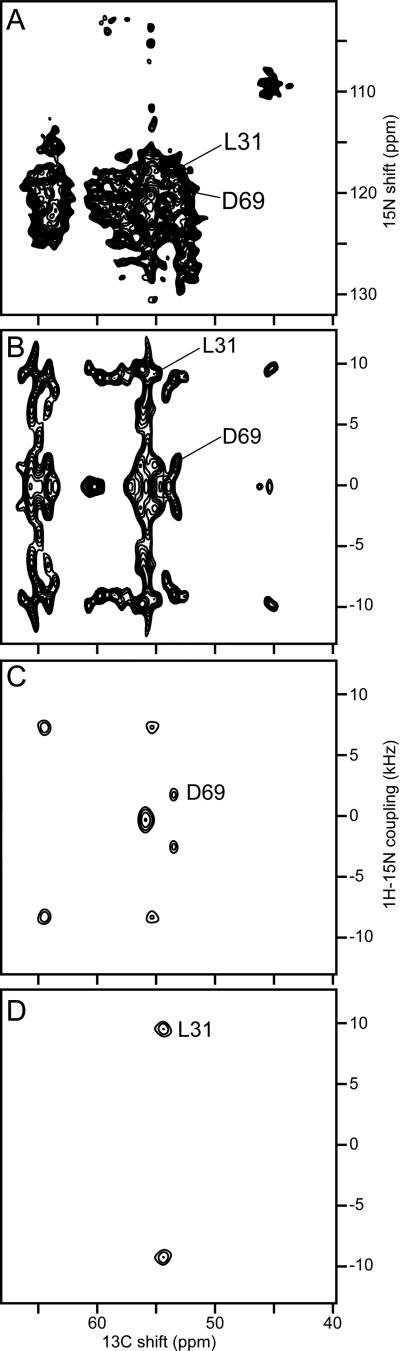
Figure 3. Multi-dimensional MAS solid-state NMR spectra of uniformly 13C/15N labeled MerFt in proteoliposomes
(A) Two-dimensional 13C/15N heteronuclear correlation spectrum of MerFt in proteoliposomes. (B) Two-dimensional 1H-15N dipolar coupling/13C chemical shift SLF spectrum of MerFt in proteoliposomes. The signals for L31 and D69 can be identified in these crowded two-dimensional spectra, which have had all resonances assigned. (C, D) Two-dimensional 1H-15N dipolar coupling/13C chemical shift SLF planes from a three-dimensional spectrum. The few signals in each plane demonstrate that complete resolution is achieved in the three-dimensional spectrum. The same dipolar coupling frequencies are measured in panels B, C, D for both L31 and D69. Similar results are obtained for all other residues and provide the input for the structure calculations.
Figure 4
Figure 4. One-dimensional slices from multi-dimensional MAS solid-state NMR spectra of uniformly 13C/15N labeled MerFt in proteoliposomes
One dimensional 15N solid-state NMR spectra of uniformly 15N/13C labeled MerFt in DMPC bilayers. A. Experimental 15N amide chemical shift powder pattern spectrum of L31 (essentially identical to that for D69) obtained at low temperature (10°C). B. Simulated static 15N amide chemical shift powder pattern spectrum based on the data in Figure 4A. C. Experimental rotationally averaged 15N amide chemical shift powder pattern spectrum of D69 at 25°C. D.Same as C. except for L31. E. Simulated static Pake powder pattern for 1H-15N amide heteronuclear dipolar coupling. F. Experimental rotationally averaged 1H-15N heteronuclear dipolar coupling for D69 at 25°C. G. Same as F. except for L3. H. Simulated static Pake powder pattern for 1H-13C heteronuclear dipolar coupling. I. Experimental rotationally averaged 1H-13C heteronuclear dipolar coupling powder pattern spectrum for D69 at 25°C. J. same as I. except for L31. The experimental data in the Figure were extracted from high resolution multidimensional experiments correlating 13C, 15N isotropic chemical shifts and either 1H-15N/ 1H-13Cα dipolar coupling or 15N chemical shift anisotropy in the third dimension (82).
Figure 5
Figure 5. One-dimensional slices from multi-dimensional MAS solid-state NMR spectra of uniformly 13C/15N labeled CXCR1 in proteoliposomes
(A) Simulated static Pake powder pattern spectrum for a 1H-15N heteronuclear dipolar coupling of an amide group in a peptide bond. (B, C) One-dimensional rotationally averaged 1H-15N heteronuclear powder patterns extracted from a three-dimensional 13C-detected 1H-15N dipolar coupling / 15N chemical shift SLF spectrum.1H-15N heteronuclear dipolar coupling frequencies (noted on the left side of the spectra) are associated with 13Cα isotropic chemical shifts (noted on the right side of the spectra).
Figure 6
Figure 6. Three-dimensional structure of MerFt in phospholipid bilayers
(A) Structure of MerFt determined by the RA solid-state NMR method described here. (B) Correlation plot of back-calculated 1H-15N heteronuclear dipolar couplings from the refined structure with experimentally measured couplings. The correlation coefficient is 0.94.

References

    1. Kendrew JC, Bodo G, Dintzis HM, Parrish RG, Wyckoff HW, Philips DC. Nature. 1958;181:666. - PubMed
    1. Perutz MF, Rossman MG, Cullis AF, Muirhead H, Will G, North AC. Nature. 1960;185:416–22. - PubMed
    1. Caffrey M. Ann Rev Biophys. 2009;38:29–51. - PubMed
    1. Wallin E, von Heijne G. Protein Sci. 1998;7:1029–38. - PMC - PubMed
    1. Sanders CR, Myers JK. Annu Rev Biophys Biomol Struct. 2004;33:25–51. - PubMed

Publication types

MeSH terms

LinkOut - more resources