Review
. 2011 Nov;25(11):1835-48.
doi: 10.1210/me.2011-1197. Epub 2011 Sep 29.

Minireview: recent developments in the physiology and pathology of the lysophosphatidylinositol-sensitive receptor GPR55

Affiliations
Review

Minireview: recent developments in the physiology and pathology of the lysophosphatidylinositol-sensitive receptor GPR55

Christopher M Henstridge et al. Mol Endocrinol. 2011 Nov.

Abstract

Emerging data suggest that off-target cannabinoid effects may be mediated via novel seven-transmembrane spanning/G protein-coupled receptors. Due to its cannabinoid sensitivity, the G protein-coupled receptor 55 (GPR55) was recently proposed as a candidate; however, GPR55 is phylogenetically distinct from the traditional cannabinoid receptors, and the conflicting pharmacology, signaling, and functional data have prevented its classification as a novel cannabinoid receptor. Indeed, the most consistent and potent agonist to date is the noncannabinoid lysophospholipid, lysophosphatidylinositol. Here we present new human GPR55 mRNA expression data, providing supportive evidence of GPR55 expression in a vast array of tissues and cell types. Moreover, we summarize major recent developments in GPR55 research and aim to update the reader in the rapidly expanding fields of GPR55 pharmacology, physiology, and pathology.


Figures
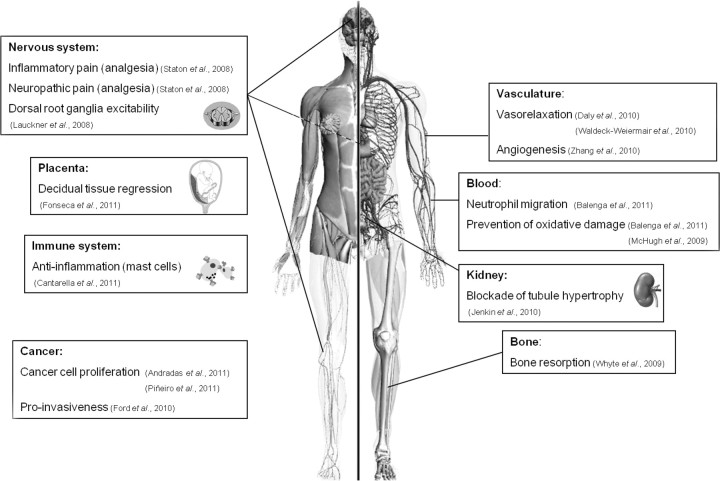
Fig. 1.
Fig. 1.
Pathophysiological relevance of GPR55 expression. Recent evidence suggests that GPR55 is involved in the control of a variety of physiological functions. In the nervous system, GPR55 regulates dorsal root ganglia excitability (49) and controls inflammatory and neuropathic pain (63). In blood, GPR55 regulates neutrophil migration (48) and may prevent oxidative damage (48, 84). GPR55 is also involved in bone metabolism, specifically inducing bone resorption (87). Other studies have suggested additional roles for GPR55 in modulating vascular function [by inducing vasorelaxation (53, 76) and controlling angiogenesis (37), renal tubule hypertrophy (109), decidual tissue regression during pregnancy (105), and mast cell-mediated antiinflammatory actions (104)]. However, additional experimental evidence is required to support these hypotheses. Besides controlling these (and most probably many other) physiological functions, GPR55 seems to play an important role in cancer progression by modulating cancer cell proliferation (52, 102) and migration (43).
Fig. 2.
Fig. 2.
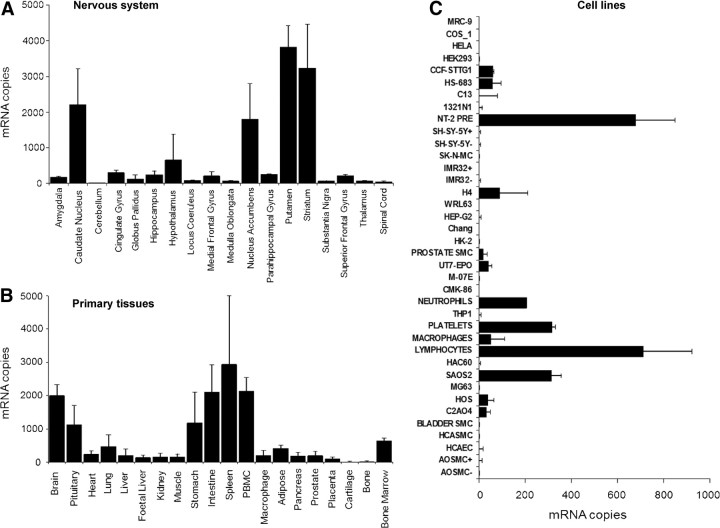
GPR55 mRNA expression in the CNS, peripheral tissues, and cell lines. TaqMan quantitative RT-PCR analysis of GPR55 in human tissues and cells was conducted. The level of mRNA expression in poly A+ RNA from 18 regions of the brain and nervous system (A) and 20 primary peripheral tissues (B) were determined as described previously (118) using a hGPR55-specific primer set: forward primer, 5′-TCTTCCCGCTGGAGGTGTTT-3′, reverse primer, 5′-CAGGATGTGGATGCTCCTGG-3′, TaqMan probe, 5′-CTTCCTCCTTCCCATGGGCATCATGG-3′. Data show the mean (±sd) copies of mRNA detected in samples from three or four individuals per tissue (two males/two females for all tissues except two males/one female for globus pallidus and four males for prostate). No trends suggestive of sex-specific expression were observed. Levels of β-actin in these samples vary within a normal range and have been described previously (118). The same hGPR55-specific primers were used to measure mRNA levels in 37 distinct human cell lines and primary cells (C). Data show mean (±sd) copies per nanogram mRNA detected in duplicate from a single batch of cells. The mRNA levels of three housekeeping genes (β-actin, glyceraldehyde-3-phosphate dehydrogenase, and cyclophilin) in these samples vary within a normal range, confirming the integrity of each RNA sample, and has been presented previously (119). +, Differentiated (IMR32 and SH-SY-5Y) or serum-starved (AOSMC) cells; −, undifferentiated or unstimulated cells. The origin of cells has been described elsewhere (120).

References

    1. Mackie K , Stella N. 2006. Cannabinoid receptors and endocannabinoids: evidence for new players. AAPS J 8:E298–E306 - PMC - PubMed
    1. Brown AJ. 2007. Novel cannabinoid receptors. Br J Pharmacol 152:567–575 - PMC - PubMed
    1. Baker D , Pryce G , Davies WL , Hiley CR. 2006. In silico patent searching reveals a new cannabinoid receptor. Trends Pharmacol Sci 27:1–4 - PubMed
    1. Oka S , Nakajima K , Yamashita A , Kishimoto S , Sugiura T. 2007. Identification of GPR55 as a lysophosphatidylinositol receptor. Biochem Biophys Res Commun 362:928–934 - PubMed
    1. Brown AJ , Robin Hiley C. 2009. Is GPR55 an anandamide receptor? Vitam Horm 81:111–137 - PubMed

Publication types

MeSH terms