


Induction of viable but nonculturable Escherichia coli O157:H7 in the phyllosphere of lettuce: a food safety risk factor
- PMID: 21965401
- PMCID: PMC3233046
- DOI: 10.1128/AEM.05020-11
Induction of viable but nonculturable Escherichia coli O157:H7 in the phyllosphere of lettuce: a food safety risk factor
Abstract
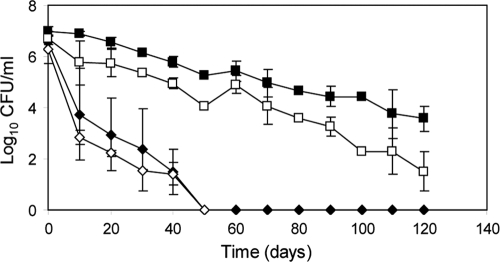
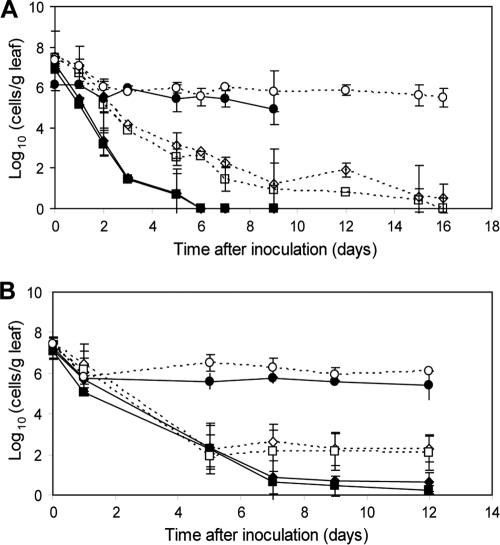
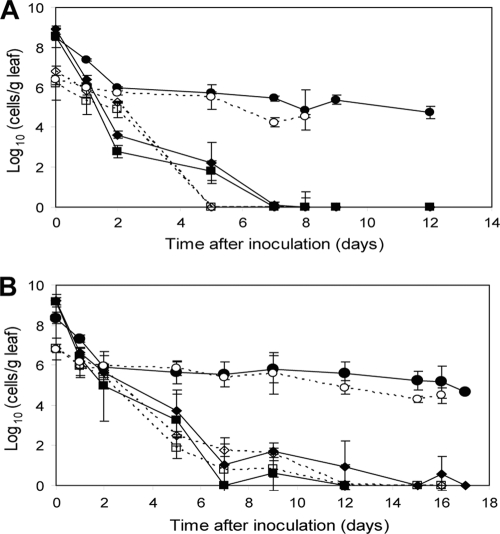
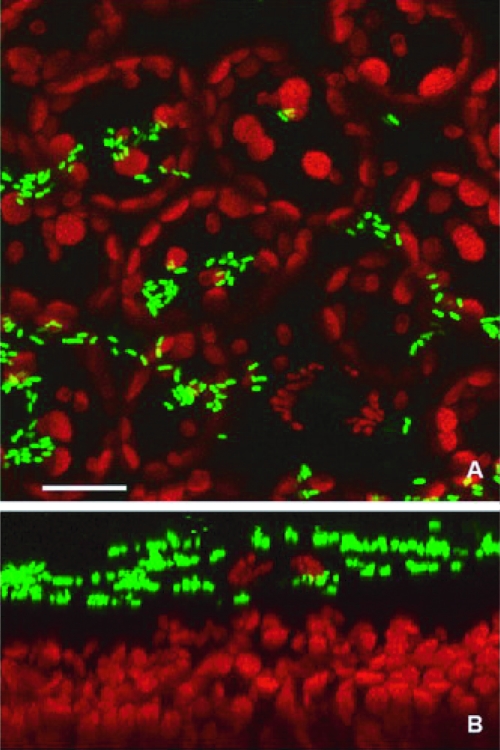
Escherichia coli O157:H7 continues to be an important human pathogen and has been increasingly linked to food-borne illness associated with fresh produce, particularly leafy greens. The aim of this work was to investigate the fate of E. coli O157:H7 on the phyllosphere of lettuce under low temperature and to evaluate the potential hazard of viable but nonculturable (VBNC) cells induced under such stressful conditions. First, we studied the survival of six bacterial strains following prolonged storage in water at low temperature (4°C) and selected two strains with different nonculturable responses for the construction of E. coli O157:H7 Tn7gfp transformants in order to quantitatively assess the occurrence of human pathogens on the plant surface. Under a suboptimal growth temperature (16°C), both E. coli O157:H7 strains maintained culturability on lettuce leaves, but under more stressful conditions (8°C), the bacterial populations evolved toward the VBNC state. The strain-dependent nonculturable response was more evident in the experiments with different inoculum doses (10(9) and 10(6) E. coli O157:H7 bacteria per g of leaf) when strain BRMSID 188 lost culturability after 15 days and strain ATCC 43895 lost culturability within 7 days, regardless of the inoculum dose. However, the number of cells entering the VBNC state in high-cell-density inoculum (approximately 55%) was lower than in low-cell-density inoculum (approximately 70%). We recorded the presence of verotoxin for 3 days in samples that contained a VBNC population of 4 to 5 log(10) cells but did not detect culturable cells. These findings indicate that E. coli O157:H7 VBNC cells are induced on lettuce plants, and this may have implications regarding food safety.
Figures
References
-
- Arana I., Seco C., Muela A., Fernandez-Astorga A., Barcina I. 2003. gfp-tagged cells as a useful tool to study the survival of Escherichia coli in the presence of the river microbial community. Microb. Ecol. 45: 29–38 - PubMed
-
- Artz R. R. E., Avery L. M., Jones D. L., Killham K. 2006. Potential pitfalls in the quantitative molecular detection of Escherichia coli O157:H7 in environmental matrices. Can. J. Microbiol. 52: 482–488 - PubMed
-
- Asakura H., et al. 2002. Passage in mice causes a change in the ability of Salmonella enterica serovar Oranienburg to survive NaCl osmotic stress: resuscitation from the viable but non-culturable state. FEMS Microbiol. Lett. 212: 87–93 - PubMed
-
- Asakura H., Igimi S., Kawamoto K., Yamamoto S., Makino S. 2005. Role of in vivo passage on the environmental adaptation of enterohemorrhagic Escherichia coli O157:H7: cross-induction of the viable but nonculturable state by osmotic and oxidative stresses. FEMS Microbiol. Lett. 253: 243–249 - PubMed
-
- Asakura H., et al. 2007. Proteomic characterization of enterohemorrhagic Escherichia coli O157:H7 in the oxidation-induced viable but non-culturable state. Microbiol. Immunol. 51: 875–881 - PubMed
Publication types
MeSH terms
Substances
LinkOut - more resources
Full Text Sources
Other Literature Sources
Medical
Molecular Biology Databases
