. 2011 Dec;193(23):6498-504.
doi: 10.1128/JB.05445-11. Epub 2011 Sep 30.

Deletion strains reveal metabolic roles for key elemental sulfur-responsive proteins in Pyrococcus furiosus

Affiliations

Deletion strains reveal metabolic roles for key elemental sulfur-responsive proteins in Pyrococcus furiosus

Stephanie L Bridger et al. J Bacteriol. 2011 Dec.

Abstract

Transcriptional and enzymatic analyses of Pyrococcus furiosus previously indicated that three proteins play key roles in the metabolism of elemental sulfur (S(0)): a membrane-bound oxidoreductase complex (MBX), a cytoplasmic coenzyme A-dependent NADPH sulfur oxidoreductase (NSR), and sulfur-induced protein A (SipA). Deletion strains, referred to as MBX1, NSR1, and SIP1, respectively, have now been constructed by homologous recombination utilizing the uracil auxotrophic COM1 parent strain (ΔpyrF). The growth of all three mutants on maltose was comparable without S(0), but in its presence, the growth of MBX1 was greatly impaired while the growth of NSR1 and SIP1 was largely unaffected. In the presence of S(0), MBX1 produced little, if any, sulfide but much more acetate (per unit of protein) than the parent strain, demonstrating that MBX plays a critical role in S(0) reduction and energy conservation. In contrast, comparable amounts of sulfide and acetate were produced by NSR1 and the parent strain, indicating that NSR is not essential for energy conservation during S(0) reduction. Differences in transcriptional responses to S(0) in NSR1 suggest that two sulfide dehydrogenase isoenzymes provide a compensatory NADPH-dependent S(0) reduction system. Genes controlled by the S(0)-responsive regulator SurR were not as highly regulated in MBX1 and NSR1. SIP1 produced the same amount of acetate but more sulfide than the parent strain. That SipA is not essential for growth on S(0) indicates that it is not required for detoxification of metal sulfides, as previously suggested. A model is proposed for S(0) reduction by P. furiosus with roles for MBX and NSR in bioenergetics and for SipA in iron-sulfur metabolism.


Figures
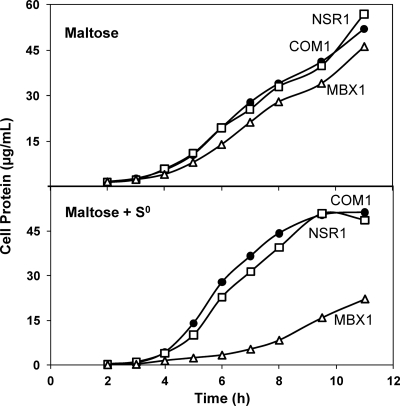
Fig. 1.
Fig. 1.
Effect of S0 availability on the growth of NSR1 and MBX1. Cultures were grown in 100-ml bottles stirred at 98°C with 5 g/liter maltose, 0.5 g/liter yeast extract, and 20 μM uracil. Cell growth was monitored by assaying total cell protein at each time point. (Top) Maltose only. (Bottom) Maltose plus 2 g/liter S0. Results obtained with COM1 (closed circles), NSR1 (open squares), and MBX1 (open triangles) are shown.
Fig. 2.
Fig. 2.
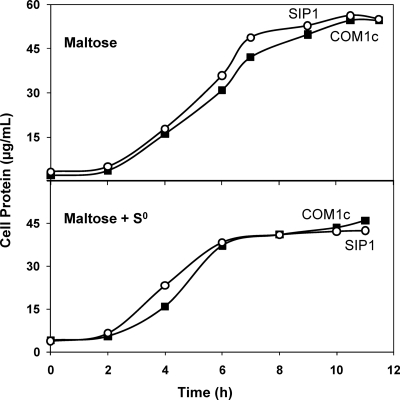
Effect of S0 availability on the growth of SIP1. Cultures were grown in 100-ml bottles stirred at 98°C with 5 g/liter maltose and 0.5 g/liter yeast extract. Cell growth was monitored by assaying total cell protein at each time point. (Top) Maltose only. (Bottom) Maltose plus 2 g/liter S0. Results obtained with COM1c (closed squares) and SIP1 (open circles) are shown.
Fig. 3.
Fig. 3.
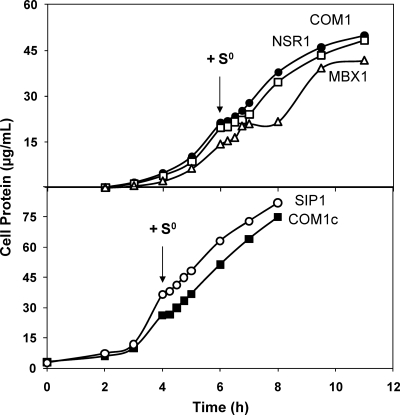
Effect of S0 addition on the growth of NSR1, MBX1, and SIP1. Kinetic growth curves of deletion strains compared to those of control strains designated in Table 1. Cultures were grown in 100-ml bottles stirred at 98°C with 5 g/liter maltose and 0.5 g/liter yeast extract prior to the addition of 2 g/liter S0 (as indicated by the arrows). Cell growth was monitored by assaying total cell protein at each time point. (Top) Uracil (20 μM) was added to the growth of COM1 (closed circles), NSR1 (open squares), and MBX1 (open triangles). (Bottom) COM1c (closed squares) and SIP1 (open circles).
Fig. 4.
Fig. 4.
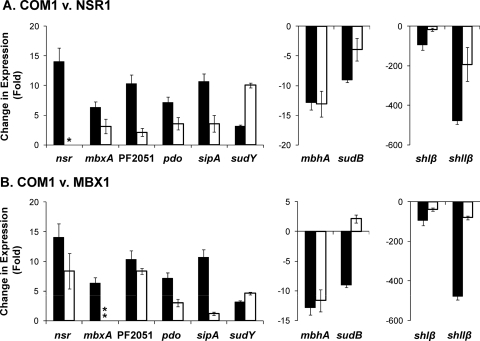
Quantitative reverse transcription-PCR of select S0 response genes. Total RNA was prepared from COM1, NSR1, and MBX1 cells harvested before and 30 min after S0 (2 g/liter) addition. For gene clusters of interest, the first gene in the operon was selected for analysis. The constitutively expressed gene PF0971 (por gamma subunit) was used as a control. Shown is the ratio of change in gene expression within 30 min of S0 addition in deletion strains (open bars) to that in the appropriate control strains (closed bars). (A) COM1 (closed bars) and NSR1 (open bars). (B) COM1 (closed bars) and MBX1 (open bars). A single asterisk indicates qPCR confirmation of the deleted gene product. Double asterisks indicate that an increase in mbxA (PF1453) gene expression was observed in MBX1; however, no gene product was observed for the deleted L subunit (PF1442). v., versus.
Fig. 5.
Fig. 5.
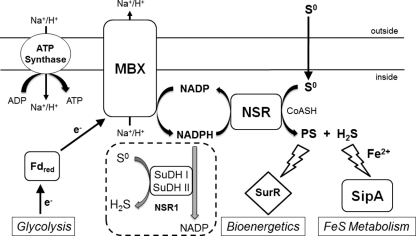
Proposed physiological roles of S0 reduction in P. furiosus: bioenergetics and FeS metabolism. MBX, membrane-bound oxidoreductase complex; NSR, NADPH sulfur oxidoreductase; SipA, sulfur-induced protein A; SurR, S0 response regulator; SuDH I and II, sulfide dehydrogenases I and II; Fd, ferredoxin; PS, polysulfide; H2S, hydrogen sulfide; CoASH, coenzyme A; NSR1, deletion strain lacking NSR. The precise mechanisms by which PS interacts with SurR and SipA involvement in FeS metabolism are not clear.

References

    1. Adams M. W., et al. 2001. Key role for sulfur in peptide metabolism and in regulation of three hydrogenases in the hyperthermophilic archaeon Pyrococcus furiosus. J. Bacteriol. 183:716–724 - PMC - PubMed
    1. Bradford M. M. 1976. A rapid and sensitive method for the quantitation of microgram quantities of protein utilizing the principle of protein-dye binding. Anal. Biochem. 72:248–254 - PubMed
    1. Chen J. S., Mortenson L. E. 1977. Inhibition of methylene blue formation during determination of the acid-labile sulfide of iron-sulfur protein samples containing dithionite. Anal. Biochem. 79:157–165 - PubMed
    1. Clarkson S. M., Newcomer E. C., Young E. G., Adams M. W. 2010. The elemental sulfur-responsive protein (SipA) from the hyperthermophilic archaeon Pyrococcus furiosus is regulated by sulfide in an iron-dependent manner. J. Bacteriol. 192:5841–5843 - PMC - PubMed
    1. Fiala G., S. K. O. 1986. Pyrococcus furiosus sp. nov. represents a novel genus of marine heterotrophic archaebacteria growing optimally at 100°C. Arch. Microbiol. 145:56–61

Publication types

MeSH terms

LinkOut - more resources