


Sleep duration or bedtime? Exploring the relationship between sleep habits and weight status and activity patterns
- PMID: 21966061
- PMCID: PMC3174832
- DOI: 10.5665/SLEEP.1266
Sleep duration or bedtime? Exploring the relationship between sleep habits and weight status and activity patterns
Abstract
Study objectives: To assess the effects of early and late bedtimes and wake up times on use of time and weight status in Australian school-aged children.
Design: Observational cross-sectional study involving use of time interviews and pedometers.
Setting: Free-living Australian adolescents.
Participants: 2200 9- to 16-year-olds from all states of Australia
Interventions: NA.
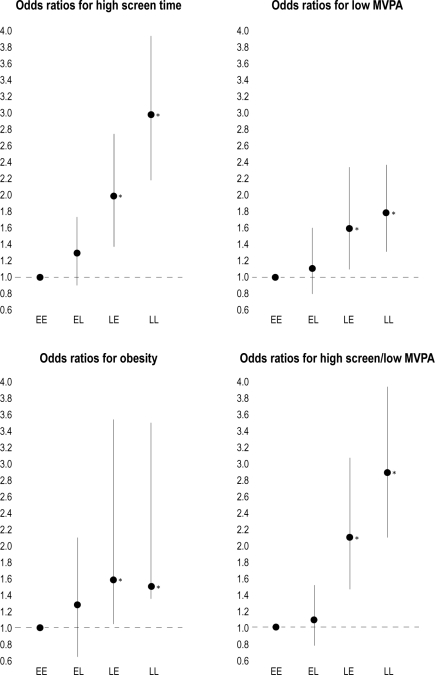
Measurements and results: Bedtimes and wake times were adjusted for age and sex and classified as early or late using median splits. Adolescents were allocated into 4 sleep-wake pattern groups: Early-bed/Early-rise; Early-bed/Late-rise; Late-bed/Early-rise; Late-bed/Late-rise. The groups were compared for use of time (screen time, physical activity, and study-related time), sociodemographic characteristics, and weight status. Adolescents in the Late-bed/Late-rise category experienced 48 min/d more screen time and 27 min less moderate-to-vigorous physical activity (MVPA) (P<0.0001) than adolescents in the Early-bed/Early-rise category, in spite of similar sleep durations. Late-bed/Late-rise adolescents had a higher BMI z-score (0.66 vs. 0.45, P=0.0015). Late-bed/Late-rise adolescents were 1.47 times more likely to be overweight or obese than Early-bed/Early-rise adolescents, 2.16 times more likely to be obese, 1.77 times more likely to have low MVPA, and 2.92 times more likely to have high screen time. Late-bed/Late-rise adolescents were more likely to come from poorer households, to live in major cities, and have fewer siblings.
Conclusions: Late bedtimes and late wake up times are associated with an unfavorable activity and weight status profile, independent of age, sex, household income, geographical remoteness, and sleep duration.
Keywords: Child; bedtime; physical activity; screen time; wake up time.
Figures
References
-
- Marshall N, Glozier N, Grunstein R. Is sleep duration related to obesity? A critical review of the epidemiological evidence. Sleep Med Rev. 2008;12:289–98. - PubMed
-
- Spiegel K, Tasali E, Penev P, Van Cauter E. Brief communication: Sleep curtailment in healthy young men is associated with decreased leptin levels, elevated ghrelin levels, and increased hunger and appetite. Ann Intern Med. 2004;141:846–50. - PubMed
-
- Spiegel K, Leproult R, Van Cauter E. Impact of sleep debt on metabolic and endocrine function. Lancet. 1999;354:1435–9. - PubMed
Publication types
MeSH terms
LinkOut - more resources
Full Text Sources
Medical
