


The role of M(3)-muscarinic receptor signaling in insulin secretion
- PMID: 21966580
- PMCID: PMC3181530
- DOI: 10.4161/cib.15716
The role of M(3)-muscarinic receptor signaling in insulin secretion
Abstract
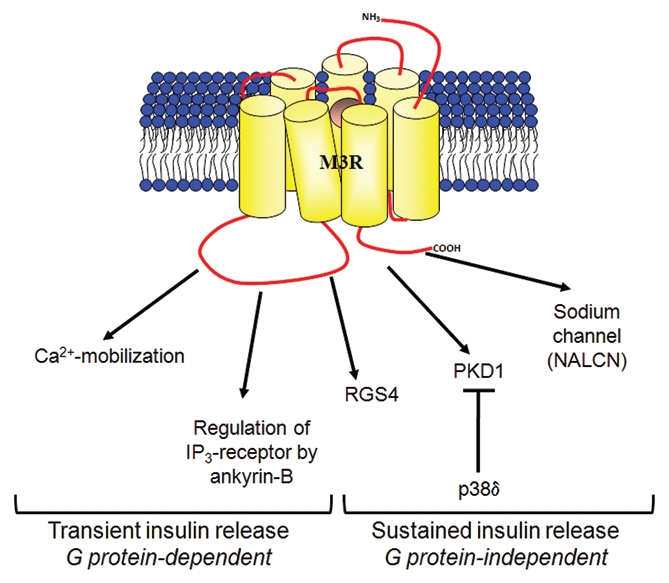
Recently, M(3)-muscarinic receptor (M3R) has been identified as the bona fide receptor responsible for the cholinergic regulation of glucose-induced insulin release. The molecular mechanisms of such regulation have also begun to be unravelled. These include the conventional G protein-dependent pathways involving calcium mobilization and activation of protein kinase C. In addition, recent studies also provided evidence for G protein-independent pathways in the regulation of insulin secretion by M3R. These include phosphorylation/arrestin-dependent activation of protein kinase D1, Src family kinase-dependent activation of the sodium channel NALCN and the involvement of regulator of G protein signaling (RGS)-4. Time has now come to extend these studies which were done mainly in rodents to human and explore the potential for targeting such pathways at different levels for the treatment of diseases with impaired insulin secretion such as type II diabetes.
Keywords: M3-muscarinic receptor; NALCN; RGS4; ankyrin-B; biased ligands; glucose homeostasis; insulin secretion; protein kinase D1.
Figures
Comment on
-
M3-muscarinic receptor promotes insulin release via receptor phosphorylation/arrestin-dependent activation of protein kinase D1.Proc Natl Acad Sci U S A. 2010 Dec 7;107(49):21181-6. doi: 10.1073/pnas.1011651107. Epub 2010 Nov 15. Proc Natl Acad Sci U S A. 2010. PMID: 21078968 Free PMC article.
References
-
- Gilon P, Henquin JC. Mechanisms and physiological significance of the cholinergic control of pancreatic beta-cell function. Endocr Rev. 2001;22:565–604. - PubMed
-
- Malaisse WJ. Stimulus-secretion coupling in the pancreatic B-cell: the cholinergic pathway for insulin release. Diabetes Metab Rev. 1986;2:243–259. - PubMed
-
- Gautam D, Han SJ, Hamdan FF, Jeon J, Li B, Li JH, et al. A critical role for beta cell M3 muscarinic acetylcholine receptors in regulating insulin release and blood glucose homeostasis in vivo. Cell Metab. 2006;3:449–461. - PubMed
LinkOut - more resources
Full Text Sources
Miscellaneous
