


Heart rate variability and exercise in aging women
- PMID: 21967166
- PMCID: PMC3298675
- DOI: 10.1089/jwh.2011.2932
Heart rate variability and exercise in aging women
Abstract
Background: Our group has shown a positive dose-response in maximal cardiorespiratory exercise capacity (VO(2max)) and heart rate variability (HRV) to 6 months of exercise training but no improvement in VO(2max) for women ≥60 years. Here, we examine the HRV response to exercise training in postmenopausal women younger and older than 60 years.
Methods: We examined 365 sedentary, overweight, hypertensive, postmenopausal women randomly assigned to sedentary control or exercise groups exercising at 50% (4 kcal/kg/week, [KKW]), 100% (8 KKW) and 150% (12 KKW) of the National Institutes of Health (NIH) Consensus Development Panel physical activity guidelines. Primary outcomes included time and frequency domain indices of HRV.
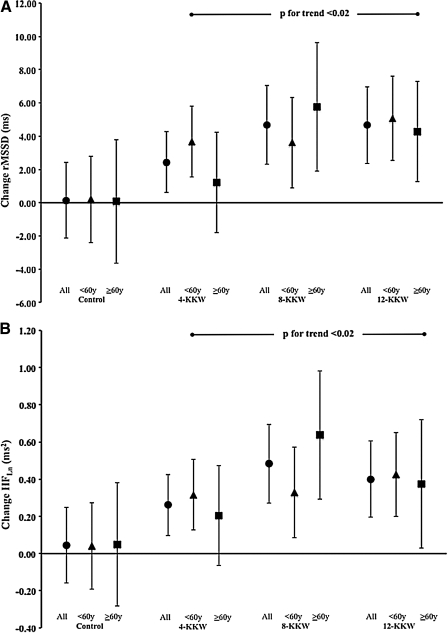
Results: Overall, our analysis demonstrated a significant improvement in parasympathetic tone (rMSSD and high frequency power) for both age strata at 8 KKW and 12 KKW. For rMSSD, the age-stratified responses were: control, <60 years, 0.20 ms, 95% confidence interval (CI)-2.40, 2.81; ≥60 years, 0.07 ms, 95% CI -3.64, 3.79; 4 KKW, <60 years, 3.67 ms, 95% CI 1.55, 5.79; ≥60 years, 1.20 ms, 95% CI -1.82, 4.22; 8-KKW, <60 years, 3.61 ms, 95% CI 0.88, 6.34; ≥60 years, 5.75 ms, 95% CI 1.89, 9.61; and 12-KKW, <60 years, 5.07 ms, 95% CI 2.53, 7.60; ≥60 years, 4.28 ms, 95% CI 0.42, 8.14.
Conclusions: VO(2max) and HRV are independent risk factors for cardiovascular disease (CVD) mortality. Despite no improvement in VO(2max), parasympathetic indices of HRV increased in women ≥60 years. This is clinically important, as HRV has important CVD risk and neurovisceral implications beyond cardiorespiratory function.
Figures
References
-
- International position paper on women's health, menopause: A comprehensive approach. National Heart, Lung, and Blood Institute NIH Publication No. 02–3284. 2000. www.nhlbi.nih.gov/health/prof/heart/other/wm_menop.htm. [May 17;2007 ]. www.nhlbi.nih.gov/health/prof/heart/other/wm_menop.htm
-
- Blair SN. Kohl HW., 3rd Paffenbarger RS., Jr Clark DG. Cooper KH. Gibbons LW. Physical fitness and all-cause mortality. A prospective study of healthy men and women. JAMA. 1989;262:2395–2401. - PubMed
-
- Kodama S. Saito K. Tanaka S, et al. Cardiorespiratory fitness as a quantitative predictor of all-cause mortality and cardiovascular events in healthy men and women: A meta-analysis. JAMA. 2009;301:2024–2035. - PubMed
-
- Tsuji H. Larson MG. Venditti FJ, Jr, et al. Impact of reduced heart rate variability on risk for cardiac events. The Framingham Heart Study. Circulation. 1996;94:2850–2855. - PubMed
-
- Tsuji H. Venditti FJ., Jr Manders ES, et al. Reduced heart rate variability and mortality risk in an elderly cohort. The Framingham Heart Study. Circulation. 1994;90:878–883. - PubMed
Publication types
MeSH terms
Grants and funding
LinkOut - more resources
Full Text Sources
Medical
