A high-risk study of bipolar disorder. Childhood clinical phenotypes as precursors of major mood disorders
- PMID: 21969459
- PMCID: PMC4552246
- DOI: 10.1001/archgenpsychiatry.2011.126
A high-risk study of bipolar disorder. Childhood clinical phenotypes as precursors of major mood disorders
Abstract
Context: The childhood precursors of adult bipolar disorder (BP) are still a matter of controversy.
Objective: To report the lifetime prevalence and early clinical predictors of psychiatric disorders in offspring from families of probands with DSM-IV BP compared with offspring of control subjects.
Design: A longitudinal, prospective study of individuals at risk for BP and related disorders. We report initial (cross-sectional and retrospective) diagnostic and clinical characteristics following best-estimate procedures.
Setting: Assessment was performed at 4 university medical centers in the United States between June 1, 2006, and September 30, 2009.
Participants: Offspring aged 12 to 21 years in families with a proband with BP (n = 141, designated as cases) and similarly aged offspring of control parents (n = 91).
Main outcome measure: Lifetime DSM-IV diagnosis of a major affective disorder (BP type I; schizoaffective disorder, bipolar type; BP type II; or major depression).
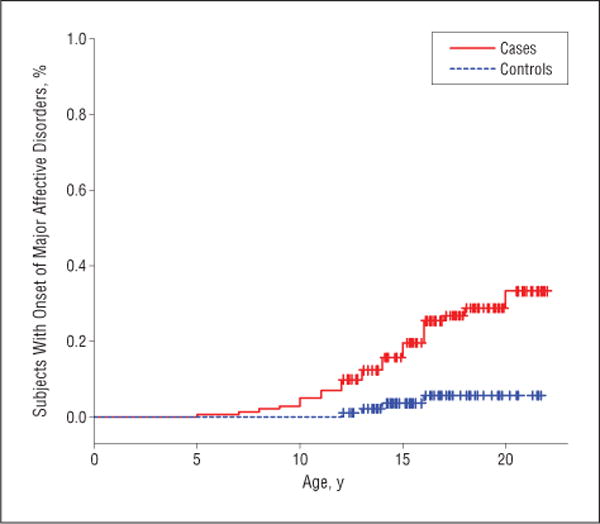
Results: At a mean age of 17 years, cases showed a 23.4% lifetime prevalence of major affective disorders compared with 4.4% in controls (P = .002, adjusting for age, sex, ethnicity, and correlation between siblings). The prevalence of BP in cases was 8.5% vs 0% in controls (adjusted P = .007). No significant difference was seen in the prevalence of other affective, anxiety, disruptive behavior, or substance use disorders. Among case subjects manifesting major affective disorders (n = 33), there was an increased risk of anxiety and externalizing disorders compared with cases without mood disorder. In cases but not controls, a childhood diagnosis of an anxiety disorder (relative risk = 2.6; 95% CI, 1.1-6.3; P = .04) or an externalizing disorder (3.6; 1.4-9.0; P = .007) was predictive of later onset of major affective disorders.
Conclusions: Childhood anxiety and externalizing diagnoses predict major affective illness in adolescent offspring in families with probands with BP.
Figures


References
-
- Tsuang MT, Faraone SV. The Genetics of Mood Disorders. Baltimore, MD: Johns Hopkins University Press; 1990.
-
- McGuffin P, Rijsdijk F, Andrew M, Sham P, Katz R, Cardno A. The heritability of bipolar affective disorder and the genetic relationship to unipolar depression. Arch Gen Psychiatry. 2003;60(5):497–502. - PubMed
-
- Gershon ES, Hamovit J, Guroff JJ, Dibble E, Leckman JF, Sceery W, Targum SD, Nurnberger JI, Jr, Goldin LR, Bunney WE., Jr A family study of schizoaffective, bipolar I, bipolar II, unipolar, and normal control probands. Arch Gen Psychiatry. 1982;39(10):1157–1167. - PubMed
-
- Gershon ES, Hamovit JH, Guroff JJ, Nurnberger JI., Jr Birth-cohort changes in manic and depressive disorders in relatives of bipolar and schizoaffective patients. Arch Gen Psychiatry. 1987;44(4):314–319. - PubMed
-
- Hillegers MH, Reichart CG, Wals M, Verhulst FC, Ormel J, Nolen WA. Five-year prospective outcome of psychopathology in the adolescent offspring of bipolar parents. Bipolar Disord. 2005;7(4):344–350. - PubMed