


All you need is light: antimicrobial photoinactivation as an evolving and emerging discovery strategy against infectious disease
- PMID: 21971183
- PMCID: PMC3260545
- DOI: 10.4161/viru.2.6.17889
All you need is light: antimicrobial photoinactivation as an evolving and emerging discovery strategy against infectious disease
Abstract
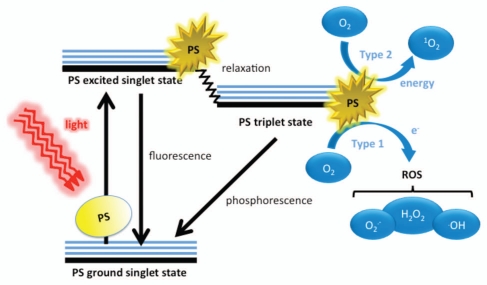
The story of prevention and control of infectious diseases remains open and a series of highly virulent pathogens are emerging both in and beyond the hospital setting. Antibiotics were an absolute success story for a previous era. The academic and industrial biomedical communities have now come together to formulate consensus beliefs regarding the pursuit of novel and effective alternative anti-infective countermeasures. Photodynamic therapy was established and remains a successful modality for malignancies but photodynamic inactivation has been transformed recently to an antimicrobial discovery and development platform. The concept of photodynamic inactivation is quite straightforward and requires microbial exposure to visible light energy, typically wavelengths in the visible region, that causes the excitation of photosensitizer molecules (either exogenous or endogenous), which results in the production of singlet oxygen and other reactive oxygen species that react with intracellular components, and consequently produce cell inactivation. It is an area of increasing interest, as research is advancing i) to identify the photochemical and photophysical mechanisms involved in inactivation; ii) to develop potent and clinically compatible photosensitizer; iii) to understand how photoinactivation is affected by key microbial phenotypic elements (multidrug resistance and efflux, virulence and pathogenesis determinants, biofilms); iv) to explore novel delivery platforms inspired by current trends in pharmacology and nanotechnology; and v) to identify photoinactivation applications beyond the clinical setting such as environmental disinfectants.
Figures
References
-
- Sigerist H. The Great Doctors. New York: Dover Publications; 1971. p. 371.
Publication types
MeSH terms
Substances
Grants and funding
LinkOut - more resources
Full Text Sources
Other Literature Sources
Medical
