


Functionalization of reactive polymer multilayers with RGD and an antifouling motif: RGD density provides control over human corneal epithelial cell-substrate interactions
- PMID: 21972074
- PMCID: PMC3222791
- DOI: 10.1002/jbm.a.33233
Functionalization of reactive polymer multilayers with RGD and an antifouling motif: RGD density provides control over human corneal epithelial cell-substrate interactions
Abstract
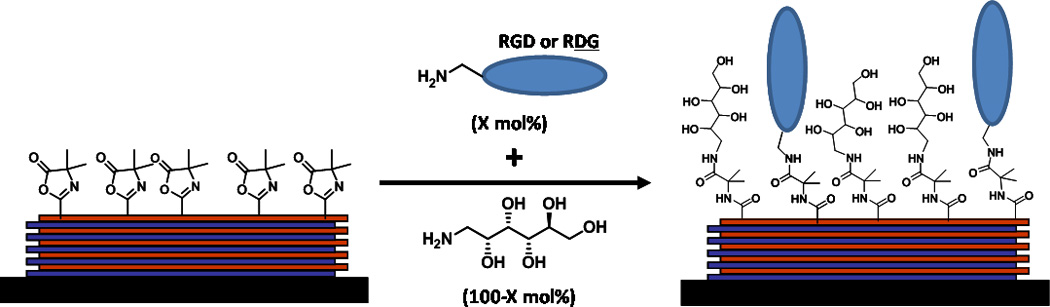
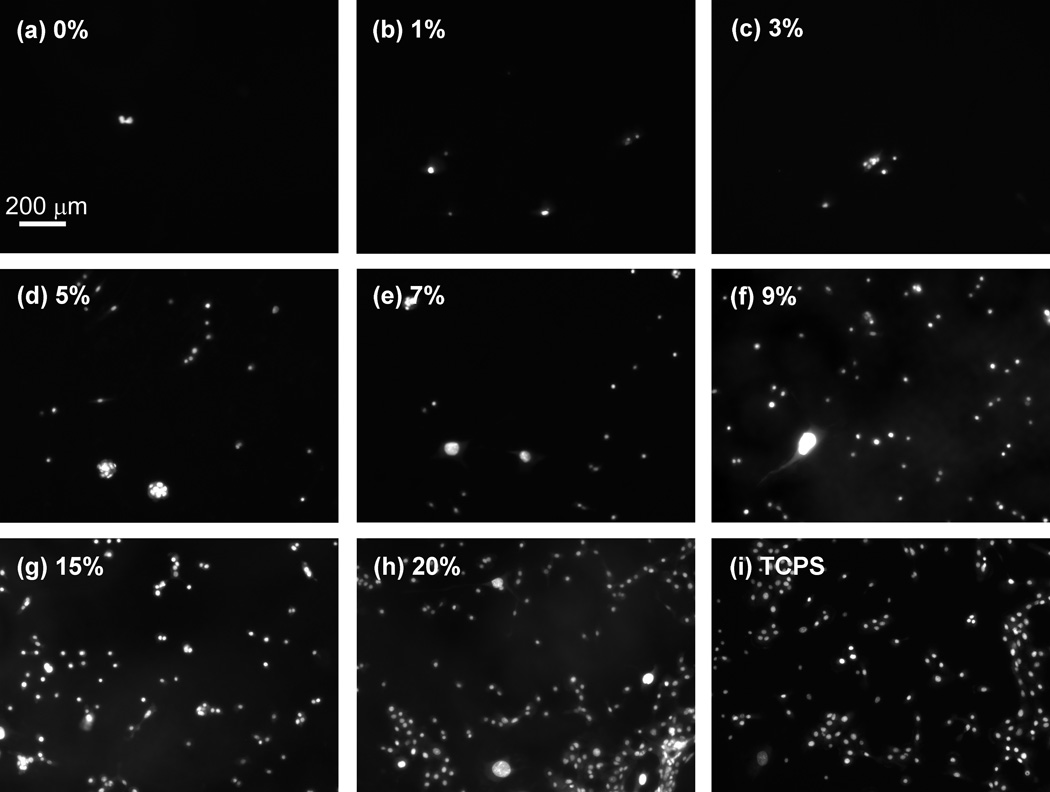
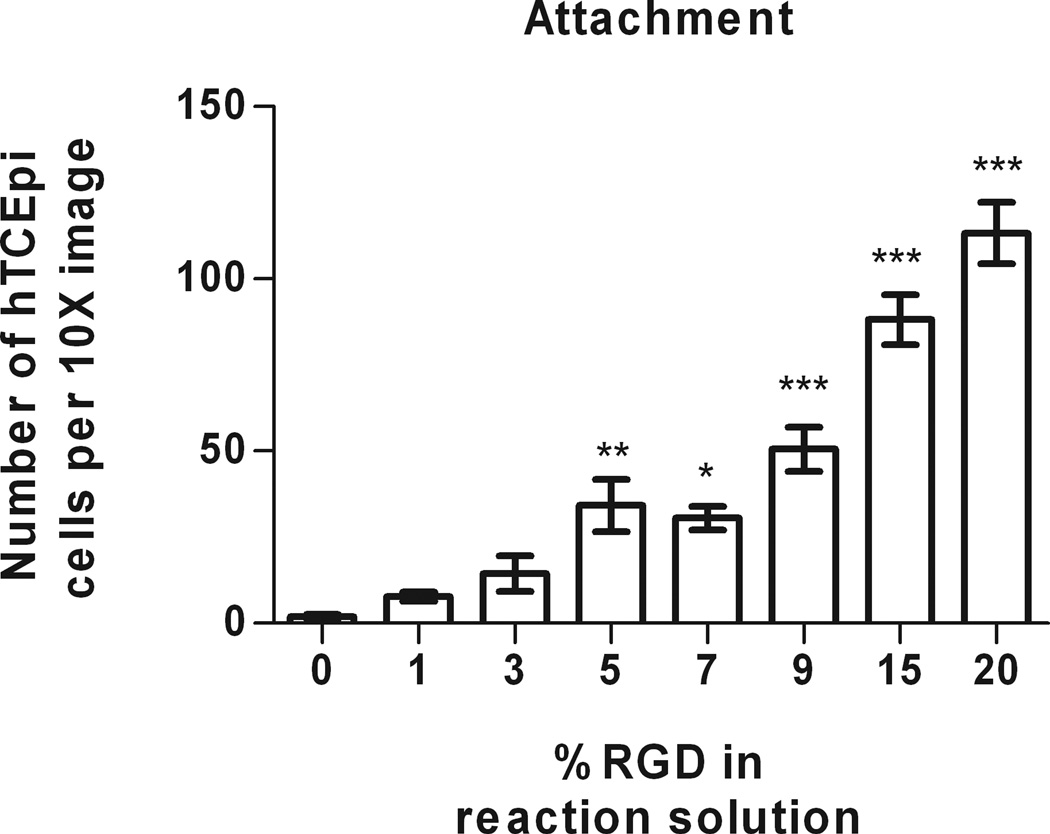
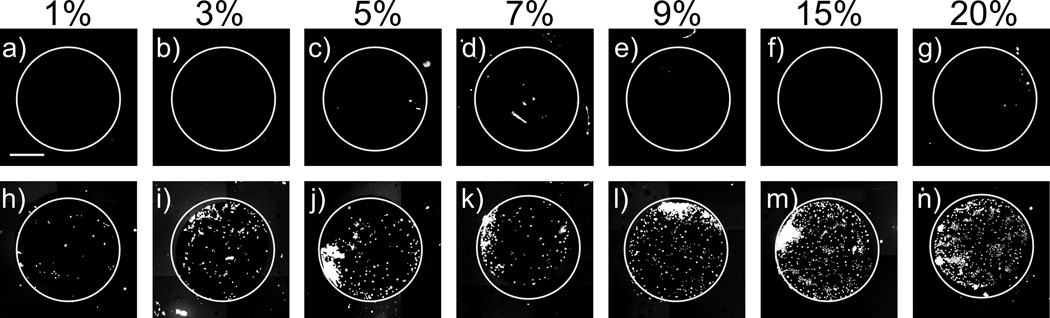
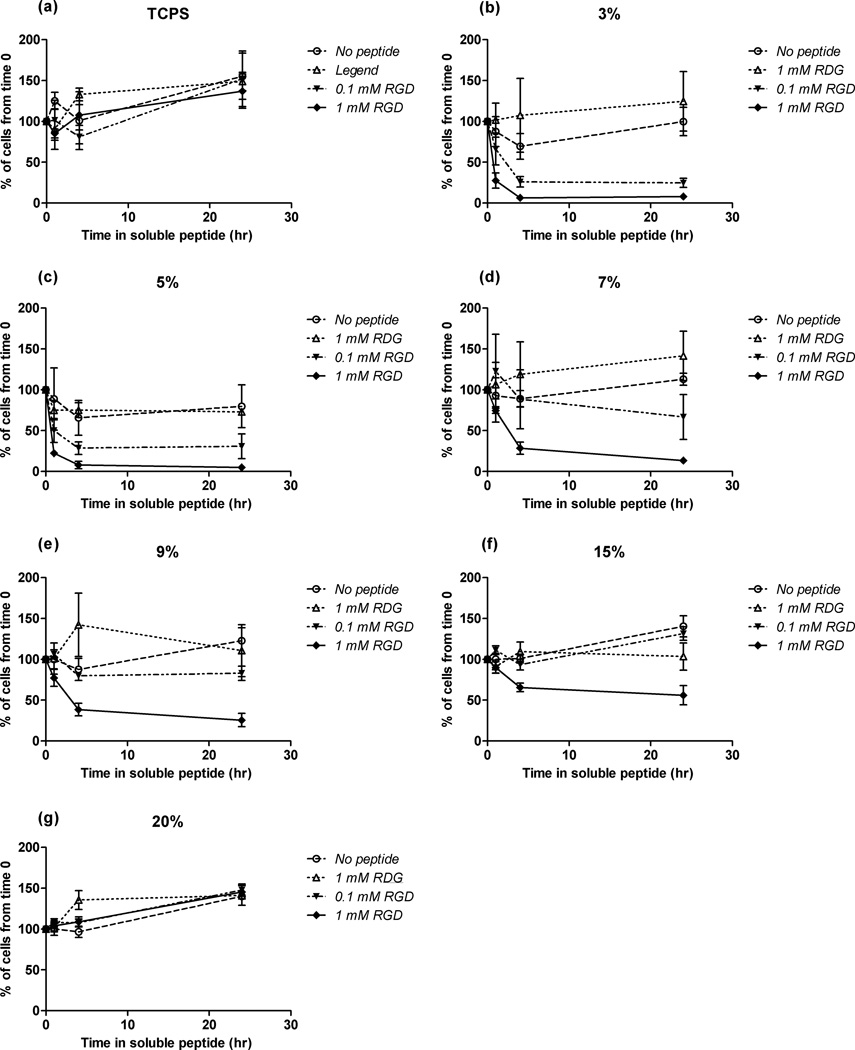
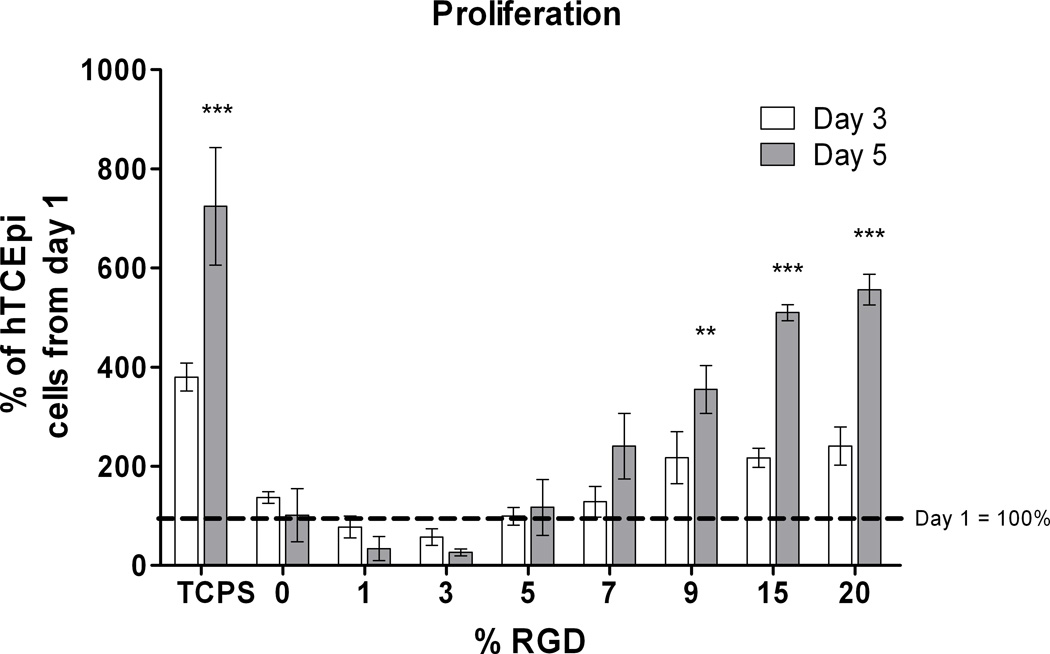
Our study demonstrates that substrates fabricated using a "reactive" layer-by-layer approach promote well-defined cell-substrate interactions of human corneal epithelial cells. Specifically, crosslinked and amine-reactive polymer multilayers were produced by alternating "reactive" deposition of an azlactone-functionalized polymer [poly(2-vinyl-4,4-dimethylazlactone)] (PVDMA) and a primary amine-containing polymer [branched poly(ethylene imine)] (PEI). Advantages of our system include a 5- to 30-fold decrease in deposition time compared to traditional polyelectrolyte films and direct modification of the films with peptides. Our films react with mixtures of an adhesion-promoting peptide containing Arg-Gly-Asp (RGD) and the small molecule D-glucamine, a chemical motif which is nonfouling. Resulting surfaces prevent protein adsorption and promote cell attachment through specific peptide interactions. The specificity of cell attachment via immobilized RGD sequences was verified using both a scrambled RDG peptide control as well as soluble-RGD competitive assays. Films were functionalized with monotonically increasing surface densities of RGD which resulted in both increased cell attachment and the promotion of a tri-phasic proliferative response of a human corneal epithelial cell line (hTCEpi). The ability to treat PEI/PVDMA films with peptides for controlled cell-substrate interactions enables the use of these films in a wide range of biological applications.
Copyright © 2011 Wiley Periodicals, Inc.
Figures
References
-
- Pierschbacher MD, Ruoslahti E. Cell attachment activity of fibronectin can be duplicated by small synthetic fragments of the molecule. Nature. 1984;309(5963):30–33. - PubMed
-
- Ruoslahti E, Pierschbacher MD. New perspectives in cell adhesion: RGD and integrins. Science. 1987;238(4826):491–497. - PubMed
-
- Rowley JA, Mooney DJ. Alginate type and RGD density control myoblast phenotype. Journal of Biomedical Materials Research. 2002;60(2):217–223. - PubMed
-
- Harbers GM, Healy KE. The effect of ligand type and density on osteoblast adhesion, proliferation, and matrix mineralization. Journal of Biomedical Materials Research Part A. 2005;75(4):855–869. - PubMed
-
- Wang H, Ma L, Yang S, Shao Z, Meng C, Duan D, Li Y. Effect of RGD-modified silk material on the adhesion and proliferation of bone marrow-derived mesenchymal stem cells. Journal of Huazhong University of Science and Technology. Medical sciences. 2009;29(1):80–83. - PubMed
Publication types
MeSH terms
Substances
Grants and funding
LinkOut - more resources
Full Text Sources
Other Literature Sources
