. 2011 Oct;140(4):1040-1047.
doi: 10.1378/chest.10-3327.

Transient receptor potential A1 channels: insights into cough and airway inflammatory disease

Affiliations

Transient receptor potential A1 channels: insights into cough and airway inflammatory disease

Maria G Belvisi et al. Chest. 2011 Oct.

Abstract

Cough is a common symptom of diseases such as asthma and COPD and also presents as a disease in its own right. Treatment options are limited; a recent meta-analysis concluded that over-the-counter remedies are ineffective, and there is increasing concern about their use in children. Transient receptor potential cation channel, subfamily A, member 1 (TRPA1) channels are nonselective cation channels that are activated by a range of natural products (eg, allyl isothiocyanate), a multitude of environmental irritants (eg, acrolein, which is present in air pollution, vehicle exhaust, and cigarette smoke), and inflammatory mediators (eg, cyclopentenone prostaglandins). TRPA1 is primarily expressed in small-diameter, nociceptive neurons where its activation probably contributes to the perception of noxious stimuli. Inhalational exposure to irritating gases, fumes, dusts, vapors, chemicals, and endogenous mediators can lead to the development of cough. The respiratory tract is innervated by primary sensory afferent nerves, which are activated by mechanical and chemical stimuli. Recent data suggest that activation of TRPA1 on these vagal sensory afferents by these irritant substances could lead to central reflexes, including dyspnea, changes in breathing pattern, and cough, which contribute to the symptoms and pathophysiology of respiratory diseases.


Figures
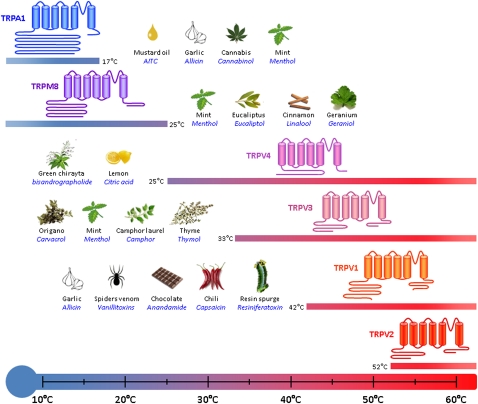
Figure 1.
Figure 1.
TRP channels act as thermosensors in sensory nerves. Transient receptor cation channels expressed in sensory neurons are activated by ambient changes. TRPA1 is activated by noxious cold from 17°C and colder temperatures. TRPM8, TRPV4, and TRPV3 are activated by warmer temperatures, with a similar threshold of 25°C for TRPM8 (which senses chilling) and TRPV4. TRPV3 is activatedy by hotter temperature (33°C threshold) creating a sensory link with TRPV1 and TRPV2, which are activated by noxious heat with respective thresholds of 42°C and 52°C. All channels can also be activated by a wide variety of agonists present in the environment. Natural stimulants are indicated on the side of each channel with their most common natural source. TRP = transient receptor potential; TRPA1 = transient receptor potential cation channel, subfamily A, member 1.
Figure 2.
Figure 2.
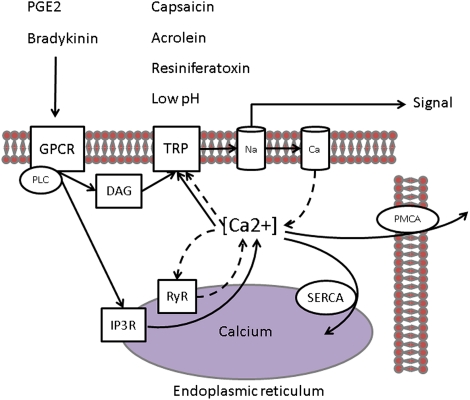
Calcium flux is associated with TRPV1 and TRPA1 activation in the cell. TRPV1 and TRPA1 produce a depolarizing inward current, mainly calcium, when opened by the binding of their respective agonists, such as capsaicin (V1), acrolein (A1), resiniferatoxin (V1), or H+ protons (V1). GPCR agonists, such as PGE2 or bradykinin, can also activate TRPV1 and TRPA1 channels via hydrolysis of phosphatidylinositol 4,5-bisphosphate and by production of diacylglycerol by the associated PLC. The inositol 1,4,5-triphosphate produced in parallel will release calcium from intracellular stores by binding to the inositol IP3R located on the endoplasmic reticulum membrane. In addition, as TRP channels activate, the resulting inward current depolarizes the membrane, triggering the opening of low-threshold voltage-gated sodium channels, which will further depolarize the membrane triggering the opening of voltage-gated calcium channels (VGCC). Calcium influx through VGCC and the RyR will induce elevation of intracellular calcium ([Ca2+]i). This significant [Ca2+]i elevation could be another mechanism regulating the activity of TRP channels, thereby inhibiting TRPV1 and activating TRPA1., This cycled regulation of [Ca2+]i by the membrane potential (Vm) and of Vm by [Ca2+]i is modulated by the capacity of the cell to clamp intracellular level of calcium, mainly via SERCA and PMCA. Ca = voltage-gated calcium channel; DAG = diacylglycerol; GPCR = G protein-coupled receptor; IP3R =1,4,5-triphosphate receptor; Na = voltage-gated sodium channels; PGE2 = prostaglandin E2; PLC = phospholipase C; PMCA = plasma membrane calcium ATPase; RyR = ryanodine receptor; SERCA = endoplasmic reticulum Ca2+-ATPase. See Figure 1 legend for expansion of other abbreviations.

References

    1. McCormick A, Fleming DM, Charlton J. London, England: HMSO; 1995. Office of Population Censuses and Surveys. Morbidity Statistics from General Practice, Fourth National Study 1991-1992. Series MB5 no 3.
    1. Irwin RS, Corrao WM, Pratter MR. Chronic persistent cough in the adult: the spectrum and frequency of causes and successful outcome of specific therapy. Am Rev Respir Dis. 1981;123(4 pt 1):413–417. - PubMed
    1. Ford AC, Forman D, Moayyedi P, Morice AH. Cough in the community: a cross sectional survey and the relationship to gastrointestinal symptoms. Thorax. 2006;61(11):975–979. - PMC - PubMed
    1. Schroeder K, Fahey T. Systematic review of randomised controlled trials of over the counter cough medicines for acute cough in adults. BMJ. 2002;324(7333):329–331. - PMC - PubMed
    1. Smith SM, Henman M, Schroeder K, Fahey T. Over-the-counter cough medicines in children: neither safe or efficacious? Br J Gen Pract. 2008;58(556):757–758. - PMC - PubMed

Publication types

MeSH terms