


Dimensional brain-behavior relationships in children with attention-deficit/hyperactivity disorder
- PMID: 21974788
- PMCID: PMC3568534
- DOI: 10.1016/j.biopsych.2011.08.013
Dimensional brain-behavior relationships in children with attention-deficit/hyperactivity disorder
Abstract
Background: Emerging neuroscientific and genetic findings emphasize the dimensional rather than the categorical aspects of psychiatric disorders. However, the integration of dimensional approaches within the current categorical diagnostic framework remains unclear. Here, we used resting state functional magnetic resonance imaging to examine whether dimensional measures of psychiatric symptomatology capture brain-behavior relationships unaccounted for by categorical diagnoses. Additionally, we examined whether dimensional brain-behavior relationships are modified by the presence of a categorically defined illness, attention-deficit/hyperactivity disorder (ADHD).
Methods: Resting state functional magnetic resonance imaging scans were collected from 37 typically developing children (aged 10.2 ± 2; 21 female subjects) and 37 children meeting DSM-IV Text Revision criteria for ADHD (9.7 ± 2; 11 female subjects). Parent-rated Child Behavior Checklist Externalizing and Internalizing scores served as dimensional measures in our analyses of default network (DN) resting state functional connectivity (RSFC).
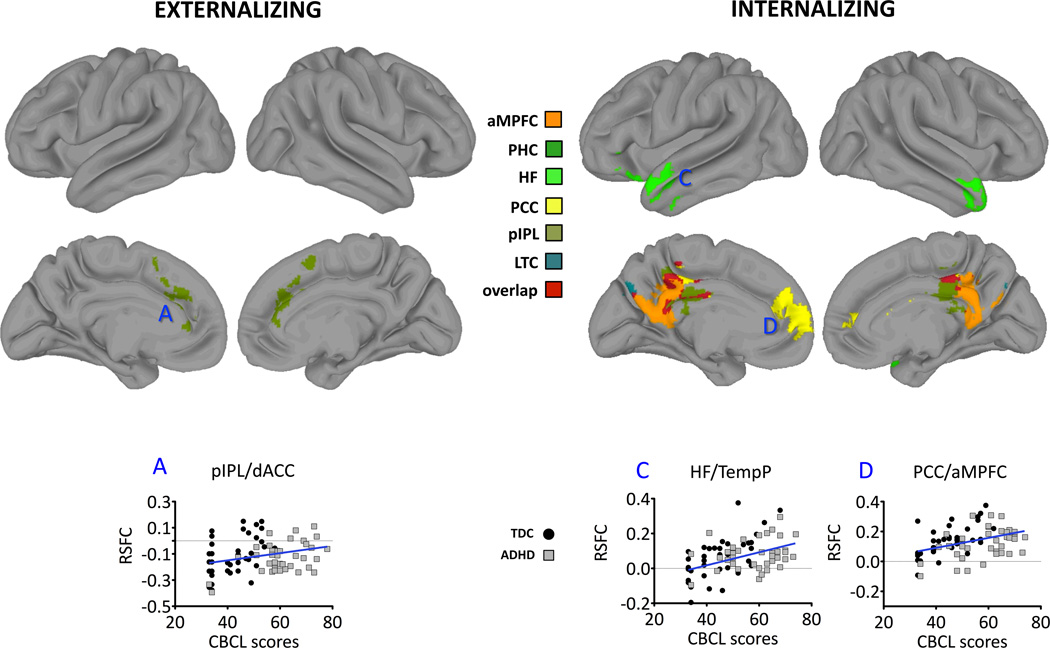
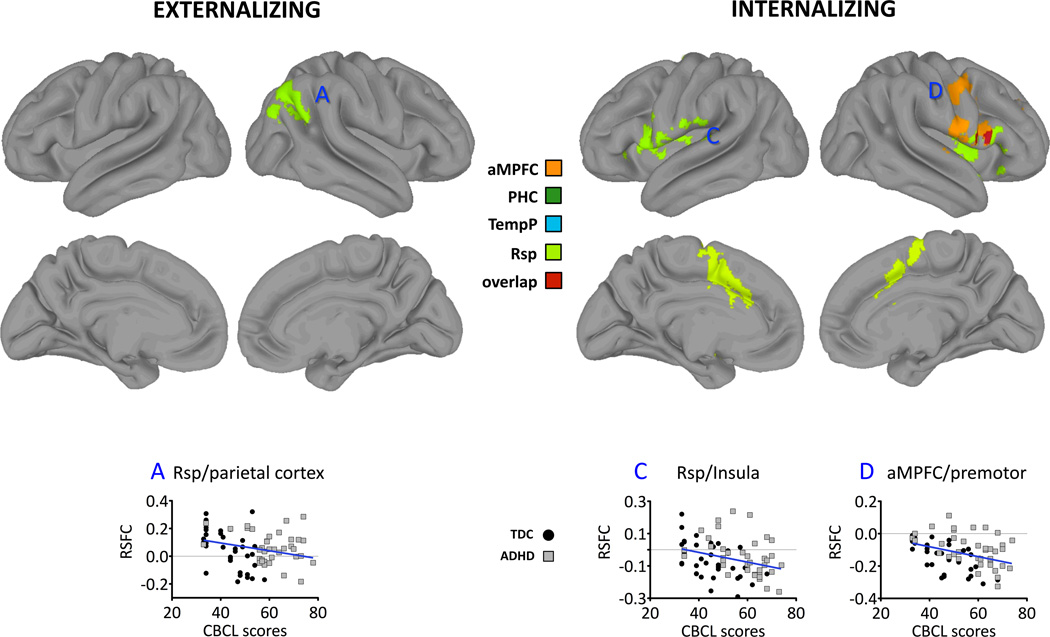
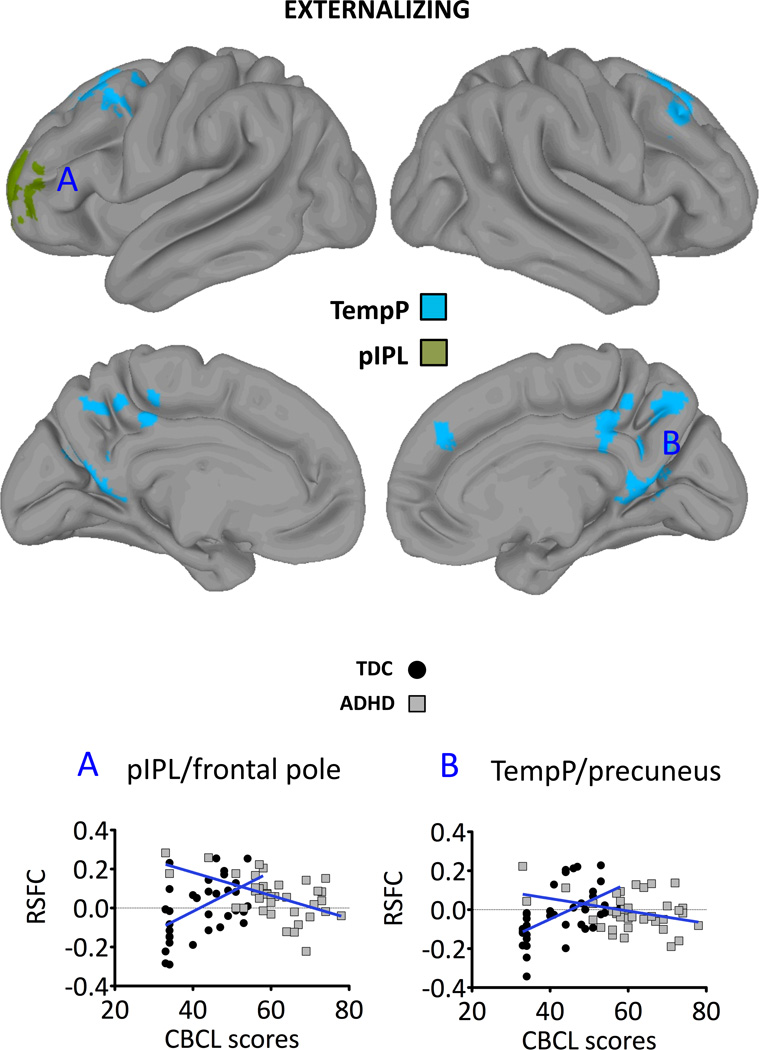
Results: Regardless of diagnosis, we observed several significant relationships between DN RSFC and both internalizing and externalizing scores. Increased internalizing scores were associated with stronger positive intra-DN RSFC, while increased externalizing scores were associated with reduced negative RSFC between DN and task-positive regions such as dorsal anterior cingulate cortex. Several of these brain-behavior relationships differed depending on the categorical presence of ADHD.
Conclusions: Our findings suggest that while categorical diagnostic boundaries provide an inadequate basis for understanding the pathophysiology of psychiatric disorders, psychiatric illness cannot be viewed simply as an extreme of typical neural or behavioral function. Efforts to understand the neural underpinnings of psychiatric illness should incorporate both categorical and dimensional clinical assessments.
Conflict of interest statement
The authors C. Chabernaud, M. Mennes, C. Kelly, K. Nooner, A. Di Martino, F.X. Castellanos and M.P. Milham declare no financial interests or potential conflicts of interest. Dr. Castellanos serves on the DSM-5 Workgroup on Attention Deficit Hyperactivity and Disruptive Behavior Disorders; the views expressed in this paper are his own and do not represent those of the Workgroup nor of the DSM-5 Task Force.
Figures
References
-
- Hyman SE. Can neuroscience be integrated into the DSM-V? Nat Rev Neurosci. 2007 Sep;8(9):725–732. - PubMed
-
- Insel T, Cuthbert B, Garvey M, Heinssen R, Pine DS, Quinn K, et al. Research domain criteria (RDoC): toward a new classification framework for research on mental disorders. Am J Psychiatry. 2010 Jul;167(7):748–751. - PubMed
-
- Shaw P, Gilliam M, Liverpool M, Weddle C, Malek M, Sharp W, et al. Cortical development in typically developing children with symptoms of hyperactivity and impulsivity: support for a dimensional view of attention deficit hyperactivity disorder. Am J Psychiatry. 2011 Feb;168(2):143–151. - PMC - PubMed
Publication types
MeSH terms
Grants and funding
LinkOut - more resources
Full Text Sources
Medical
Molecular Biology Databases
