. 2012 May;6(3):204-10.
doi: 10.1111/j.1750-2659.2011.00295.x. Epub 2011 Oct 4.

A plant-based system for rapid production of influenza vaccine antigens

Affiliations

A plant-based system for rapid production of influenza vaccine antigens

Yoko Shoji et al. Influenza Other Respir Viruses. 2012 May.

Abstract

Background: Influenza virus is a globally important respiratory pathogen that causes a high degree of annual morbidity and mortality. Significant antigenic drift results in emergence of new, potentially pandemic, virus variants. The best prophylactic option for controlling emerging virus strains is to manufacture and administer pandemic vaccines in sufficient quantities and to do so in a timely manner without impacting the regular seasonal influenza vaccine capacity. Current, egg-based, influenza vaccine production is well established and provides an effective product, but has limited capacity and speed.

Objectives: To satisfy the additional global demand for emerging influenza vaccines, high-performance cost-effective technologies need to be developed. Plants have a potential as an economic and efficient large-scale production platform for vaccine antigens.

Methods: In this study, a plant virus-based transient expression system was used to produce hemagglutinin (HA) proteins from the three vaccine strains used during the 2008-2009 influenza season, A/Brisbane/59/07 (H1N1), A/Brisbane/10/07 (H3N2), and B/Florida/4/06, as well as from the recently emerged novel H1N1 influenza A virus, A/California/04/09.

Results: The recombinant plant-based HA proteins were engineered and produced in Nicotiana benthamiana plants within 2 months of obtaining the genetic sequences specific to each virus strain. These antigens expressed at the rate of 400-1300 mg/kg of fresh leaf tissue, with >70% solubility. Immunization of mice with these HA antigens induced serum anti-HA IgG and hemagglutination inhibition antibody responses at the levels considered protective against these virus infections.

Conclusions: These results demonstrate the feasibility of our transient plant expression system for the rapid production of influenza vaccine antigens.


Figures

Figure 1
Figure 1
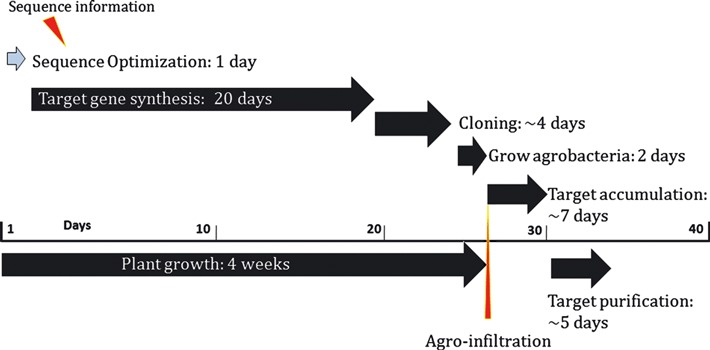
Schematic diagram of the target protein production in N. benthamiana using the launch vector pGRD4. The diagram shows production flow and time course after obtaining the amino acid sequences of target antigens.
Figure 2
Figure 2
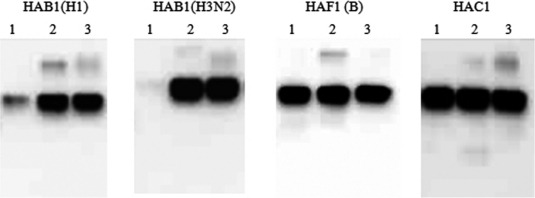
Expression and solubility profiles of hemagglutinin antigens produced in plants. Leaf tissue samples were collected at 7 DPI and homogenized in the extraction buffer without (total soluble protein: lane 1) or with 0·5% Triton X‐100 (total soluble protein with the detergent: lane 2), and with 1× gel loading buffer for total protein (lane 3). All samples were subjected to SDS–PAGE, and Western blot analysis was carried out using an anti‐6xHis mouse mAb.
Figure 3
Figure 3
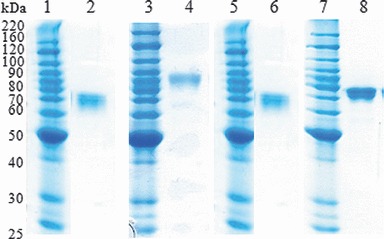
Purification of hemagglutinin (HA) antigens from plant tissue. Purified HA antigens were analyzed by SDS–PAGE followed by Coomassie staining. Lane 1, 3, 5, and 7: Molecular marker, lane 2: HAB1(H1), lane 4 HAB1(H3), lane 6: HAF1(B), and lane 8: HAC1.
Figure 4
Figure 4
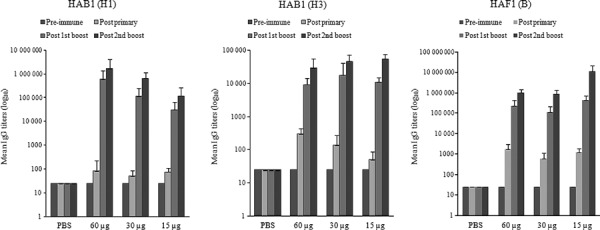
Titers of hemagglutinin (HA)‐specific IgG antibodies in mice immunized with HAB1(H1), HAB1(H3), or HAF1(B). Mice were immunized with a HA antigen three times, at days 0, 14, and 28, and serum samples were collected prior to each immunization and 2 weeks after the third dose (study day 42). Data are shown as the mean serum IgG titers ± SE.
Figure 5
Figure 5
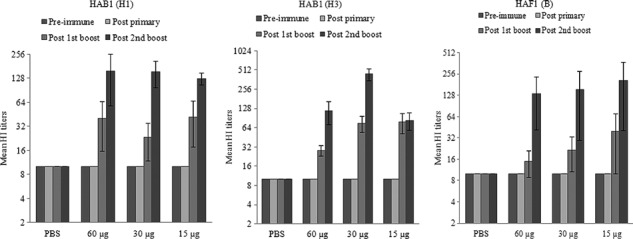
Titers of hemagglutination inhibition (HI) antibodies against seasonal influenza strains. Mice were immunized with HAB1(H1), HAB1(H3), or HAF1(B) three times, at days 0, 14, and 28, and serum samples were collected prior to each immunization and 2 weeks after the third dose (study day 42). Anti‐A/Brisbane/59/07, A/Brisbane/10/07, and B/Florida/4/06 HI antibody titers were expressed as the reciprocal of the highest dilution of serum that inhibits hemagglutination of eight hemagglutinin units of each virus. Samples without detectable HI antibody titers were assigned a titer of 10. Data shown are the mean titers (log2) from each group of immunized mice ± SE.
Figure 6
Figure 6
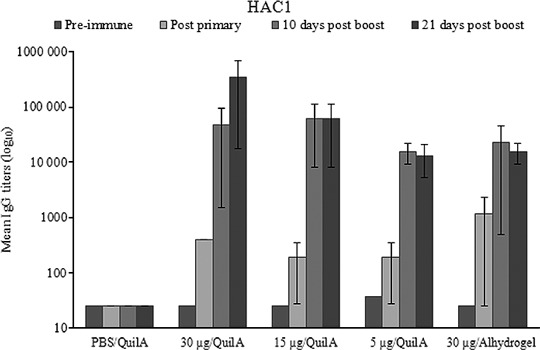
Titers of hemagglutinin‐specific IgG antibodies in mice immunized with HAC1. Mice were immunized with HAC1 twice, at days 0 and 21, and serum samples were collected prior to each immunization, as well as 10 and 21 days after the second dose (study days 31 and 42, respectively). The HAC1 antigen was administered to mice either in the presence of Quil A (s.c.) or adsorbed to Alhydrogel (i.m.). Anti‐A/California/07/09 IgG antibody titers were expressed as the mean serum IgG titers ± SE.
Figure 7
Figure 7
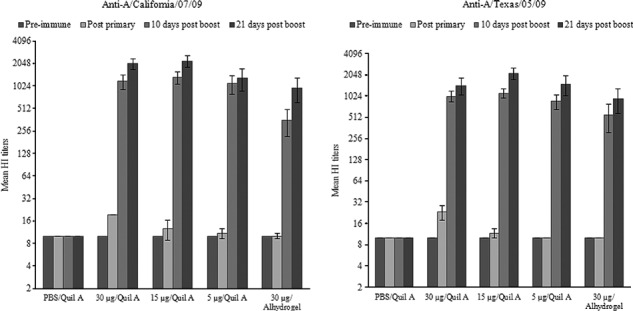
Titers of hemagglutination inhibition (HI) antibodies against the novel H1N1 influenza A strains. Mice were immunized with HAC1 twice, at days 0 and 21, and serum samples were collected prior to each immunization, as well as 10 and 21 days after the second dose (study days 31 and 42, respectively). The HAC1 antigen was administered to mice either in the presence of Quil A (s.c.) or adsorbed to Alhydrogel (i.m.). Anti‐A/California/07/09 and A/Texas/5/09 HI antibody titers were expressed as the reciprocal of the highest dilution of serum that inhibits hemagglutination of eight hemagglutinin units of each virus. Samples without detectable HI titers were assigned a titer of 10. Data shown are the mean titers (log2) from each group of immunized mice ± SE.

References

    1. Nichol KL, Treanor JJ. Vaccines for seasonal and pandemic influenza. J Infect Dis 2006; 194(Suppl 2):S111–S118. - PubMed
    1. Lu B, Zhou H, Ye D, Kemble G, Jin H. Improvement of influenza A/Fujian/411/02 (H3N2) virus growth in embryonated chicken eggs by balancing the hemagglutinin and neuraminidase activities, using reverse genetics. J Virol 2005; 79:6763–6771. - PMC - PubMed
    1. Bragstad K, Nielsen LP, Fomsgaard A. The evolution of human influenza A viruses from 1999 to 2006: a complete genome study. Virol J 2008; 5:40. - PMC - PubMed
    1. Lugovtsev VY, Vodeiko GM, Strupczewski CM, Ye Z, Levandowski RA. Generation of the influenza B viruses with improved growth phenotype by substitution of specific amino acids of hemagglutinin. Virology 2007; 365:315–323. - PubMed
    1. Centers for Disease Control and Prevention . Serum cross‐reactive antibody response to a novel influenza A (H1N1) virus after vaccination with seasonal influenza vaccine. MMWR Morb Mortal Wkly Rep 2009; 58:521–524. - PubMed

MeSH terms