


Transcobalamin 2 variant associated with poststroke homocysteine modifies recurrent stroke risk
- PMID: 21975197
- PMCID: PMC3198974
- DOI: 10.1212/WNL.0b013e318233b1f9
Transcobalamin 2 variant associated with poststroke homocysteine modifies recurrent stroke risk
Abstract
Objectives: The Vitamin Intervention for Stroke Prevention trial found an association between baseline poststroke homocysteine (Hcy) and recurrent stroke. We investigated genes for enzymes and cofactors in the Hcy metabolic pathway for association with Hcy and determined whether associated single nucleotide polymorphisms (SNPs) influenced recurrent stroke risk.
Methods: Eighty-six SNPs in 9 candidate genes (BHMT1, BHMT2, CBS, CTH, MTHFR, MTR, MTRR, TCN1, and TCN2) were genotyped in 2,206 subjects (83% European American). Associations with Hcy measures were assessed using linear regression models assuming an additive genetic model, adjusting for age, sex, and race and additionally for baseline Hcy when postmethionine load change was assessed. Associations with recurrent stroke were evaluated using survival analyses.
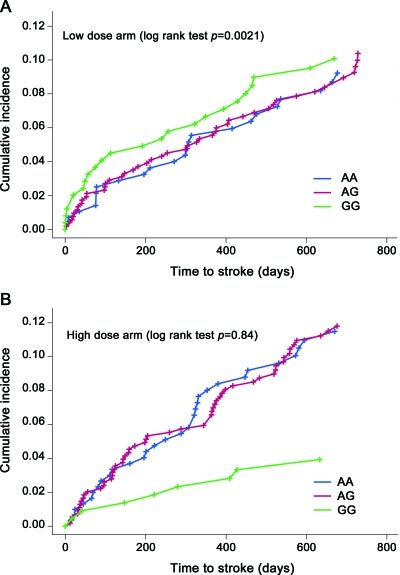
Results: Five SNPs in the transcobalamin 2 (TCN2) gene were associated with baseline Hcy (false discovery rate [FDR]-adjusted p = 0.049). TCN2 SNP rs731991 was associated with recurrent stroke risk in the low-dose arm of the trial under a recessive model (log-rank test p = 0.009, hazard ratio 0.34). Associations with change in postmethionine load Hcy levels were found with 5 SNPs in the cystathionine β-synthase (CBS) gene (FDR-adjusted p < 0.031).
Conclusions: TCN2 variants contribute to poststroke Hcy levels, whereas variants in the CBS gene influence Hcy metabolism. Variation in the TCN2 gene also affects recurrent stroke risk in response to cofactor therapy.
Figures
References
-
- Hankey GJ, Jamrozik K, Broadhurst RJ, Forbes S, Anderson CS. Long-term disability after first-ever stroke and related prognostic factors in the Perth Community Stroke Study, 1989–1990. Stroke 2002;33:1034–1040 - PubMed
-
- Hankey GJ, Spiesser J, Hakimi Z, Carita P, Gabriel S. Time frame and predictors of recovery from disability following recurrent ischemic stroke. Neurology 2007;68:202–205 - PubMed
-
- Toole JF. Vitamin intervention for stroke prevention. J Neurol Sci 2002;203–204:121–124 - PubMed
-
- Toole JF, Malinow MR, Chambless LE, et al. Lowering homocysteine in patients with ischemic stroke to prevent recurrent stroke, myocardial infarction, and death: the Vitamin Intervention for Stroke Prevention (VISP) randomized controlled trial. JAMA 2004;291:565–575 - PubMed
Publication types
MeSH terms
Substances
Grants and funding
LinkOut - more resources
Full Text Sources
Other Literature Sources
Medical
Miscellaneous
