


Adolescent physical activity and the built environment: a latent class analysis approach
- PMID: 21975286
- PMCID: PMC3266467
- DOI: 10.1016/j.healthplace.2011.09.004
Adolescent physical activity and the built environment: a latent class analysis approach
Abstract
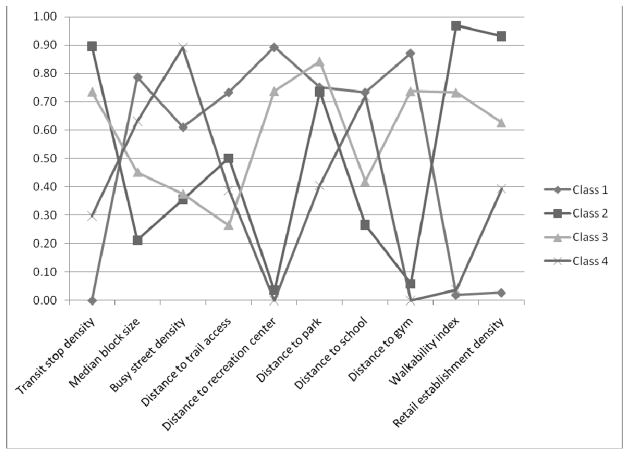
This study used latent class analysis to classify adolescent home neighborhoods (n=344) according to built environment characteristics, and tested how adolescent physical activity, sedentary behavior, and screen time differ by neighborhood type/class. Four distinct neighborhood classes emerged: (1) low-density retail/transit, low walkability index (WI), further from recreation; (2) high-density retail/transit, high WI, closer to recreation; (3) moderate-high-density retail/transit, moderate WI, further from recreation; and (4) moderate-low-density retail/transit, low WI, closer to recreation. We found no difference in adolescent activity by neighborhood class. These results highlight the difficulty of disentangling the potential effects of the built environment on adolescent physical activity.
Copyright © 2011 Elsevier Ltd. All rights reserved.
Figures
References
-
- Biddle SJ, Gorely T, Stensel DJ. Health-enhancing physical activity and sedentary behaviour in children and adolescents. J Sports Sci. 2004;22:679–701. - PubMed
