


The accuracy of probabilistic versus temporal clinician prediction of survival for patients with advanced cancer: a preliminary report
- PMID: 21976316
- PMCID: PMC3233300
- DOI: 10.1634/theoncologist.2011-0173
The accuracy of probabilistic versus temporal clinician prediction of survival for patients with advanced cancer: a preliminary report
Abstract
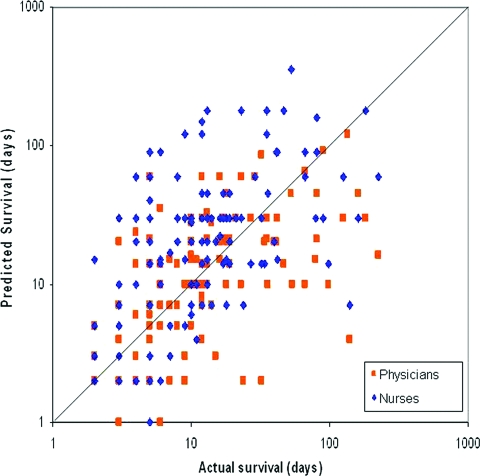
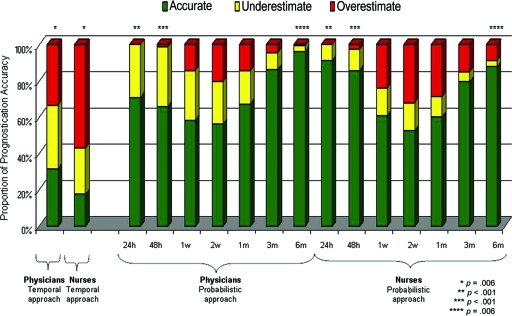
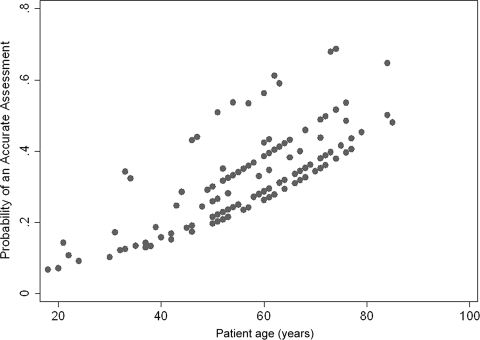
Clinicians have limited accuracy in the prediction of patient survival. We assessed the accuracy of probabilistic clinician prediction of survival (CPS) and temporal CPS for advanced cancer patients admitted to our acute palliative care unit, and identified factors associated with CPS accuracy. Eight physicians and 20 nurses provided their estimation of survival on admission by (a) the temporal approach, "What is the approximate survival for this patient (in days)?" and (b) the probabilistic approach, "What is the approximate probability that this patient will be alive (0%-100%)?" for ≥24 hours, 48 hours, 1 week, 2 weeks, 1 month, 3 months, and 6 months. We also collected patient and clinician demographics. Among 151 patients, the median age was 58 years, 95 (63%) were female, and 138 (81%) had solid tumors. The median overall survival time was 12 days. The median temporal CPS was 14 days for physicians and 20 days for nurses. Physicians were more accurate than nurses. A higher accuracy of temporal physician CPS was associated with older patient age. Probabilistic CPS was significantly more accurate than temporal CPS for both physicians and nurses, although this analysis was limited by the different criteria for determining accuracy. With the probabilistic approach, nurses were significantly more accurate at predicting survival at 24 hours and 48 hours, whereas physicians were significantly more accurate at predicting survival at 6 months. The probabilistic approach was associated with high accuracy and has practical implications.
Conflict of interest statement
Figures
References
-
- Weeks JC, Cook EF, O'Day SJ, et al. Relationship between cancer patients' predictions of prognosis and their treatment preferences. JAMA. 1998;279:1709–1714. - PubMed
-
- Lamont EB, Christakis NA. Complexities in prognostication in advanced cancer: “To help them live their lives the way they want to”. JAMA. 2003;290:98–104. - PubMed
-
- Hui D, Con A, Christie G, et al. Goals of care and end-of-life decision making for hospitalized patients at a Canadian tertiary care cancer center. J Pain Symptom Manage. 2009;38:871–881. - PubMed
-
- Lamont EB, Christakis NA. Physician factors in the timing of cancer patient referral to hospice palliative care. Cancer. 2002;94:2733–2737. - PubMed
Publication types
MeSH terms
Grants and funding
LinkOut - more resources
Full Text Sources
