


Flexibility in embodied lexical-semantic representations
- PMID: 21976384
- PMCID: PMC6869997
- DOI: 10.1002/hbm.21365
Flexibility in embodied lexical-semantic representations
Abstract
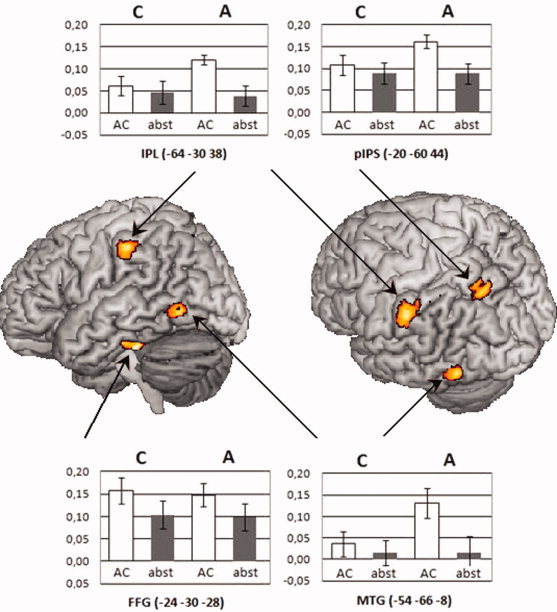
According to an embodied view of language comprehension, language concepts are grounded in our perceptual systems. Evidence for the idea that concepts are grounded in areas involved in action and perception comes from both behavioral and neuroimaging studies (Glenberg [1997]: Behav Brain Sci 20:1-55; Barsalou [1999]: Behav Brain Sci 22:577-660; Pulvermueller [1999]: Behav Brain Sci 22:253-336; Barsalou et al. [2003]: Trends Cogn Sci 7:84-91). However, the results from several studies indicate that the activation of information in perception and action areas is not a purely automatic process (Raposo et al. [2009]: Neuropsychologia 47:388-396; Rueschemeyer et al. [2007]: J Cogn Neurosci 19:855-865). These findings suggest that embodied representations are flexible. In these studies, flexibility is characterized by the relative presence or absence of activation in our perceptual systems. However, even if the context in which a word is presented does not undermine a motor interpretation, it is possible that the degree to which a modality-specific region contributes to a representation depends on the context in which conceptual features are retrieved. In the present study, we investigated this issue by presenting word stimuli for which both motor and visual properties (e.g., Tennis ball, Boxing glove) were important in constituting the concept. Conform with the idea that language representations are flexible and context dependent, we demonstrate that the degree to which a modality-specific region contributes to a representation considerably changes as a function of context.
Copyright © 2011 Wiley Periodicals, Inc.
Figures
References
-
- Astafiev SV, Stanley C, Shulman G, Corbetta M ( 2004): Extrastriate body area in human occipital cortex responds to the performance of motor actions. Nat Neurosci 7: 542–548. - PubMed
-
- Aziz‐Zadeh L, Wilson SM, Rizzolatti G, Iacoboni M ( 2006): Congruent embodied representations for visually presented actions and linguistic phrases describing actions. Curr Biol 16: 1818–1823. - PubMed
-
- Baayen R, Piepenbrock R, Van Rijn H ( 1993): The CELEX Lexical Database (CD‐ROM). Philadelphia, PA: Linguistic Data Consortium, University of Pennsylvania.
-
- Barsalou LW ( 1999): Perceptual symbol systems. Behav Brain Sci 22: 577–660. - PubMed
-
- Barsalou LW ( 2008): Grounded cognition. Ann Rev Psychol 59: 617–645. - PubMed
Publication types
MeSH terms
LinkOut - more resources
Full Text Sources
